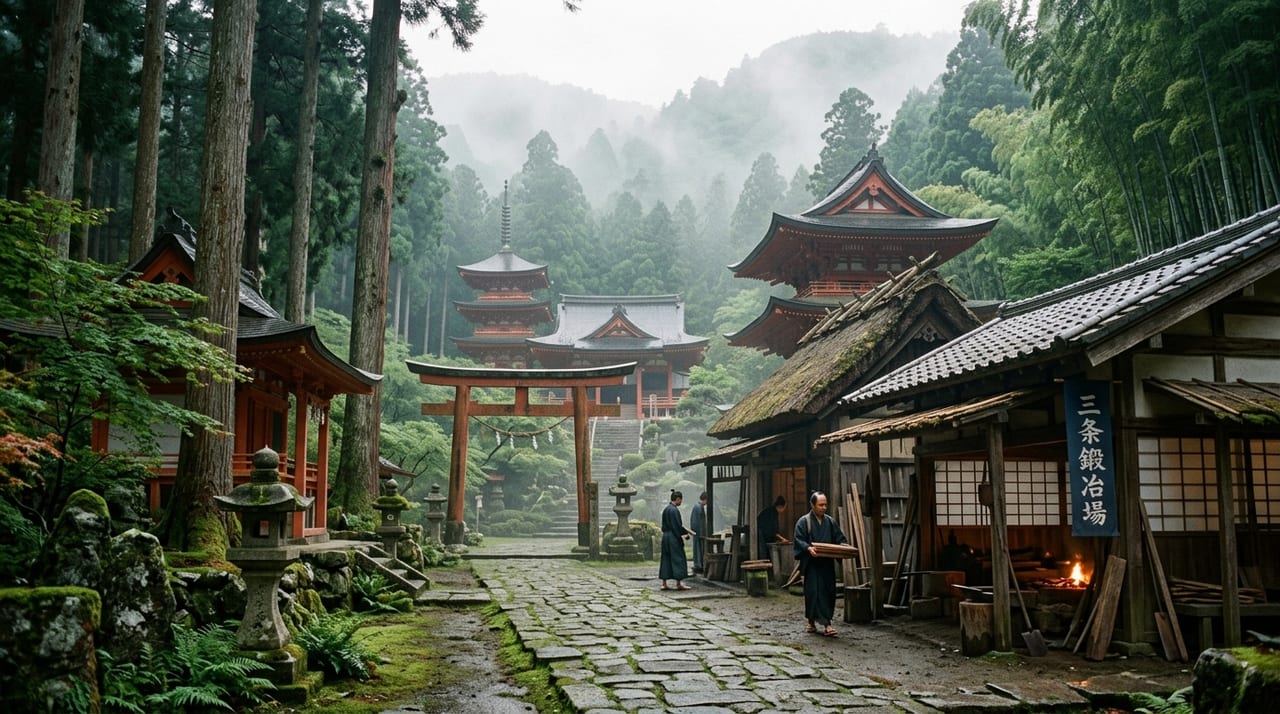
 * Image is for illustrative purposes only.
Sanjo School — The Oldest Yamashiro Swordsmithing School
三条派——山城最古の刀工集団
The Sanjō school was one of the oldest recorded sword-smith groups in Japan, established in the mid-Heian period and centered in Sanjō in Kyoto (present-day Nakagyō Ward, Kyoto). Its founder is Sanjō Kokaji Munechika, and later smiths such as Sanjō Yoshiie were active in the same area. Positioned as the source of the Yamashiro-den tradition, the Sanjō style is closely tied to the aesthetic sensibilities of Heian court culture and embodies the ideal form of Heian-period tachi, with high curvature and an elegant silhouette. The works of Sanjō smiths were valued as art objects that went beyond mere weapons. The famous blade Kogitsune-maru (no longer extant), said to have been forged by Kokaji Munechika after praying at an Inari shrine, has been passed down to the present as an anecdote symbolizing the mystical aspect of the Sanjō school. The techniques of the Sanjō school were inherited by the later Rai and Awataguchi schools and became the foundation of the long tradition of Yamashiro smiths.
Description
Establishment and Historical Background of the Sanjō School
The Sanjō school refers to a group of smiths who lived in Sanjō in Kyoto around the 10th century, in the mid-Heian period. During this era, Kyoto flourished as the political and cultural center of the ritsuryō state, and aristocratic society, including the imperial family and the Fujiwara clan, nurtured a sophisticated aesthetic culture. Swords were not simply military equipment but deeply rooted symbols of authority and beauty in aristocratic society.
Sanjō Kokaji Munechika, regarded as the founder of the Sanjō school, is a legendary smith said to have been active from the late 10th to the early 11th century. His name appears in many later historical records, but many details of his life contain legendary elements, and it is often difficult to verify them historically. Nevertheless, the existence of swords attributed to Munechika is recorded in multiple sources, and the characteristics of his style are described with relative clarity.
The legend that Munechika retreated to worship at the Inari shrine (present-day Fushimi Inari Taisha), received an oracle from the god, and completed the famous blade Kogitsune-maru with the help of a fox spirit, a small fox, was later adapted into the Noh play "Kokaji" and widely performed. This legend played a major role in spreading the sacred nature and outstanding skill of the Sanjō school among the public, but it also contributed to confusion between historical fact and legend.
The Sanjō workshops were located in Sanjō in Kyoto, which since the Heian period had been a town of craftsmen where various artisans lived together. Smiths, metal workers, dyers, and other craftspeople concentrated in the area, creating an environment in which they exchanged techniques with one another. The smiths of the Sanjō school were active within this community of craftspeople and established a distinctive style that fused a refined urban aesthetic with functionality as weapons.
Technical Characteristics of Blade-Making
The blade-making techniques of the Sanjō school are characterized by a combination of advanced metallurgical knowledge of the period and refined design.
Steel selection and refining: The smiths of the Sanjō school are thought to have used tamahagane selection and refining techniques that were advanced for their time. The forging texture (jigane hada) was mainly a relatively simple and uniform itame-hada, before the clear school-specific features of the later Five Traditions were established. The steel is said to have a clear grayish-white tone, and some examples show utsuri (reflections).
Characteristics of the hamon: The hamon of the Sanjō school is often refined, based on komidare (small irregular patterns) and kochōji (small chōji patterns). Unlike the flamboyant chōji-midare of later Ko-Bizen, it is characterized by gentle variation close to sugu-ha (straight temper line). Some blades show sunagashi and kinsuji within the hardened zone, and some researchers see in them the early signs of the later Sōshū-den features.
Shape (sugata katachi): Heian-period Sanjō tachi have a slender form with elegant curves, deep koshizori (curvature at the hip), and a large difference between the width at the base (motohaba) and the width at the point (sakihaba). The shinogi (ridge) is low, and the cross-section of the blade has a generous hiraniku (flat thickness), embodying the aesthetic norms of Heian courtiers in its overall graceful flow. In the Kamakura period, the mihaba (width of the blade) became somewhat broader and the curvature changed, but the Sanjō school tended to retain the elegant Heian form until the end.
Tang (nakago): The tang of the Sanjō school is often shorter than those of the later schools and has a form suited to the Heian-period method of wearing swords (suspended from the waist). Few mekugi-ana (peg holes) are present, and the signature style is relatively simple, with many single- or two-character inscriptions such as "Sanjō" or "Munechika" and "Yoshiie."
Principal Smiths and Works
Sanjō Munechika: The de facto founder of the Sanjō school and the most famous blade-smith of the mid-Heian period (10th–11th centuries). He is known for the legend of Kogitsune-maru, but the most celebrated surviving work attributed to him is the National Treasure Mikazuki Munechika, held by the Tokyo National Museum. Mikazuki Munechika is counted among the Tenka Goken (Five Great Swords of the Realm), and its name is said to derive from the crescent-shaped uchinoke (patterns) that appear on the blade. Its pale bluish jigane, fine ashi (small lines) in the hamon, and graceful curvature are described as the peak of Heian aesthetics.
Sanjō Yoshiie: A smith regarded as Munechika's successor, said to have been active from the 11th to the 12th century. Few of his extant works remain, but his style combines the elegance and refinement inherited from Munechika.
Gojō Kanenaga: A representative smith of the Gojō school, said to be either a son or a grandson of Munechika. He lived in Gojō in Kyoto around the Chōgen era of the mid-Heian period, and was known for dignified sugu-ha and komidare appropriate to the Yamashiro-den tradition. He served as a bridge that transmitted the style of the Sanjō school to later generations.
Later Influence and Transmission
The technical legacy of the Sanjō school holds immeasurable importance in the history of Yamashiro smiths. The Gojō line, including Gojō Kanenaga and Gojō Kuninaga, descended from Munechika's lineage, and in the early Kamakura period the Awataguchi school appeared. Smiths of the Rai school, led by Rai Kuniyuki, developed their techniques to meet the new aesthetic demands of the Kamakura period, while inheriting the clear forging texture and gentle hamon of the Sanjō tradition.
The Awataguchi school (awataguchi-ha) is also known as a school that inherited the Sanjō tradition, and the lineage of exceptional tanto craftsmanship leading to Tōshirō Yoshimitsu is regarded as carrying on the refined urban craft sensibility of the Sanjō school.
From a longer-term perspective, the basic principle of the Sanjō school, the harmony of beauty and functionality, was inherited throughout the broader Yamashiro tradition. It continued to have a spiritual influence on the Kyoto shintō (new swords) of the Edo period, including the Horikawa lineage, and on the works of contemporary smiths of the caliber of Living National Treasures.
The fact that the Noh play "Kokaji" continued to be repeatedly performed on the Noh stage from the Muromachi period onward shows that the spiritual and cultural importance of the Sanjō school had taken root in Japanese society across the ages. This story, in which swords merge with Shinto belief and performing arts, elevated the Sanjō school beyond a mere guild of smiths into a symbolic presence of Japanese culture.
Extant Works and Research Status
The extant works of the Sanjō school are not numerous, but because of their high quality, many of the individual works are designated as National Treasures or Important Cultural Properties. The most important work is the National Treasure Mikazuki Munechika, held by the Tokyo National Museum, a single blade that can be called the origin of Japanese sword research. In addition, several works by Munechika and Yoshiie are held in museums and shrines across the country, and detailed research by scholars continues.
Research on the Sanjō school does more than clarify the history of an individual school. It offers a rich interdisciplinary field where the technical, cultural, and religious histories of the Heian period intersect, and its academic value is highly regarded today.
Characteristics of This Era
- Embodiment of Heian courtier aesthetics: slender tachi with deep koshizori, and a gentle hamon based on komidare and sugu-ha. It is positioned as the first school to elevate the yūgen and miyabi of Heian aristocratic society into sword form
- Beauty of the clear forging texture: the itame-hada of the jigane is dense and uniform, with a clear grayish-white tone. Compared with the Five Traditions of the Kamakura period and later, it has fewer decorative elements, but the purity of the material itself stands out. The pale bluish utsuri of Mikazuki Munechika is regarded as the peak of this quality
- Ties to myth and legend: through the legend of Kogitsune-maru and the Inari deity and the adaptation into the Noh play "Kokaji," the Sanjō school has the richest mythological and literary background in the history of Japanese swords, and it was deeply involved in the foundations of Japanese culture, which places swords as sacred beings
- Source of the Yamashiro tradition: the long lineage of Yamashiro smiths, leading to the Rai school, the Awataguchi school, and the Horikawa lineage, could not have been established without the techniques and spirit inherited from the Sanjō school. It is highly regarded academically as the school that established the character of Japanese swords as "swords of the capital"
- Sword culture and the court: in the Noh play Kokaji, Munechika forges a sword for Emperor Ichijō by imperial command, and the Sanjō school has been remembered as smiths tied to the court culture of the capital.
- Relationship to the Tenka Goken: Mikazuki Munechika is the only work of the Sanjō school counted among the Tenka Goken (Mikazuki Munechika, Ōdenta Mitsuyo, Dōjigiri Yasutsuna, Onimaru Kunitsuna, and Juzumaru Tsunetsugu), and it is still revered today as a sword at the summit of the aesthetic and historical value of Japanese blades.