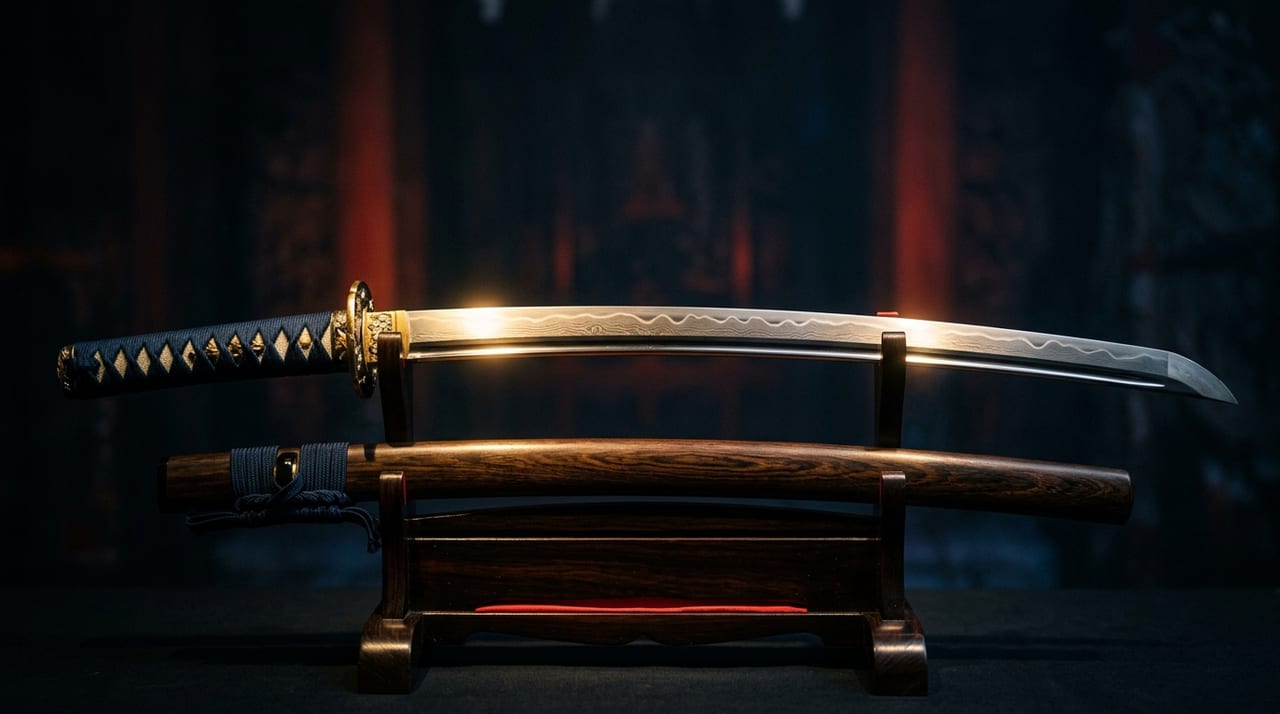
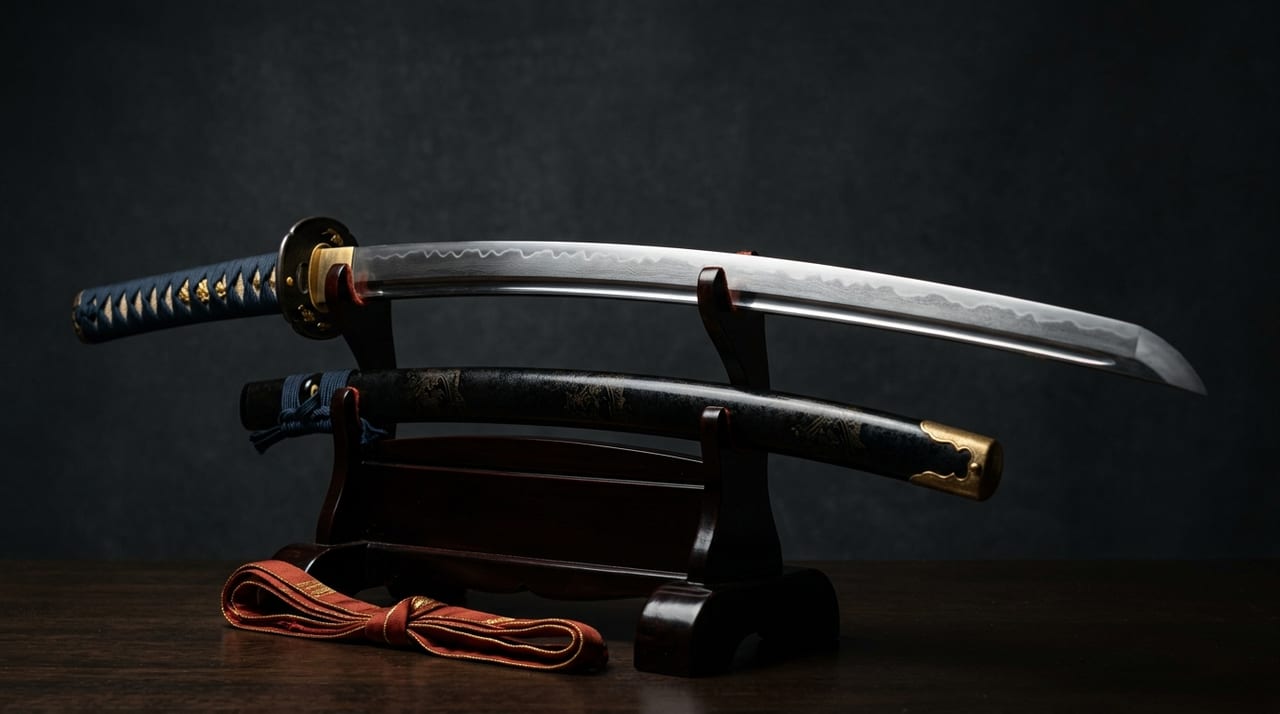
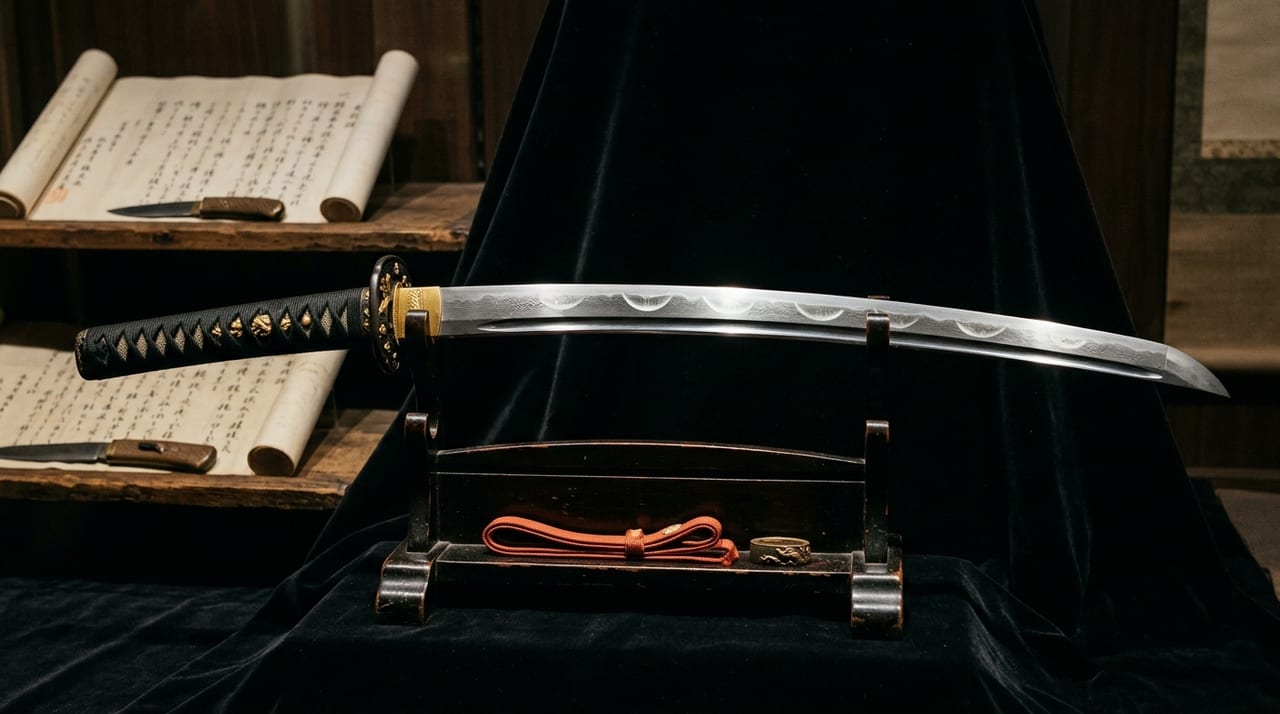
Type 98 Guntō Complete Guide — The Most-Produced Regulation Sword of the Shōwa Period: Features of the Brown Leather Saya and a Collector's Guide
 * Image is for illustrative purposes only.
Table of Contents
The Birth of the Type 98 Guntō — The Imperial Army's Design Philosophy in Wartime
In Shōwa 13 (1938), drawing on the lessons of the Second Sino-Japanese War and in preparation for large-scale warfare, the Imperial Army established the "Type 98 guntō" as the regulation sword for officers. Its predecessor, the Type 94 guntō (established in Shōwa 9), was highly regarded for its elaborate koshirae, but was costly to manufacture and ill-suited to mass supply.
To address this, the Type 98 placed "mass producibility, durability, and cost optimization" at the core of its design philosophy. Each component of the koshirae was standardized and unified, establishing a system in which multiple Army arsenals and civilian tōshō could produce to the same specifications in parallel. As a result, for roughly seven years from the Second Sino-Japanese War to the end of the Pacific War, the Type 98 was continuously mass-supplied as the principal officer's guntō. The large number of surviving examples attests to this exceptional scale of production.
The Brown Leather-Covered Saya — Visual Features and Practicality of the Type 98
The most immediately identifiable visual feature of the Type 98 is its "brown or black cowhide-covered saya." Whereas the earlier Type 94 employed black lacquer or painted saya, the Type 98 adopted as standard a leather-covered saya in which cowhide was wrapped over a wooden core. This change was not merely a cost reduction but was grounded in superior practicality: the leather-covered saya required no lacquering step, greatly shortening the manufacturing process, and offered excellent impact resistance. The circumstances behind the shift from lacquered to leather-covered saya are treated in The History of Lacquer Techniques on Guntō Saya.
Detailed Structure of the Koshirae
The saya is leather-covered with a single vertical seam running along it. The kojiri is less rounded than that of the Type 94, giving it a more combat-oriented design. The attachment position of the belt fittings was also improved.
The tsuka follows the basic structure of the Type 94 but with a slight change to the shape of the kashira (pommel cap). The tsuka-maki is standardly a hishi-maki in gold-brown silk thread (synthetic fiber toward the end of the war), with a tendency for simplification of materials in late-production examples.
The tsuba is basically iron, with motifs of the Army star and cherry blossom. In the Type 98 the tsuba specifications were thoroughly standardized, and the custom-ordered pieces seen on the Type 94 virtually disappeared. The kurigata and mekane were also unified in simpler designs, increasing interchangeability between components.
These specification changes were a rational improvement that minimized variation between arsenals and achieved interchangeability capable of delivering consistent performance in any environment.
The Depth of Appraisal Created by Blade Diversity
What makes appraisal of the Type 98 complex — and at the same time enhances its appeal for collectors — is the diversity of blades it contains.
The great majority of mass-produced Type 98 swords contain a "Shōwa-tō," produced using machine processing and electric furnaces. Such industrial blades are uniform in quality and characteristically show no traditional kitae-hada (forging grain). At the same time, it is not uncommon to find blades traditionally forged under the commissioned tōkō system housed in a Type 98 koshirae.
Because officers could choose a blade of their preference and order a Type 98 koshirae to fit it, the value of the blade can differ greatly between examples that look identical on the outside. Cases have been confirmed in which Yasukuni-tō, items arranged through the Imperial Reservists' Association, or prized works by renowned tōkō working in the Bizen-den or Sōshū-den traditions are housed in a Type 98 brown leather saya.
When purchasing or appraising, it is essential to always draw the blade and carefully examine the mei (signature), stamps, and condition of the rust on the nakago (tang). "Do not judge by appearance" is the guiding principle of appraisal for swords of this era.
Quality Changes by Production Period — The Trajectory from Early to Late Examples
Over its approximately seven-year production run, the Type 98 underwent notable changes in quality.
Early production examples (Shōwa 13–16) were manufactured when arsenal production capacity was at its peak; the stitching of the leather saya is careful and the finish of the fittings is uniform. The plating on the kashira and kojiri is thick, and if well preserved, a sheen remains.
Mid-period examples (Shōwa 17–18) come from a time when output surged along with the expansion of the Pacific War. Quality is largely maintained, but signs of component simplification begin to appear.
Late production examples (Shōwa 19–20) show pronounced shortages of materials and decline in industrial capacity. The leather is thin and the stitching rough, and the fittings include degraded plating and iron substitutes mixed in. The tsuka-maki is coarsened in both material and wrapping technique, and the blades are also shorter (nagasa of 67 cm or less) with irregular shapes. Late examples tend to be rated lower in the market, but they possess an inherent value as historical records documenting the actual state of production in the final stages of the war.
What Stamps and Mei Tell About Manufacturing History and the Value of Individual Examples
Type 98 examples sometimes retain stamps indicating the manufacturing arsenal and period.
On the tsuba and tsuka fittings there are intaglio marks of "Type 98" or "98," arsenal abbreviation stamps (such as "Tō" for the Tokyo Artillery Arsenal, "Ō" for the Osaka Artillery Arsenal, and "Na" for the Nagoya Arsenal), and year-of-manufacture stamps in Shōwa year notation. These are direct evidence for identifying the period and place of manufacture and are of extremely high historical value.
On the nakago mei, in addition to year-month-day stamps of the form "Shōwa [year], [month], [day]," some examples retain a commission number and inspection stamps (star, cherry blossom, numerals). Such examples are rarities for which the manufacturing history can be traced, and they have value as primary sources for military research.
Position in Today's Market and Collecting Wisely
Because so many Type 98 examples survive, they are the most widely circulated of all Shōwa guntō and are often regarded as an entry-level collectible. Standard Type 98 examples housing a Shōwa-tō circulate at prices ranging from several tens of thousands to over one hundred thousand yen, depending on condition.
Characteristics of examples considered rare and valued differently:
- Traditionally forged blades by commissioned tōkō (with the mei of a renowned tōkō)
- Works by tōkō later designated as Living National Treasures
- Early production examples in extremely fine preserved condition (complete sets with leather saya, fittings, and blade all intact)
- Complete examples retaining full arsenal stamps
Collecting the Type 98 is a field with the thrill of "historical treasure hunting." It is important not to evaluate by appearance alone, to always examine the blade, and to verify the condition of stamps, mei, and rust with an expert. Because these items are regulated under the Act for Controlling the Possession of Firearms or Swords and Other Such Weapons (Jūtōhō), confirming the registration certificate and completing the possession procedures are mandatory. We recommend making use of appraisals by domestic sword dealers and the Society for the Preservation of Japanese Art Swords, and collecting through reliable acquisition channels.