Tsuchitori Blending Techniques — Raw Materials, Mixing Ratios, the Drying Process before Yaki-ire, and Their Influence on Hamon Formation
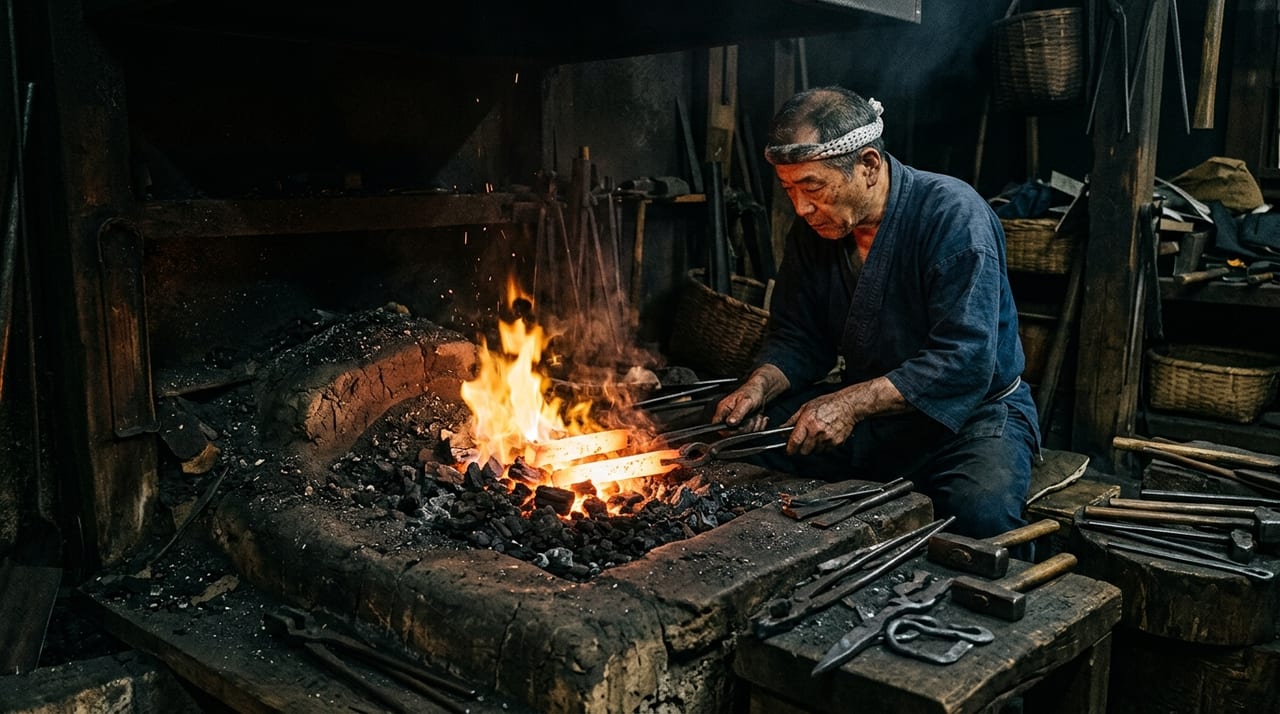 * Image is for illustrative purposes only.
Table of Contents
What is Tsuchitori — the Preparatory Process that Governs Yaki-ire
When discussing yaki-ire (quenching) of nihontō, attention tends to focus on "water temperature" and "the moment of quenching." However, what fundamentally determines the shape of the hamon (temper line) is the blending and application of the clay (tsuchi) applied to the blade before yaki-ire. The process of preparing this clay is called tsuchitori.
Tsuchitori appears simple at first glance, yet it is an exceptionally demanding process requiring advanced skill and experience. The clay's materials, grain size, moisture content, mixing ratios, and drying conditions after application directly affect the width, visual character, and the development of nie (visible martensite crystals) in the hamon. In other words, tsuchitori is the process of drawing up the blueprint for the hamon, and the tōshō's vision of the intended hamon is distilled into the clay's composition.
Basic Raw Materials — Three Types of Ingredients
Traditional nihontō clay is generally prepared from a base of the following three types of materials.
| Raw Material | Characteristics and Role |
|---|---|
| Toishi-ko (whetstone powder) | Powder from the whetstones used by togishi (chiefly medium to fine grade). The primary material providing adhesion and insulation to the blade. Grain size varies by whetstone type, affecting heat transfer during yaki-ire. Using a greater proportion of coarse-grained toishi-ko increases the clay's insulating effect, tending to stabilize the hamon without allowing it to spread too wide. |
| Mokutan-ko (charcoal powder) | Pulverized charcoal. Primarily functions as a buffer against the rapid heating and cooling of yaki-ire, regulating clay shrinkage. The type of charcoal (pine, bamboo, oak, etc.) differs in grain coarseness and water absorption, and tōshō have their own preferences for charcoal type. |
| Nendo (clay) | Natural clayey soil. Functions as the binder in tsuchitori, adhering the toishi-ko and mokutan-ko to the blade. The shrinkage rate varies by the clay's origin and quality, so even the same ratios can produce different results. Some tōshō are particular about the source of their clay, and this becomes a "secret tradition of the tōshō's clay" passed down through generations. |
Mixing Ratios — Closely Guarded Secrets of Schools and Individuals
The mixing ratios of the clay are treated as closely guarded secrets by individual tōshō, and in many cases they are not disclosed. However, the following general tendencies are known.
The rough framework of a typical blend is "toishi-ko : mokutan-ko : nendo = 5–7 : 1–2 : 2–3 (by weight)," but this is merely a rough guideline, and the formulations that individual tōshō have refined over years of experience vary enormously.
Tōshō who use "atsu-tsuchi" (thick clay) and those who use "usu-tsuchi" (thin, uniform clay) differ fundamentally in the hamon width and visual character they seek. When aiming for chōji-midare characteristic of Bizen-den, precise placement of specific clay only at the edge is required; when aiming for ō-nie characteristic of Sōshū-den, there is a tendency to combine an overall thin clay application with rapid yaki-ire.
Mixing and Drying — A Process that Demands Craftsman's Intuition
When blending the clay, the tōshō first measures out each material in the appropriate amounts, then kneads them together while adding water little by little. Controlling the amount of water is particularly important; the expression "slightly firmer than an earlobe" is sometimes used in the world of craftsmen. If the moisture content is not appropriate, the following risks arise.
- If there is too much moisture, the clay will sag after being applied to the blade and tends to crack during drying.
- If there is too little moisture, adhesion to the blade weakens, increasing the risk of the clay flaking off during yaki-ire.
The mixed clay is carefully applied to the blade with a brush or fingers. The basic principle is to apply it thinly near the edge (or with a distinctive pattern at the edge) and thickly near the mune (back of the blade), but the precise thickness at each area is left to the tōshō's discretion. Whether the hamon takes the form of gunome or chōji-midare is determined by this differential clay application.
Drying after application is also carefully managed. Rapid drying generates internal stress in the clay and causes cracking, so natural drying (several hours to overnight) is the principle. Direct sunlight and strong hot air must be avoided, and in modern workshops where the temperature and humidity of the drying room can be controlled, appropriate environmental control may be implemented.
The Science of Clay — Insulating Effect and the Physics of Yaki-ire
To explain scientifically the influence of clay on hamon formation, it comes down to "control of rapid cooling through the clay's insulating effect." During yaki-ire, the edge area where the clay is thin (or absent) cools rapidly upon contact with water, forming the hard metallic structure known as martensite. This is the area that appears visually as the hamon.
On the other hand, the mune and ji areas where thick clay has been applied cool more slowly, inhibiting hardening and leaving a tough, resilient structure. This difference in cooling rates between the two zones is the fundamental mechanism that creates the boundary of the hamon. Subtle variations in the grain size, density, and thickness of the clay produce nuanced differences in cooling speed, which in turn manifest as nie, nioi (fine martensite mist), and the visual character of the hamon.
Viewed from the perspective of modern materials science, the clay's composition represents the design of localized cooling rates, and the tōshō's accumulated experiential knowledge is in fact grounded in a sophisticated thermodynamic intuition. The complex phase transformations that occur in the instant of yaki-ire have been controlled by tōshō through empirical knowledge transmitted over hundreds of years. The profound depths of the tsuchitori process lie at the intersection of the science and craftsman's knowledge of nihontō.
For a deeper understanding of the relationship between clay preparation before yaki-ire and steel hardness, reading Clay Preparation for Yaki-ire alongside this article will deepen your understanding.