The Science of Yaki-ire (Water Quenching and Oil Quenching): Heat Treatment Theory for Rapid Cooling and Hamon Formation
 * Image is for illustrative purposes only.
Table of Contents
Yaki-ire: The Moment That "Makes or Breaks" the Sword
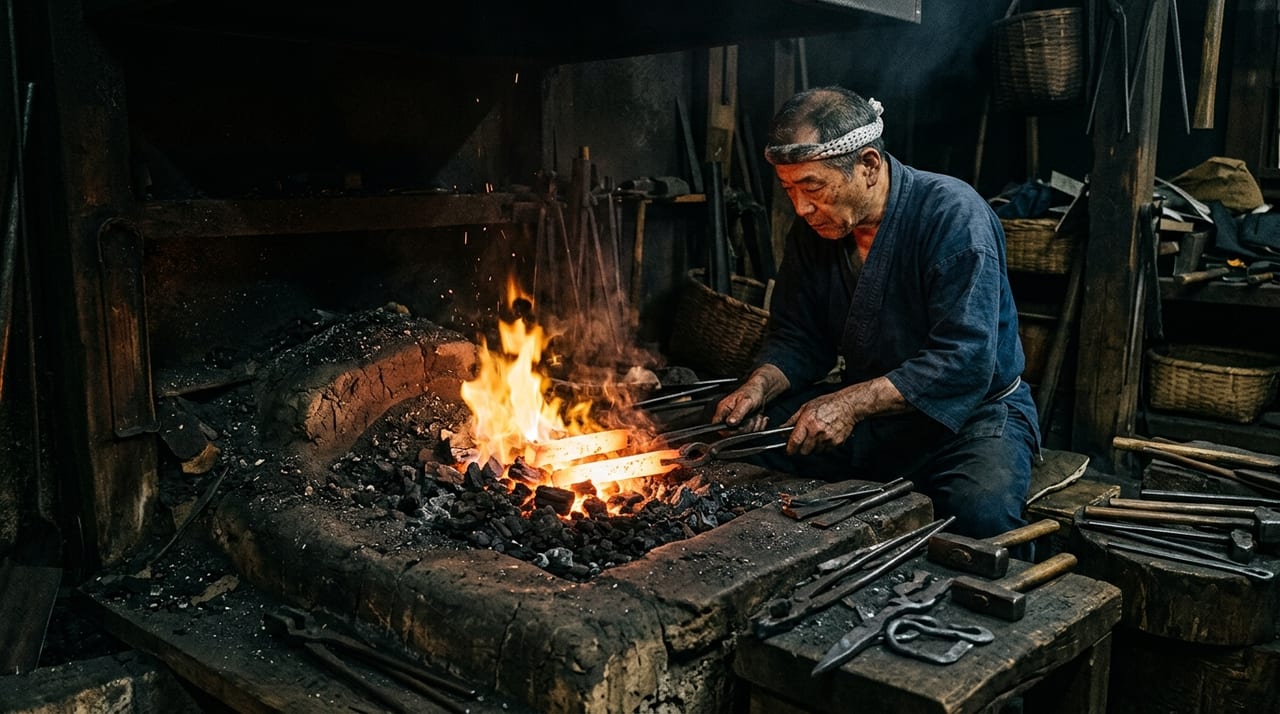
In the manufacturing process of the Japanese sword, yaki-ire is the most dramatic and dangerous step. After heating a blade that has been forged and shaped over many days to a high temperature (800–900°C), it is plunged in an instant into cold water (or oil)—this rapid cooling allows the sword to possess in a single piece of metal the contradictory properties of a "hard edge" and a "tough mune."
If yaki-ire succeeds, a beautiful hamon appears and the sword becomes a finished piece excellent for both use and appreciation. If it fails, however, the blade cracks, warps, and in some cases the tōkō may be injured. This is why it is said that "yaki-ire makes or breaks the sword."
The Science of Yaki-ire as Seen Through Metallic Microstructure
To understand the principles of yaki-ire, it is essential to understand the changes in the metallic microstructure of iron—particularly "martensitic transformation."
When iron (carbon steel) is heated above the A1 transformation point (723°C), it transforms into a crystal structure called "austenite." If rapidly cooled (quenched) from this state, the carbon has nowhere to escape and transforms into "martensite," an extremely hard (but brittle) crystal structure. Slow cooling, on the other hand, produces "pearlite" or "ferrite," soft structures with high toughness.
What makes the yaki-ire of the Japanese sword ingenious is that it creates a hard section (the edge) and a soft section (the mune and jigane) within the same blade. What makes this possible is tsuchioki—the technique of covering the parts other than the edge with refractory clay to intentionally vary the cooling rate.
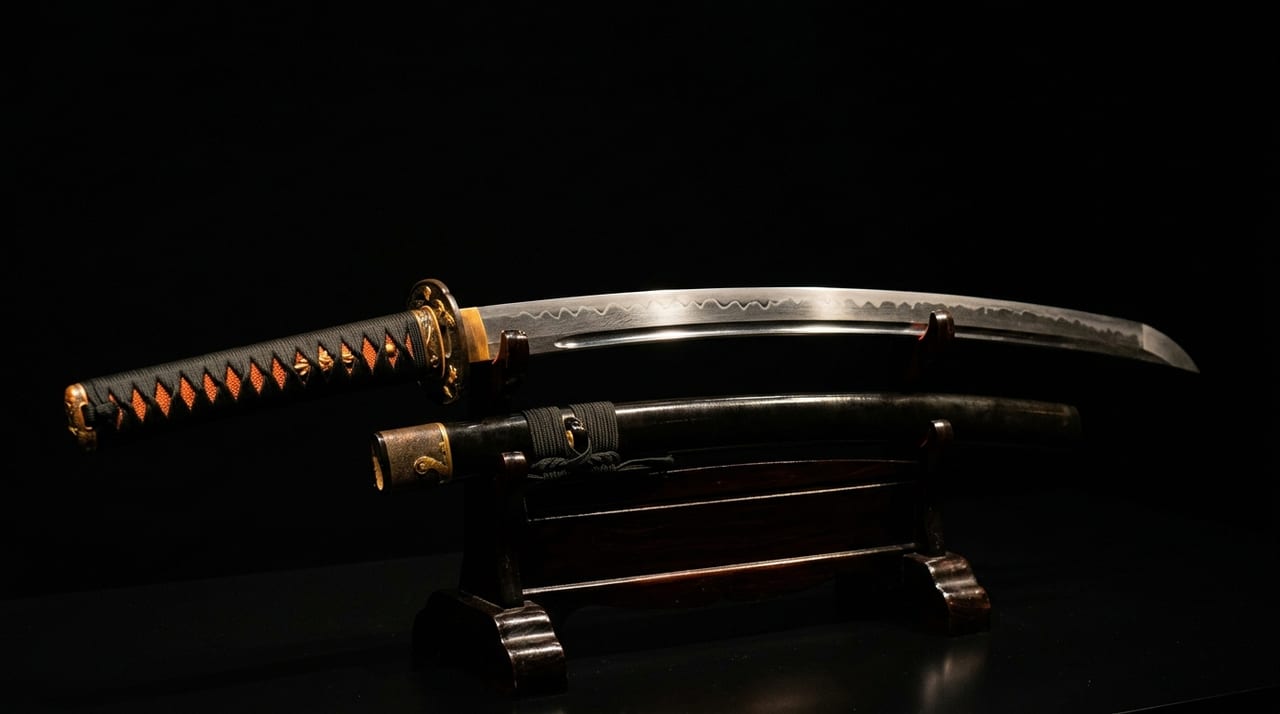
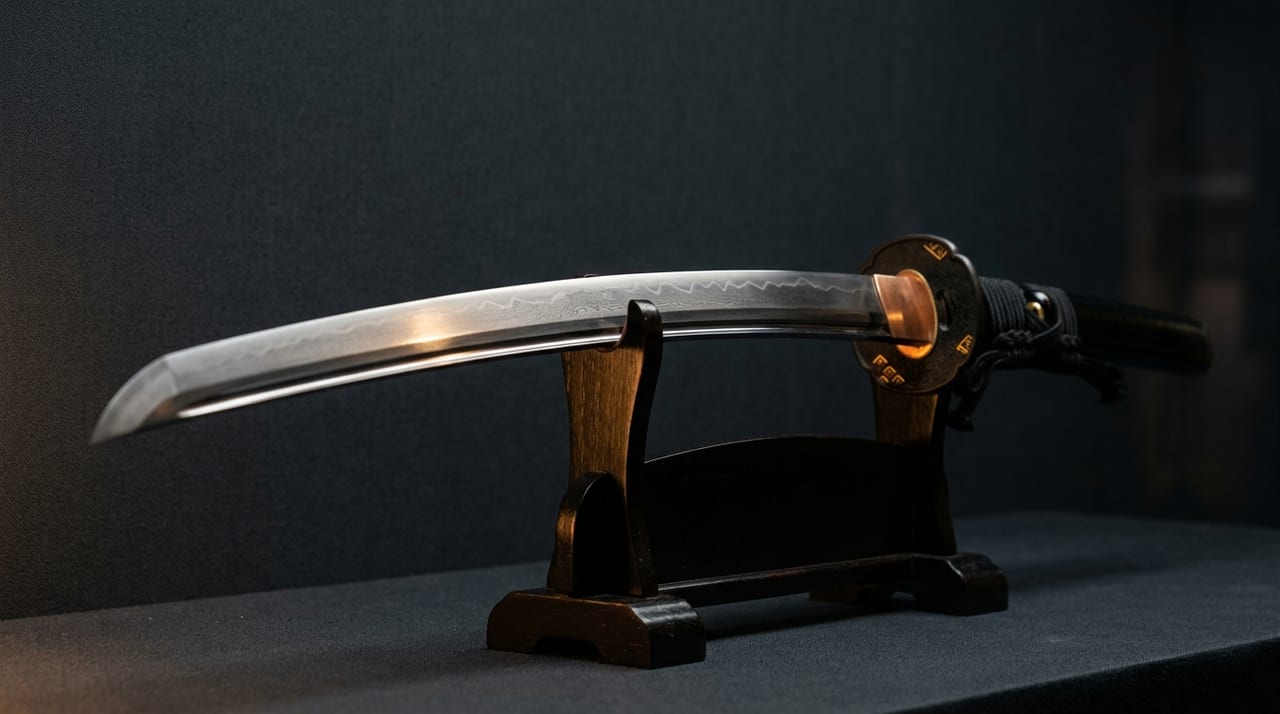
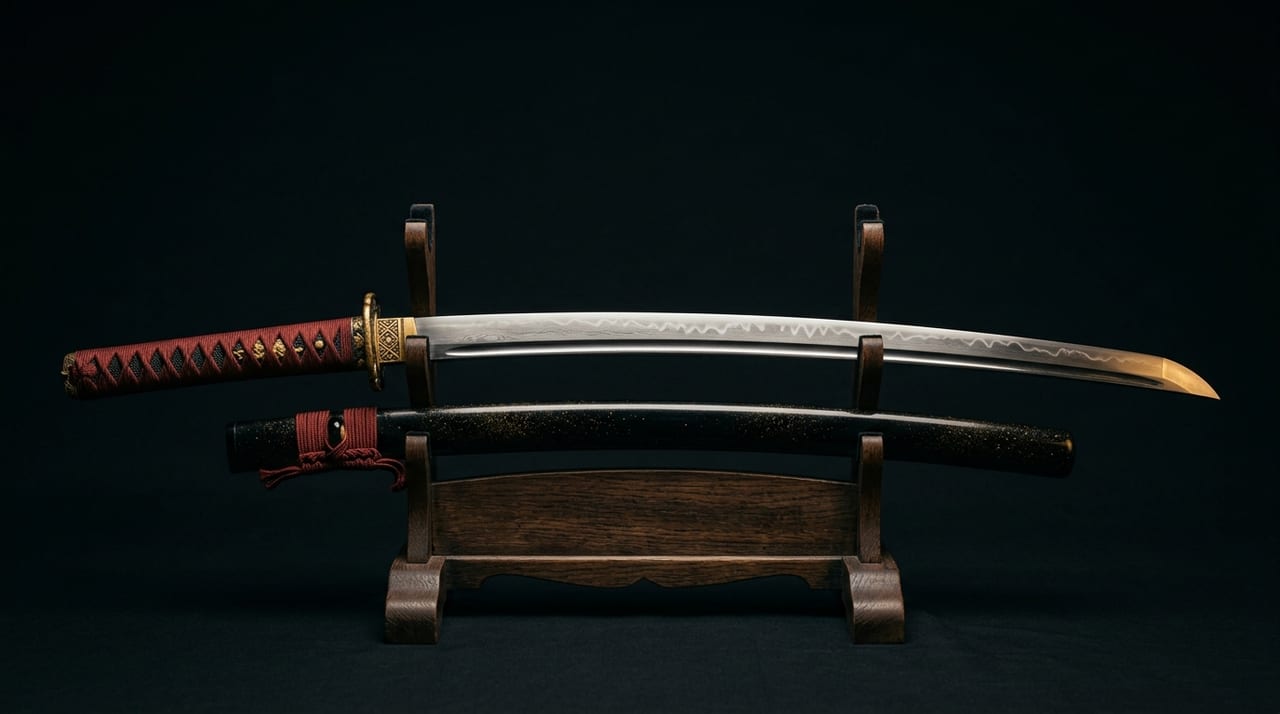
The clay-covered areas are not rapidly cooled and remain soft (pearlite and bainite microstructures). Only the edge area, free of clay, is rapidly quenched and becomes martensitic, producing a hard edge. At this boundary, the hamon appears.
Water Quenching and Oil Quenching: The Differences Between Two Cooling Media
Yaki-ire for Japanese swords falls into two main types: water quenching (mizuyaki) and oil quenching (aburayaki). This is not merely a difference in convention but reflects differences in steel composition, traditional school, and desired finish. The differences between the two can be summarized as follows.
| Item | Water quenching (mizuyaki) | Oil quenching (aburayaki) |
|---|---|---|
| Method characteristics | The most traditional method, which rapidly quenches high-carbon steel such as tamahagane | A method using oil (or a water-oil mixture) in place of water, also adopted by many modern tōshō |
| Cooling character | The high thermal conductivity of water produces a faster cooling rate, making hard martensite more likely to form | Oil has lower thermal conductivity than water, and its gentler cooling reduces the risk of distortion and cracking |
| Hamon produced and representative examples | nie—white granular light in the hamon—tends to appear readily; many famous swords of Bizen-den and Sōshū-den were made by water quenching | The hamon tends toward a relatively uniform nioi character |
| Risks and notes | However, the stress from rapid cooling is great, and the risk of cracking (quench cracking) and sori distortion is high, requiring advanced skill and experience from the tōkō | Modern industrial quenching technology has developed a variety of quench oils, but some tōkō in traditional Japanese sword kaji still use vegetable oil (such as rapeseed oil) |
Controlling Water Temperature and Furnace Temperature: The Craftsman's "Intuition" and Science
The greatest factor determining the success or failure of yaki-ire is temperature control. Particularly important are the following two points.
- Heating temperature (furnace temperature)
- Temperature of the cooling medium (water temperature or oil temperature)
Regarding furnace temperature, some tōkō today use thermocouples and optical pyrometers as supplementary aids, but many traditional tōkō judge temperature by the "color" of the blade—yellow-brown, orange, or white. Once the A1 transformation point (723°C) is exceeded, the blade glows orange to yellow-white, and the skill of "reading by eye" the color at the optimal quenching temperature of 800–900°C is the fruit of many years of experience.
Water temperature is also important; even the same well water differs greatly between summer and winter, affecting the outcome of yaki-ire. If the water temperature rises too high in summer, the cooling rate drops and the quench becomes insufficient; if the water temperature is too low in winter, the stress from rapid cooling increases and cracking becomes more likely. Some tōkō choose the season and time of day for yaki-ire in order to manage the water temperature and achieve the best results.
The Metallic Microstructure Appearing in the Hamon: The True Nature of Nie and Nioi
Nie and nioi, which lie at the heart of hamon appreciation, can be explained scientifically as differences in metallic microstructure.
Nie consists of granular martensite formed at the hamon boundary, produced by sharp rapid cooling. It can be observed with a loupe or the naked eye as white glittering "granules" that emit a strong luster. Where nie is coarse and large it is called ara-nie; though its coarseness may be considered a flaw, in the omidare hamon of Sōshū-den it is prized as a magnificent beauty.
Nioi consists of martensite particles finer than nie distributed in a haze-like manner, making individual particles difficult to distinguish even with a loupe. It appears like a white mist and is frequently seen in swords of Bizen-den and Yamato-den. A sword in which nioi is deep and full is described as having a "deep nioiguchi" and is considered a characteristic of refined, superior work.
Conclusion: The Moment Where Science and Craftsmanship Intersect
Yaki-ire is the moment at which the scientific process of martensitic transformation—explicable by modern metallurgy—intersects with the craftsman's intuition backed by decades of experience. Water or oil, what temperature, how fast to cool—small differences in these parameters separate a masterwork sword with a beautiful hamon from a failure. Yaki-ire is regarded as the crux of sword making because this step cannot be redone, and the hamon and the sword's performance are both determined here simultaneously.