Insurance for Nihontō — Essential Knowledge for Protecting Your Collection
 * Image is for illustrative purposes only.
Table of Contents
Why Insurance Is Necessary for a Nihontō Collection
Nihontō are classified as high-value fine art objects due to their high aesthetic and historical value. It is not uncommon for a single outstanding piece to be worth several million to tens of millions of yen. When such a collection is struck by fire, theft, flood damage, or accidental breakage, the loss incurred without adequate insurance is irreparable.
The assumption that "I am confident in my storage conditions" is a dangerous one. Fires that engulf an entire building and theft carried out by specialist operatives can happen even to careful collectors. Having an insurance strategy is not only about protecting assets; it is also a responsibility to reliably pass on historical heritage to the next generation.
The main risks to bear in mind are as follows.
- Fire: damage can be sustained not only from your own home or storage facility, but also from the spread of fire from adjacent buildings
- Theft: in addition to ordinary burglars, the existence of criminal groups that specifically target fine art is well known
- Flood damage and moisture: inundation above floor level or flooding caused by plumbing problems can lead to rust on the blade and warping of the saya and koshirae
- Breakage: toppling or falling due to earthquakes, impacts during transport, and unexpected accidents during maintenance should also be anticipated
The Decisive Difference Between All-Risk Movable Property Insurance and Household Contents Insurance
The "fire insurance" and "household contents insurance" that many people turn to first are structurally ill-suited for covering high-value fine art. General household contents insurance has a "per-item coverage limit," and there are cases where even a sword worth several million yen is covered for only a few hundred thousand yen.
All-risk movable property insurance covers movables in general, including fine art and antiques, and covers a wide range of risks such as fire, theft, breakage, and flood damage. The system allows you to register your entire collection as an "itemized list" and receive coverage commensurate with the appraised value. The premium is higher than household contents insurance, but for those who hold a high-value collection, all-risk movable property insurance is not a choice but an essential precaution. Request quotes from multiple insurance companies and carefully compare the balance of coverage content, deductible conditions, and premiums.
To summarize the differences between the two:
| Comparison Item | Household Contents Insurance | All-Risk Movable Property Insurance |
|---|---|---|
| Coverage Target | General household contents (with per-item limit) | Movables in general, including fine art and antiques |
| Itemized Registration | Not usually required | Appraised value registered individually |
| Premium Level | Relatively inexpensive | Tends to be higher than household contents insurance |
| Suitable Use | Comprehensive coverage of general household contents | Individual coverage for high-value collections |
When comparing quotes, also confirm the following items.
- Whether natural disasters (earthquakes, flood damage, etc.) are included in the coverage
- The deductible amount (self-pay amount) settings and the resulting changes in premium
- The method of calculating the insurance payout (whether based on current market value or agreed value)
- The notification method when adding a new sword to the collection and when the coverage is updated accordingly
Fine Art Insurance — Filling the Gaps During Exhibition and Loan
For collectors considering not only home storage but also submitting pieces to nihontō exhibitions or lending them at appreciation events, examining fine art insurance is indispensable. Many all-risk movable property insurance policies do not cover damage outside the owner's control, or coverage is limited.
Fine art insurance can include coverage for risks during transport, unforeseen events at exhibition venues, and damage during restoration by specialist craftspeople. It is critically important to calculate the appraised value accurately and keep it up to date at all times.
Before taking out a policy, it is advisable to confirm at least the following points with the insurance company.
- Whether the transport route from home to the venue and back is included in the coverage
- Whether theft or damage at the lending destination or exhibition venue is covered
- How accidents during delivery to and collection from specialist restoration craftspeople are handled
- The venue's security and management arrangements during the exhibition period
The Absolute Importance of the NBTHK Kanteisho — The Lifeline of Insurance
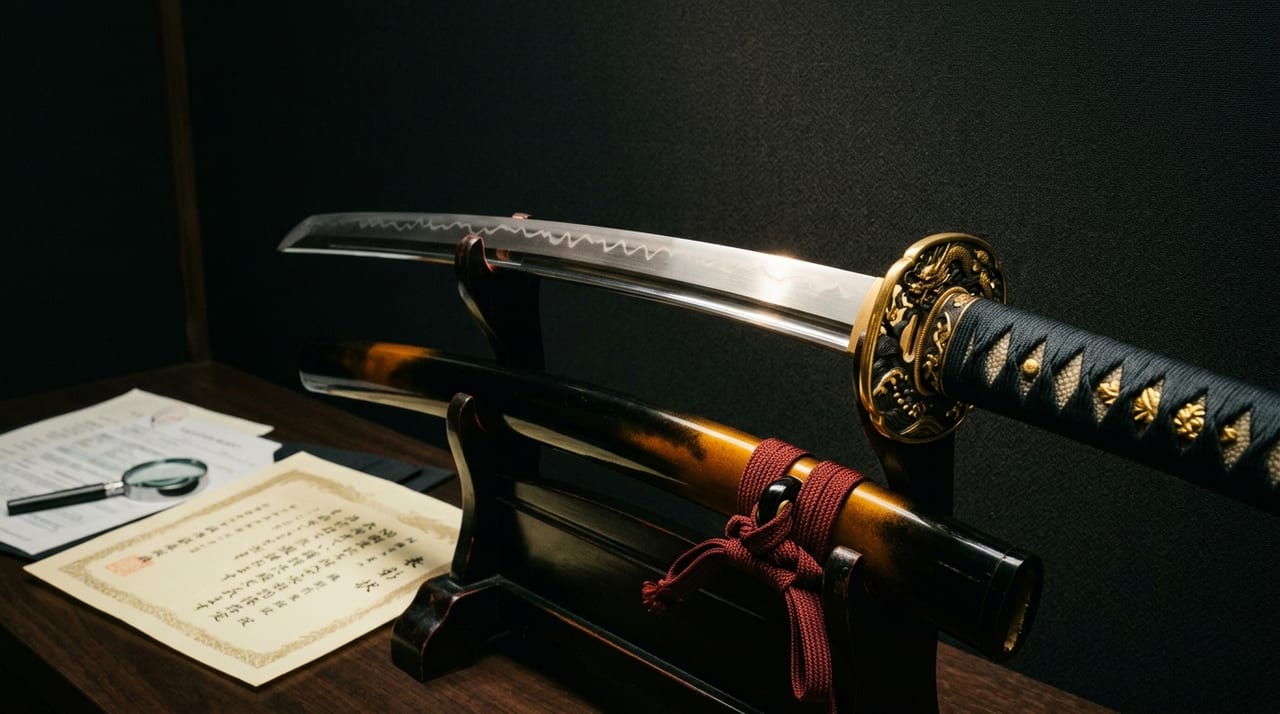
The most decisive role at the time of an insurance claim is played by the kanteisho (appraisal certificate) issued by NBTHK (Society for the Preservation of Japanese Art Swords). The kanteisho is a document in which a third party objectively certifies the authenticity, appraised value, and characteristics of a sword, and it serves as the most important basis when an insurance company calculates the coverage amount. For a sword without a kanteisho, making an insurance claim is nearly impossible, or only a significantly lower coverage amount will be approved.
Store the original kanteisho in a fireproof safe, and keep multiple copies distributed in safe locations outside the home, such as a bank safe-deposit box. Saving a digital scan to the cloud is also effective.
When actually filing an insurance claim, it is generally required to prepare the following documents in addition to the kanteisho.
- NBTHK kanteisho (original or copy)
- Receipt and sales contract from the time of purchase
- Photographs and video recording the condition
- Documents proving the damage, such as the acceptance number of a theft report or a disaster certificate
Keeping all of these together in a single folder at all times ensures that procedures in an emergency will proceed smoothly.
Building a System of Photographic, Video, and Digital Backup Records
From the standpoint of insurance documentation, it is strongly recommended to take high-resolution photographs of each part — the entire sword, the mei, the hamon, the jigane, the kojiri, and so on — and back them up to multiple cloud storage services. Initial condition records play a decisive role not only in verifying identity in the event of theft and as evidence when filing an insurance claim, but also for future appraisals and sales.
By standardizing the color temperature during photography and recording under different lighting conditions, accurate documentation can be created. A video record capturing the entire sword is also effective as proof of condition. Manage image files by linking them to the date and the sword's name and mei.
Examples of parts to photograph are as follows.
- The entire blade (both obverse and reverse sides)
- Close-up of the mei
- Close-ups of the hamon and jigane
- The complete koshirae including the saya, tsuka, kojiri, sashiza, and so on
- Areas showing pre-existing condition such as scratches or stains
Periodic Reappraisal and Review of Coverage Amounts
Appraisal values in the nihontō market fluctuate constantly. Works by prominent tōkō and historically rare swords can see their market value rise significantly over the course of a decade. If the appraised value at the time of enrollment has fallen far below the current market value, adequate coverage will not be received in the event of an emergency.
Make it a habit to request reappraisal from a trusted appraiser at least every three years, and ideally every year, and to review the coverage amount. Conducting reappraisal in conjunction with resubmission for NBTHK review is efficient.
At the same time as reviewing your insurance, organizing related documents such as the insurance policy, kanteisho, and photographic records will allow procedures to proceed smoothly in the event of an emergency. Regular preparation of your system is the very core of genuine risk management.
Examples of documents to organize are as follows.
- Insurance policy (showing the contract details and special clauses)
- Original or copy of the NBTHK kanteisho
- Photographs and video recording the most recent condition
- Past appraisal reports and valuation documents
When transporting a sword overseas, do not forget to add transport insurance. The legal regulations governing the import of nihontō vary greatly by country. Confirming local laws before transport and entrusting the work to a specialist fine art transport company is the golden rule for safety.