A Complete Guide to Japanese Sword Dealers' Sourcing Routes — Dealers Reveal the Real Business of Procurement: Auctions, Estate Clearances, and Overseas Buying
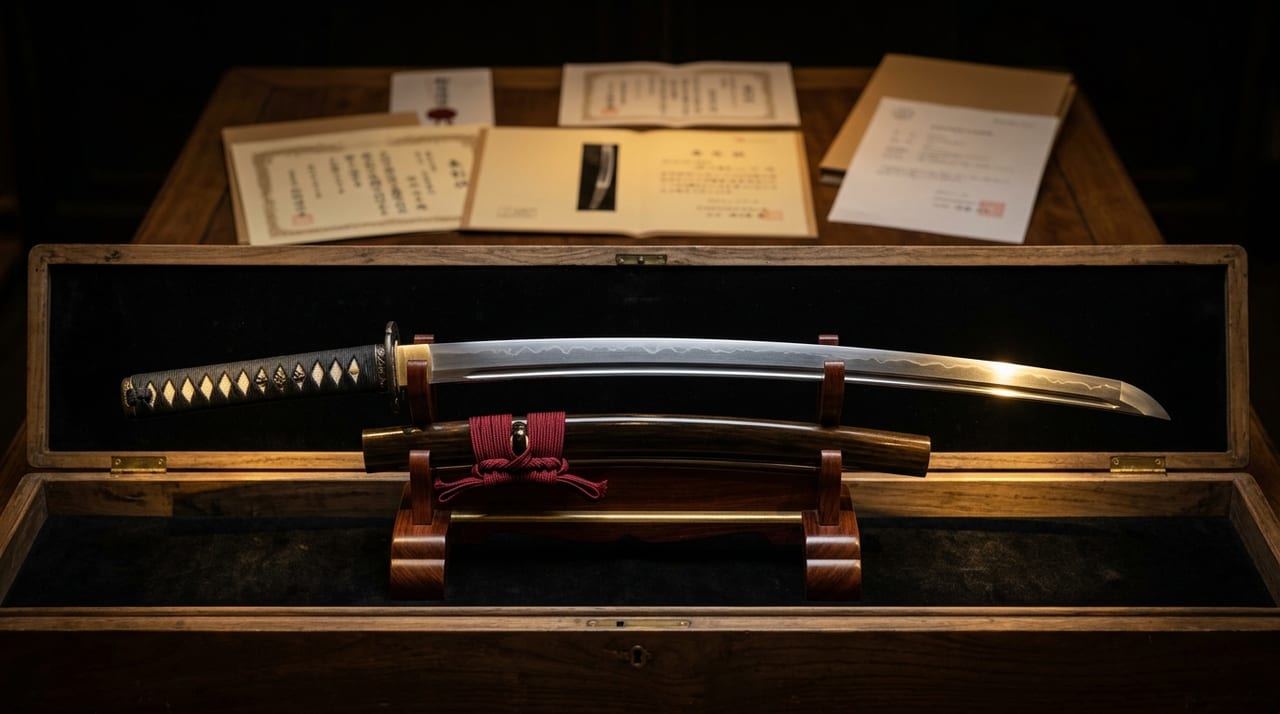 * Image is for illustrative purposes only.
Table of Contents
Sword Dealers' Sourcing Routes Are, as a Rule, Kept Secret
The Japanese sword industry is known as a closed world. The outlets through which ordinary collectors can purchase Japanese swords — antique shops, auctions, and sword fairs — are relatively visible, but where do sword dealers themselves source their stock? The reality behind this rarely comes to light, and even among industry insiders the accepted wisdom is that "sourcing routes are trade secrets."
This article, drawing on interviews with sword dealers and industry materials, sets out to shed light on the full picture of those sourcing routes. Understanding the entry points of the sword business also gives buyers an important key to answering the question: "Why is this sword priced the way it is?"
Route 1: Bid Meetings and Auction Sales (Closed Markets for Dealers Only)
The largest arena for procurement is the bid meeting. Unlike auctions open to the public, these are closed competitive sales in which only dealers may participate, held several times a month by sword-dealer associations and trade organizations across the country.
At bid meetings, consignors range from dealers to bereaved families to individual collectors, but winning bidders are almost always professional dealers. The typical format is to write a bid amount on a slip of paper sealed inside an envelope for each sword, with the priority being that competitors cannot read your price rather than transparency.
The basic commercial flow is for dealers to add "preparation costs (polishing, shirasaya, and kanteisho acquisition)" and profit on top of the price paid at these venues. As of 2026, online bid meetings have begun to spread, and an environment is forming in which even dealers in regional areas can participate more easily.
Route 2: Estate Clearances and Inheritance Cases (Private Direct Procurement)
An equally important route alongside bid meetings is procurement through estate clearances. Cases in which heirs discover a Japanese sword among a deceased person's belongings and contact a sword dealer at a loss for how to dispose of it never cease.
The strength of this route is the absence of competition. Unlike competitive auctions where multiple dealers vie against each other, negotiations are one-on-one with the bereaved family, making it highly likely that the sword can be acquired at a fair price on terms favorable to the dealer. Seasoned sword dealers cultivate lateral connections with legal professionals, funeral companies, and estate-clearance firms, building networks that generate referrals.
One caveat is that issues under the Firearms and Swords Control Act (Jūtōhō) — such as the presence or absence of a registration certificate and name-transfer procedures — tend to become complicated in estate-clearance cases, and dealers who can handle the legal procedures on clients' behalf earn greater trust, which has led to a growing number of sword dealers forming partnerships with attorneys and administrative scriveners.
Route 3: Overseas Buying (Reverse-Import Route)
Since the Meiji era, Japanese swords have flowed out of Japan in large numbers. The swords that left the country are scattered across Europe, the United States, Australia, Hong Kong, and elsewhere, and the circumstances were as follows.
- Swords taken out by foreigners as souvenirs during the Bakumatsu and Restoration period
- Swords confiscated by GHQ after the Pacific War
- Swords sold to collectors
In recent years, Japanese sword collectors overseas have been facing the challenges of aging and inheritance, and cases in which they approach Japanese dealers about selling swords back are increasing. Sword dealers who specialize in overseas buying visit London, New York, Sydney, and other cities several times a year to purchase from individual collectors and from surplus museum holdings.
Among the swords acquired through this "reverse-import" route, some are "undiscovered masterworks" that have no record of circulation within Japan and have never been examined by researchers. There are in fact multiple reported cases in which a mumei tachi purchased from an heir living overseas turned out, after polishing, to be a zaimei work by a renowned tōkō and received a high appraisal.
Route 4: Direct Procurement from Tōkō (Consignment and Purchase of New Swords)
Sword dealers who maintain trading relationships with gendaitō tōkō either buy new completed swords directly from the tōkō or receive them on consignment. Because tōshō want to focus on forging and many are craftspeople uncomfortable with sales and customer service, a "consignment system" in which they entrust sales to a trusted dealer has become widely established.
In this arrangement, the tōshō sets a minimum desired price, and the difference between that and whatever higher price the sword sells for becomes the dealer's profit. On the other hand, there are also cases in which a dealer purchases the sword outright after it is forged and holds it as inventory.
It should be noted that works by the top tōshō of gendaitō — those designated Living National Treasures or holding mukansa rank — attract such a flood of prospective buyers that they are difficult to obtain through ordinary channels. Dealers who can handle this class of sword on a stable basis have built special trading relationships grounded in long years of master-apprentice bonds and personal trust, and this serves as a differentiating factor within the industry.
Route 5: Purchase Requests from Individual Collectors
Walk-in purchases and purchase requests from collectors who have lost the urge to collect, need funds, or want to pare down their collections also constitute a stable sourcing route for dealers.
The purchase price is the "dealer purchase price (cost price)," which is typically around 40 to 70 percent of the retail price of the same sword. Experienced dealers draw on their market sense and appraisal skills to maximize the margin between the purchase price and the selling price.
That said, many dealers are reluctant to make purchases. Buying indiscriminately places pressure on management due to inventory-management costs, the risk of unsold stock, and cash-flow concerns. Swords that are mumei, in poor condition, or have problems with their registration certificates are frequently refused.
The Cost Structure of Procurement and Its Relationship to Retail Pricing
Swords sourced through each of these routes often require additional investment to "enhance their value" before they can be sold. The main additional costs are as follows.
- Polishing costs: for a sword in poor condition, approximately 100,000 to 500,000 yen
- Shirasaya: if no storage shirasaya (plain storage scabbard) is present, one must be ordered separately
- NBTHK appraisal: fees and a set review period are required
- Photography: high-quality photography is also indispensable for online sales
The retail price consists of this "cost" — the sum of all such additional expenses — with profit, operating costs, and advertising expenses added on top. As a general rule of thumb, the retail price is said to be two to three times the procurement price, though for notable works it can exceed five times.
Conclusion: Knowing the Sourcing Routes Becomes a Collector's Weapon
Understanding "where and how" sword dealers source their stock gives one a perspective from which to judge whether a sword's price is fair. A collector who can ask "Why is this sword priced this way?" and verify the sourcing route and provenance with the dealer develops the ability to avoid unjustifiably high prices and to choose swords of appropriate value.
The world of swords is built on relationships of trust. Knowing the structure of this industry for oneself is the first step toward finding a dealer one can trust. In TOUKENZA's online catalog, the sourcing background and provenance information for each listed sword are disclosed to the extent possible, providing a trading environment with a high degree of transparency.