The Real Operations of Sword Markets and Auction Events — From Nationwide Trade Fairs to Private Auctions: the Economics of "Venues" in the Sword Industry
 * Image is for illustrative purposes only.
Table of Contents
What Are Sword Markets and Auction Events?
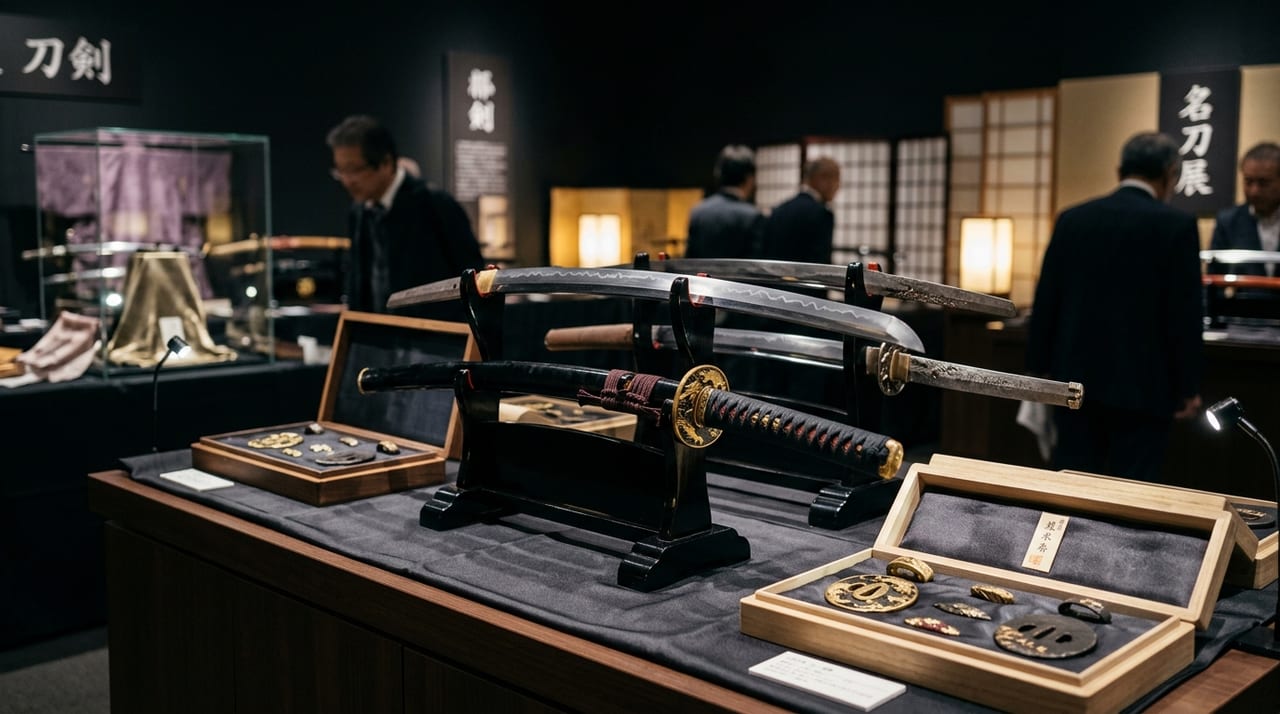
In the distribution of nihontō, sword markets (tōkenichi) and auction events (nyūsatsukai) are the most important "venues" for trade. Unlike regular sales at specialized sword shops, these venues bring together a large number of consigned items in one place, allowing buyers to compare, select, and negotiate directly.
Sword markets and auction events differ clearly in format.
Sword markets (fixed-price sale format): A format in which consignors set prices and visitors negotiate and purchase directly. It can be described as the nihontō equivalent of an antiques market. There is a tendency for swords in relatively affordable entry-level price ranges to circulate here.
Auction events (competitive bidding format): A competitive trading venue in which participants write amounts in sealed envelopes and deposit them in nested boxes ("nested bidding"), or in which the highest bidder wins in an auction format. Rare kotō and famous blades are often traded in this format.
Venues and Timing of Major Sword Markets and Auction Events Nationwide
Distribution hubs for nihontō tend to overlap with regions where tōkō and sword dealers have historically concentrated.
Tokyo: As the center of the sword industry, regular auction events are held in the areas around Nihonbashi, Ginza, and Ueno. Major sword markets concentrate especially in spring (April–May) and autumn (October–November). The Tokyo Bijutsu Club (Tōbi) holds regular competitive sales of nihontō, and attendance by industry insiders is considered essential.
Osaka/Kyoto: In the Kinki region, the Osaka Bijutsu Club hosts some of the industry's largest auction events. Consignments centered on Bizen swords and Yamato swords are common, and sword dealers from the Kansai area participate in large numbers. In Kyoto, specialist markets are held not only for nihontō but also for tōsōgu (tsuba, menuki, tsuka, and the like).
Okayama (Osafune): As the sacred home of Bizen swords, sword markets hosted by the local sword association are held several times a year. They have a local character, drawing tōkō and sword dealers from the area, but rare Bizen swords do sometimes come to market here.
Nagoya: In the Chūbu region, the Nagoya sword dealers' association hosts auction events two to three times a year. The regional character of this market is that kotō from Owari and Mino circulate here in relatively large numbers.
Information on upcoming sword markets is circulated to members by local sword dealers' associations and organizing bodies; general-admission fixed-price sales are sometimes announced as local event listings. If attending for the first time, confirming the event format (fixed-price sale or auction) and the participation requirements in advance will help avoid confusion on the day.
Eligibility and Procedures for Auction Events
Many industry auction events are not open to the public, and participation may be subject to conditions.
Industry-only auction events: There exist "dealer auction events" in which only member shops of the National Sword Dealers' Cooperative Association (Zentōshō) may consign and bid. Here, trade is conducted between dealers rather than for general customers. Auction catalogs are distributed only to member shops, and taking them outside is often prohibited.
General-admission auction events: In auctions open to the public that handle items from museum and art museum asset liquidations or private collector disposals, general participants may bid after screening. However, participant registration and identity verification are often required.
When applying for a general-admission auction event, it is advisable to read the participation rules set by the organizer in advance. Operational rules — such as cancellations after winning a bid being in principle not permitted, and preview times being limited — differ from organizer to organizer, so confirming these at the application stage will prevent confusion on the day.
Fee Structure from Consignment to Purchase
When participating in a sword market or auction event, the most important practical knowledge concerns the fee structure.
Consignor (seller) fees:
- Seller's commission (success fee): It is standard practice to pay the organizer a fee based on the sale price
- Consignment registration fee: May be paid in advance
- Photography and catalog listing fee: When the organizer produces a catalog, listing fees may be charged separately
Buyer (winning bidder) fees:
- Buyer's premium: Applies at some events
- Consumption tax: Levied on the sale price and fees
Rates and amounts differ from organizer to organizer. Before consigning or bidding, verify the terms and conditions; sellers should compare net proceeds and buyers should compare total payment amounts.
The Importance of Previews and In-Person Inspection
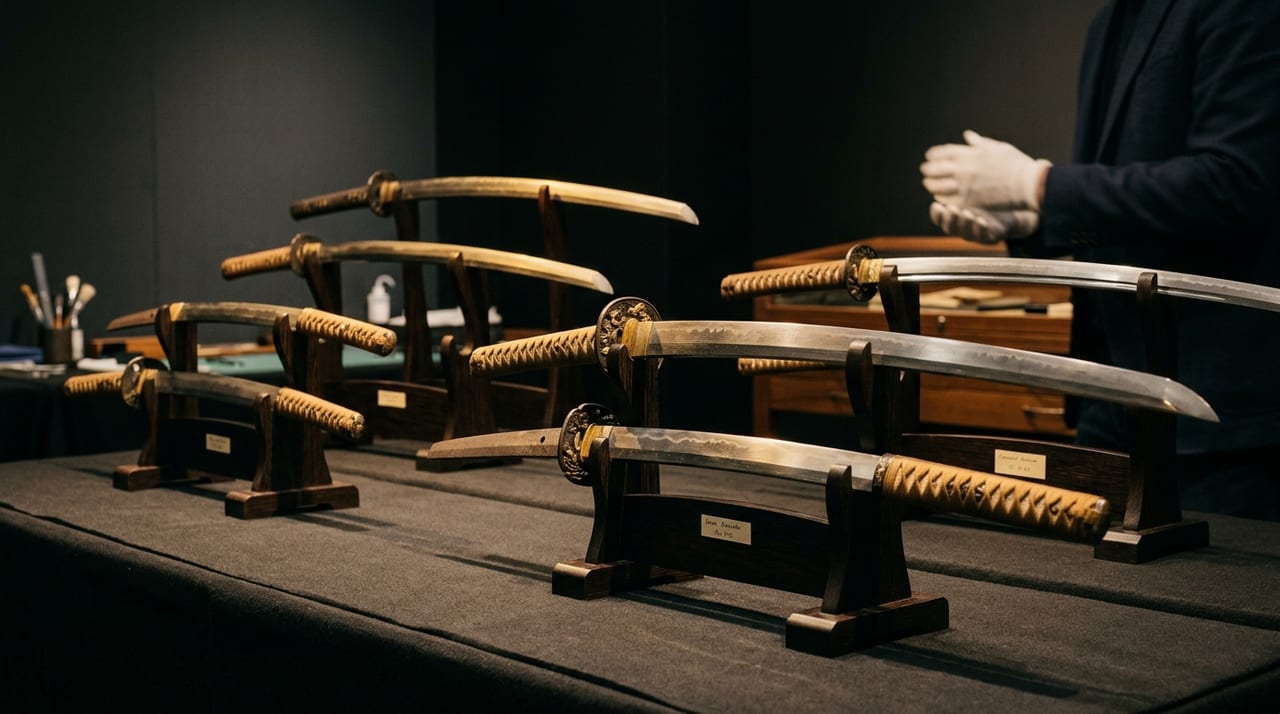
When participating in an auction event or sword market, the most important practical matter to be attentive to is the preview (shitami). At most auction events, a preview period is scheduled ahead of the actual bidding or purchasing, during which attendees can handle and inspect consigned items in person.
The main points to confirm at the preview stage are as follows.
- Condition of the mei (whether zaimei or mumei, and whether there is anything unnatural about how the signature is cut)
- Condition of the jigane and hamon (state of polish, presence of flaws or rust)
- Presence of accessories (koshirae, shirasaya, kanteisho, registration certificate, etc.)
- Whether the registration certificate (firearms and swords registration certificate) matches the actual item
It is often difficult to assess details such as the condition of the jigane, the activity of the hamon, and minute flaws from photographs or an online catalog alone. Particularly when considering high-value consignments, confirming the actual item at the preview wherever possible — and, when uncertain, obtaining the company or advice of a trusted expert — contributes to reducing practical risk.
The Relationship Between Auction Events and Price Formation
For nihontō price benchmarks, auction event results serve as an important reference point. Particularly for rare items and famous blades of Important Cultural Property class, there is almost no trading in ordinary markets, so the sale prices achieved at auction events are shared within the industry as the "current market value."
Zentōshō and major dealer associations have a mechanism for regularly notifying member shops of major sale results, and this functions to form price benchmarks across the entire industry.
Post-Purchase Practicalities — Payment, Handover, and Handling of Registration Certificates
The practical steps following a successful purchase are also points to be aware of before participating. The general process is: after the purchase is finalized, the organizer issues an invoice; payment, including fees and consumption tax, is made by the specified deadline; and handover of the actual item takes place after payment is confirmed.
At the time of handover, it is necessary to confirm that the registration certificate (firearms and swords registration certificate) and any kanteisho that were included are reliably handed over together. Because nihontō must be transferred and received together with their registration certificate (Act for Controlling the Possession of Firearms or Swords and Other Such Weapons (Jūtōhō) (e-Gov Legal Search), Article 18), confirming this at the point of handover is an indispensable practical step. If participating from a distant location, the organizer may arrange transport or inform participants of delivery services, but given that these are valuable works of art, it is also advisable to confirm in advance the method of transport, packaging, and whether insurance is included.
The Process When Considering Consignment
When wishing to consign a sword one owns to an auction event, the process generally begins with consulting the organizer or a member shop regarding appraisal and consignment. If the consultation results in a determination that consignment is possible, a consignment agreement is concluded, information is compiled for photography and catalog listing, and the item is listed in the catalog in accordance with the event schedule.
When considering consignment, it is advisable to receive a thorough explanation from the organizer regarding the pre-event estimate (such as reserve price and fee conditions) and to be satisfied before signing the agreement. Because nihontō evaluations differ greatly from item to item, it is not uncommon for consignors to consult multiple organizers and specialist shops and compare conditions.
The Impact of Going Online and the Future
Entering the 2020s, with the COVID-19 pandemic as the catalyst, the shift to online auction events in the nihontō world progressed rapidly.
Advantages of online auction events:
- Dealers and collectors living in regional areas can participate in major auction events in Tokyo and Osaka
- Prior confirmation of consigned items via digital photographs and video is possible
- Reduction of hosting costs (venue fees, travel expenses)
Challenges of online auction events:
- The condition of a sword (state of the jigane, quality of polish, presence of minor flaws) is difficult to judge without in-person inspection
- Distinguishing forged mei and forgeries has its limits when relying on digital confirmation
- The "excitement of bidding on the day" is lost, making it difficult for the competitive energy of an auction to build
In light of these challenges, hybrid formats that combine online previews with in-person previews at the venue have begun to appear at some auction events. For participants, the practice of narrowing down candidates online in advance and making the final judgment through in-person inspection is an effective way to keep practical risk in check.
Sword markets and auction events are the most vital infrastructure in the distribution of nihontō. The healthy functioning of these "venues" leads to appropriate price formation and the preservation of nihontō as cultural assets.