Techniques and Materials of the Shirasayashi: The Complete Process of Wood Selection, Shaping, and Finishing by Craftsmen Who Make Storage Saya
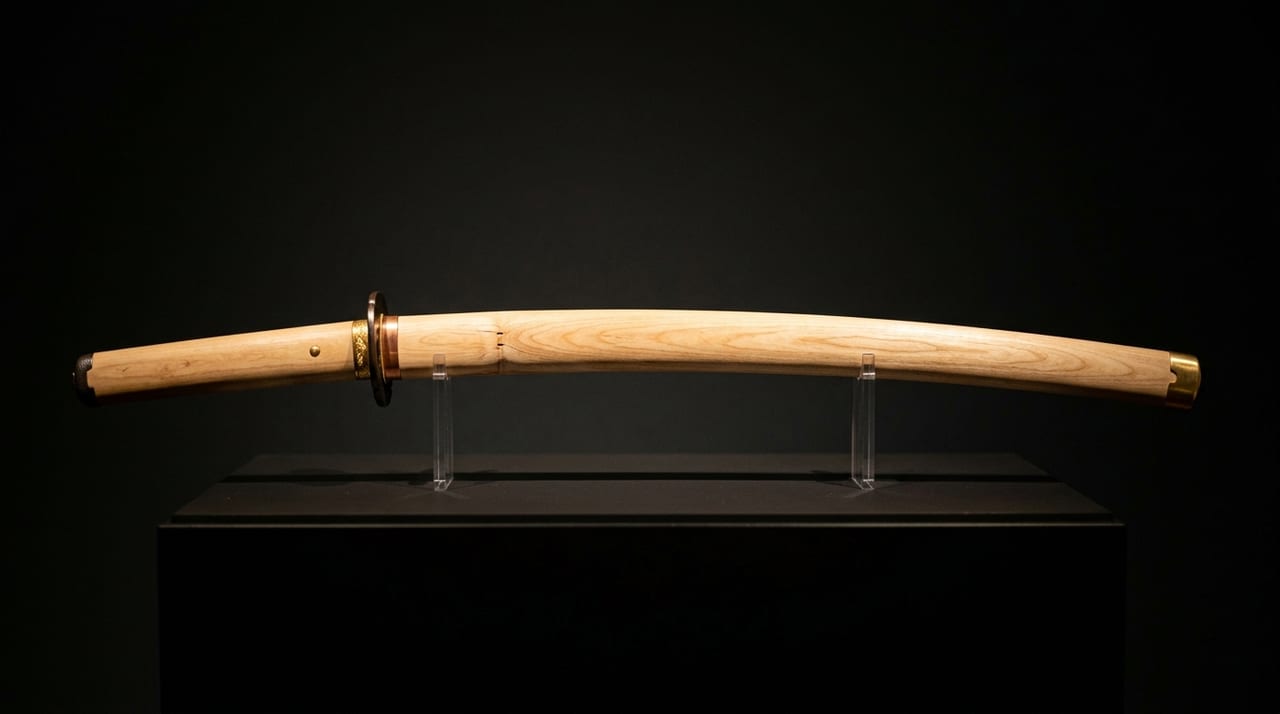 * Image is for illustrative purposes only.
Table of Contents
What Is a Shirasaya, and Why Are Specialist Craftsmen Needed?
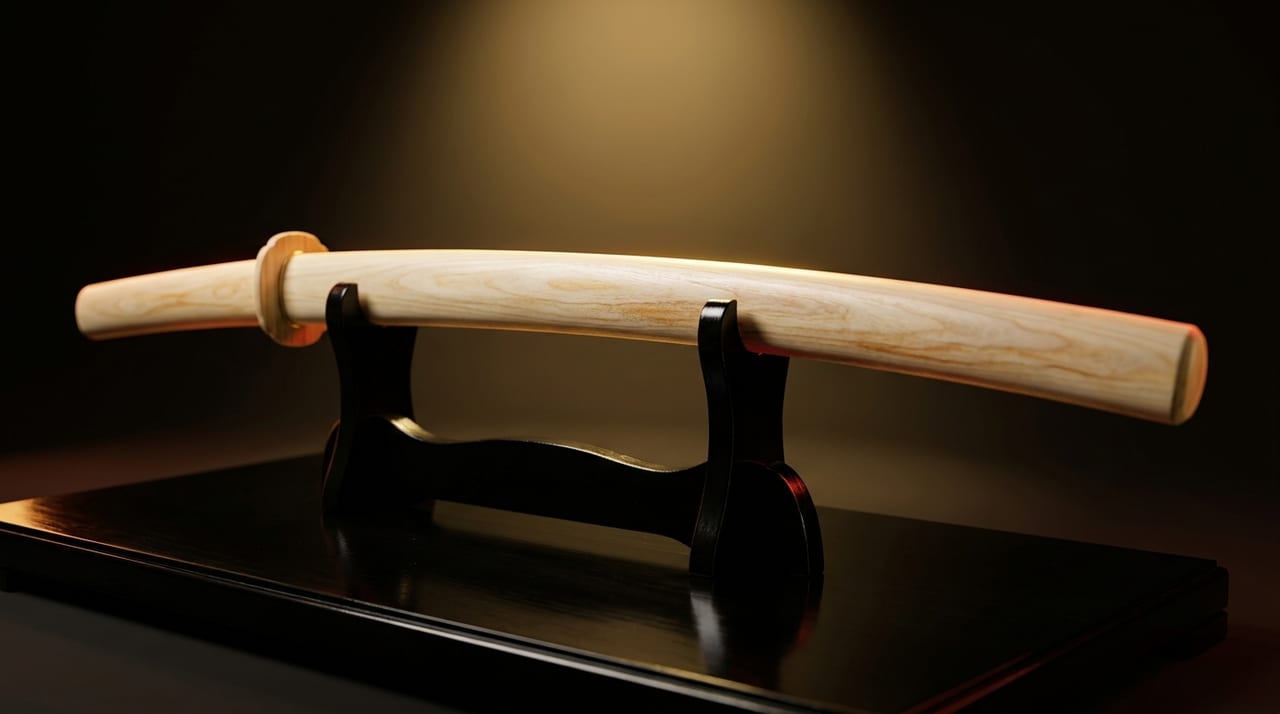
A shirasaya is a saya made exclusively for preservation and storage, finished in plain natural wood with no lacquer or decoration of any kind. In contrast to the koshirae of a nihontō—the decorated saya intended for actual carrying and use—a shirasaya is above all a functional vessel for preserving the blade in the best possible condition over the long term.
The quality of a shirasaya directly affects the condition in which the blade is maintained. Humidity, vibration, the contact area between saya and blade, and ventilation—all of these are governed by the materials and precision of the shirasaya. For this reason, making a shirasaya has long been considered not simple woodworking but the work of specialist craftsmen who possess a deep understanding of the metallurgical properties of nihontō.
A shirasaya does not come fitted with a tsuka or tsuba as koshirae do. Working from the habaki already fitted to the blade—the metal collar that secures the blade in the saya and prevents gaps at the mouth—the sayashi aligns the dimensions of the interior cavity and the mouth. Even when new koshirae are being made or repaired, the standard practice is first to house the blade in a shirasaya for safekeeping; the shirasaya thus serves as an indispensable intermediate station in the management of nihontō.
The Historical Place of the Shirasayashi
The shirasayashi tends to be regarded as one of the less prominent figures among nihontō craftsmen, yet the history of the trade stretches back to the Kamakura period. After the Muromachi period, when swords came to be appreciated as works of art, the storage shirasaya became indispensable, and among sayashi craftsmen a group specializing exclusively in shirasaya emerged.
During the Edo period, it became standard practice to prepare a shirasaya in conjunction with the sword appraisal and togi conducted by the Honami family. Making a new shirasaya for a freshly polished sword was considered part of the togishi's work, and the skills of togishi and shirasayashi were closely intertwined.
Today, shirasayashi number only a few dozen nationwide, concentrated in Tokyo, Kyoto, and Osaka. Because making or repairing a shirasaya is an essential step in the buying, selling, and restoration of swords, the relationship between sword dealers and shirasayashi remains close to this day. While shirasayashi rarely appear in the spotlight, a system in which togishi, sayashi, and sword dealers share information with one another while completing a single sword still persists today.
Choice of Wood: Why Hōnoki Is Chosen
The most widely used material for shirasaya is hōnoki (Japanese bigleaf magnolia).
- Low oil content: Hōnoki has little resin or oil, making it unlikely that oil constituents will migrate to the blade and compromise its quality. The greatest danger to be avoided in sword storage is chemical contamination inside the saya, and in this regard hōnoki is an ideal material.
- Ease of working: The grain is even and well-suited to the precise hollowing-out of a cavity such as the interior of a saya. A hardness that is neither too hard nor too soft allows a precise finish on the inner walls.
- Moderate breathability: Subtle breathability allows gradual adjustment of humidity changes inside the saya. If the saya is too airtight, moisture becomes trapped inside and causes rust, which hōnoki prevents.
- Stable availability: Produced throughout Japan and distributed as a construction timber and lacquerware material, hōnoki can be procured reliably.
By contrast, resinous conifers such as matsu (pine) are avoided as shirasaya materials. Because resin adhering to the blade can become a cause of rust, shirasayashi consider the potential impact on the blade from the very moment they select the wood.
For special shirasaya, kuwa (mulberry), kiri (paulownia), or kaki (persimmon) are sometimes used. Kuwa is highly durable, kiri is lightweight with excellent humidity-regulating properties, and kaki is said to carry tannins derived from astringent persimmon that offer antiseptic and insect-repellent benefits.
The Shirasaya-Making Process: From Kidori to Completion
1. Kidori (wood selection): Selecting the appropriate section from the raw timber. The grain, knots, and absence of splits are assessed to find a section that combines both strength and workability. Natural drying for three to five or more years is ideal; timber that has not dried sufficiently will warp after completion, causing the fit with the blade to change in a dangerous way.
2. Wari (splitting): The timber is split lengthwise and divided into two boards from which the interior cavity—the space that houses the blade—will be carved. The direction of the grain is checked and oriented to run parallel to the blade.
3. Carving the interior cavity: The inner faces of the two boards are precisely carved to match the shape of the blade. The ideal is for the blade to slide slowly into the saya under its own weight—neither too tight nor too loose. In this step the shape of the habaki also serves as a reference, and the area around the mouth is finished with no gap, precisely matched to the thickness of the habaki.
4. Bonding and shaping: The two carved boards are bonded together with komenori (rice paste), and the outside is shaped to the outer profile of the saya. The reason komenori has long been used is the practical advantage it offers: the saya can later be split open for repair.
5. Fitting of kōguchi, kurigata, and kojiri: The accessory parts—the kōguchi, kurigata, kojiri, and others—are fitted.
6. Finish polishing: The outer surface of the saya is polished with sandpaper and whetstones to bring out the beautiful natural grain of the plain wood.
7. Trial fitting (tameshi-ire): The completed saya is actually fitted with the blade, and the feel of drawing and sheathing as well as the seating at the mouth is confirmed. If there are any problems—too stiff, or too loose—the interior cavity is fine-tuned at this stage to arrive at the final finish.
The Role of the Shirasaya as Seen in Sayagaki
The surface of a shirasaya may receive a sayagaki—inscriptions in ink with a brush recording information such as the mei and period, written by an expert who has appraised or polished the blade. Sayagaki is a practice unique to shirasaya; it is not normally done on the lacquered saya of koshirae. It is precisely because the surface is plain natural wood that the ink takes hold, allowing the inscription to serve as a record for future examination of the blade. When buying, selling, or storing swords, a sayagaki written on a shirasaya becomes one of the clues that convey the history of the blade.
What Owners Should Know About Storing and Handling a Shirasaya
There are points that owners themselves should bear in mind in order to keep a blade housed in a shirasaya in good condition for a long time.
First and foremost, the blade should never be touched with bare hands. Finger oils and perspiration that adhere to the blade become a cause of rust. When examining the blade, use a clean cloth or washi paper, and take care not to touch the edge directly.
For storage, choose a location away from direct sunlight and extreme heat or humidity, where temperature and humidity fluctuations are minimal. Places with poor ventilation where moisture tends to collect—the back of a closet or wardrobe, for example—should be avoided.
It is also important not to force the blade when drawing or sheathing. Pressing hard because the movement feels stiff risks damaging the interior cavity or even splitting the saya itself. If drawing or sheathing feels wrong, it is advisable not to force it but to consult a shirasayashi or sword dealer.
Furthermore, shirasaya may over the years shrink as the wood dries out or develop cracks from desiccation. Regularly inspecting the saya visually and having any abnormality examined by a specialist at an early stage will help protect the blade over the long term.
Challenges Facing Today's Shirasayashi
The greatest challenge is the shortage of successors. Mastering the skills requires at least five to ten years of apprenticeship, and it takes considerable time after becoming independent to achieve a stable income.
Securing high-quality hōnoki is also becoming more difficult. Craftsmen report that the abandonment of forest management and the decline of the forestry industry have made it hard to obtain timber of the right quality that has been properly dried.
At the same time, growing interest in swords means that demand for shirasaya repair and new commissions remains solid, and the increase in young sword enthusiasts as new clients is a source of hope. In order to ensure that these skills and traditions are reliably passed on to the next generation, coordinated support from the industry, government, and enthusiasts alike is needed.