The Saya-shi's Material Science — How Hō Wood, Its Drying, Grain, and Kidori Determine Saya Quality and a Craftsman's Discerning Eye
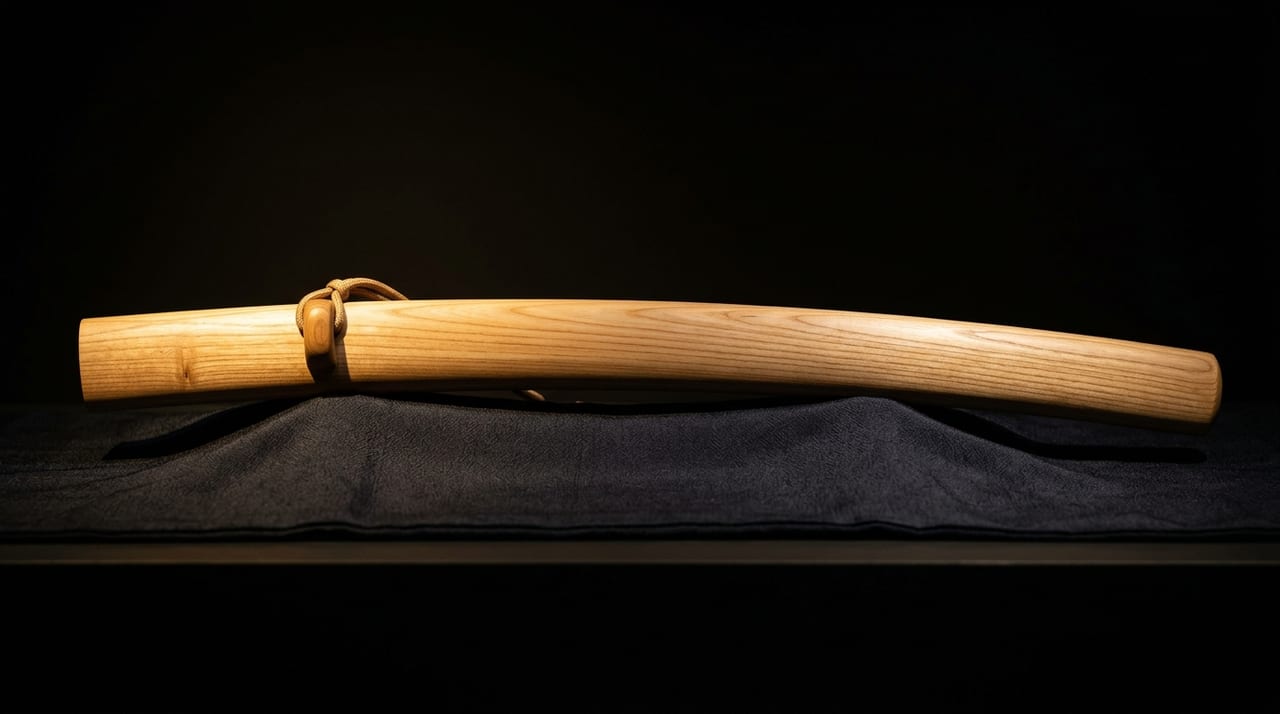 * Image is for illustrative purposes only.
Table of Contents
Why Hō Wood Is Used for Saya
The most standard wood used for nihontō saya is hō wood (hōnoki, Magnolia obovata). This choice is not coincidental; it is because the physical properties of hō wood are ideal for storing a sword.
The main properties of hō wood are as follows.
- Moderate softness and workability: It is softer than iron and easy to carve precisely with chisels and gouges. Wood that permits precise working is essential for carving a groove that faithfully reproduces the "tame" (the degree of sori) of the blade.
- Humidity regulation: It is said to have a moderate humidity-regulating function, preventing excessive drying and condensation inside the saya.
- Low oil content: Woods with high oil content can cause rust on the blade, so hō wood, which is low in oil and neutral, is preferred.
- Resistance to splitting: The grain is uniform and deformation or splitting after drying is relatively minimal.
While hō wood is soft and easy to work, its fiber is dense, making it easy to maintain strength even when shaved thin — another reason it is prized as saya material. Since a saya is a tool that envelops the blade, it cannot be made unnecessarily thick, and the wood must not split or warp even when thinly fashioned. This combination of softness and strength is precisely why hō wood has continued to be chosen over other woods.
Shirasaya and Koshirae — Different Roles Despite the Same Hō Wood
Saya are broadly divided into two types: shirasaya (plain storage scabbard) and koshirae (mounting). A shirasaya uses no lacquer or metal fittings whatsoever; it is a storage-only saya fashioned from bare hō wood, where the wood surface touches the blade directly to absorb excess moisture and prevent rust. Koshirae, on the other hand, is an outer casing finished with lacquer and metal ornaments, made for the purposes of display or wearing. Hō wood is often used as the base inside koshirae as well; the lacquer and metal fittings are purely the outer finish, and the inner wooden portion that directly contacts the blade is fundamentally hō wood, just as with shirasaya. Shirasaya is recommended for long-term storage because it keeps the wood in a state of direct contact with the blade, without the intervention of lacquer or metal fittings.
Drying the Wood — The Process to Which Craftsmen Devote the Most Time
The single most important condition for making a good saya is "sufficient drying." Using green wood or insufficiently dried wood causes the wood to shrink and deform after completion, leading to serious problems: the saya warps so that the blade no longer fits, or the blade becomes stuck inside the saya.
Traditionally, three to ten years of natural drying has been considered ideal. The method of slowly drying wood in a well-ventilated place away from direct sunlight and rain prevents sudden deformation. Today, artificial drying (low-temperature drying, high-frequency drying) is also used, but opinions among craftsmen are divided as to whether it achieves quality equivalent to natural drying.
If a saya is fashioned from insufficiently dried wood, the dimensions will continue to change over years after completion as moisture slowly escapes from inside the wood. The reason saya-shi devote long years to drying is to wait patiently until the wood reaches a state of moisture equilibrium with its surrounding environment and its dimensions have become nearly stable.
Renowned saya-shi always keep multiple pieces of wood in "stock," and "material management" — appropriately selecting and differentiating among woods of varying drying ages — is one of their important duties.
Wood Grain Direction and the Technique of Kidori
When using hō wood as saya material, the kidori judgment — which direction to carve the groove relative to the grain — greatly influences quality.
Wood has three orientations: masame, itame, and koguchi.
| Name | Description |
|---|---|
| Masame | A face cut perpendicular to the annual rings, characterized by straight, parallel grain lines |
| Itame | A face cut parallel to the annual rings, exhibiting a curved grain |
| Koguchi | A cross-section cut transversely across the annual rings |
The ideal for saya kidori is "masame-dori." A saya made from masame board deforms little from drying and is stable for long-term storage. Itame material produces attractive figure (moku) but is considered to carry a higher risk of deformation. A masame-dori saya can be identified visually by straight stripes running along the length of the saya following the annual rings; the difference from itame material, whose grain undulates, is easy to distinguish by comparison.
When deciding on kidori, what saya-shi pay the closest attention to is the "presence or absence of knots (fushi)" and "irregularities in the grain." Knots make it easier for cracks to form after drying, and grain irregularities make deformation difficult to predict. The experience of picking up a piece of wood and judging it by sight and touch is the very core of a "craftsman's discerning eye."
Joining and Adhering the Saya — Why Sokui Is Used
A saya is made not by hollowing out a single piece of wood but by joining two boards, each carved with a groove following the shape of the blade. For this joint, a paste made from kneaded rice grains called sokui has long been used. Rather than bonding the pieces together firmly like a synthetic adhesive, the purpose is to keep the saya in a state where it can be split open for internal inspection and repair should the need arise. The fact that a joining method is chosen with future maintenance in mind — given that the saya is a tool that must protect the blade over a long period — speaks to how saya-shi work does not end with simply "carving and assembling."
Characteristics of Hō Wood by Region of Origin
Hō wood is distributed across Japan from Hokkaido to Kyushu, but the quality of the wood differs by region of origin. Wood from cold regions has fine, closely spaced annual rings and high density. This is because growth is slow and thick cell walls are formed, and such wood is considered to have high durability as saya material.
Hō wood from Hokkaido and Tohoku is particularly highly regarded among saya-shi, and securing quality material is becoming increasingly difficult. In recent years, as domestic supply has declined, European hō wood (related species such as Magnolia acuminata) has been tried as a substitute, but many craftsmen are averse to the quality difference compared to Japanese-grown wood.
Material Challenges Facing Today's Saya-shi
What today's saya-shi universally point to is "difficulty obtaining quality hō wood." In the past, dedicated channels existed between forest management and lumber dealers for saya-shi, but the decline of the forestry industry and the aging and retirement of intermediaries have thinned the distribution of quality material.
Securing a sufficient drying period requires keeping long-term inventory, which brings cash flow problems as well. In the saya-shi's work, where mass production is difficult, "advance procurement and inventory management" of quality material is not only a technical challenge but a management challenge as well.
In the transmission of saya-shi craftsmanship, passing on to apprentices the material knowledge of "how to read wood, how to dry wood, and how to take kidori from wood" is considered an educational challenge as important as — or more important than — how to carve the blade channel.
Saya Condition Points That Buyers and Owners Should Check
When sheathing a sword, the tightness of the koiguchi (the mouth of the saya) is a clue to the saya's condition. If it is too loose, the blade will rattle inside the saya, which can lead to damage to the interior. Conversely, if it is too tight, excessive force is applied each time the blade is drawn or sheathed, which can damage both the saya and the blade. It is also worth checking regularly for cracks anywhere on the saya, peeling at the joints, and signs of mold or insect damage on the wood. When storing, choosing a place with minimal temperature and humidity fluctuation and avoiding direct sunlight are the basics for maintaining the condition not only of the saya but also of the blade.