Continental Sword Imports in the Asuka Period — Tang and Baekje Sword Technology Adopted by the Suiko Court
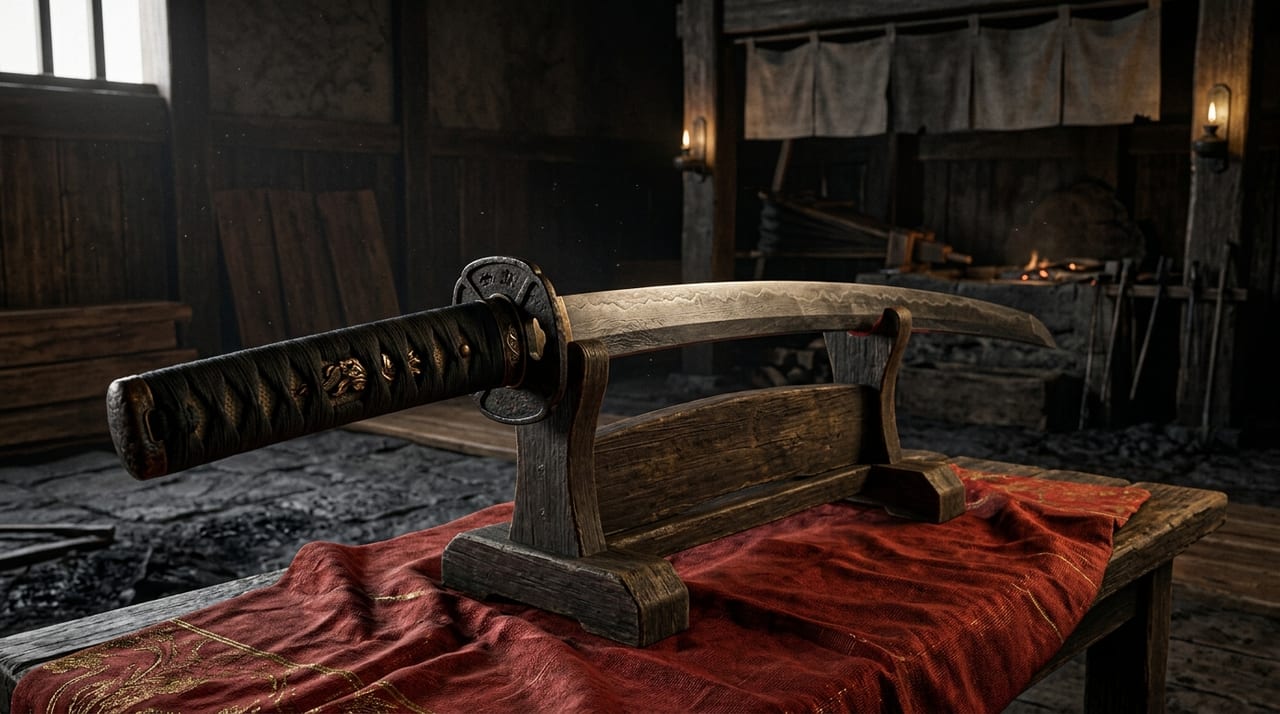 * Image is for illustrative purposes only.
Table of Contents
The Asuka Period and the Wave of Continental Culture — The "Import Period" in Sword History
When discussing the history of the Japanese sword, the narrative most often begins with the curved blade — the tachi with its sori (curvature) — that emerged in the Heian period. Yet the history of swords in Japan begins far earlier, and the Asuka period (approximately 592–710) stands out as a particularly noteworthy "period of active importation of continental technology."
Centered on the reign of Empress Suiko (r. 593–628) and Prince Shōtoku, Japan actively pursued diplomatic and cultural exchange with the Sui dynasty of China and with Baekje, Goguryeo, and Silla on the Korean Peninsula. The Tang dynasty was founded in 618, and the Chinese dynasty with which the Suiko court had direct dealings was the Sui (until 618). Full-scale diplomatic relations and technological reception from the Tang began with the first mission to Tang China in 630, unfolding from the Nara period onward. The international relations of this era were not limited to mere political contact; they constituted a vast project for transplanting advanced elements of civilization — metallurgical technology, forging techniques, Buddhist culture, and more — onto the Japanese archipelago.
This article examines the sword technologies that flowed in from the continent during the Asuka period and their influence on the later development of the Japanese sword.
Before the Asuka Period — The State of Swords in the Kofun Period
To understand the imports of the Asuka period, it is first necessary to grasp the situation that preceded it in the Kofun period (roughly the late 3rd century to the 7th century).
In Kofun-period Japan, large numbers of iron swords and iron blades have been excavated as burial goods. Well-known examples include the gold-inlaid inscribed iron sword (kokuhō, National Treasure) found at Inariyama Kofun in Saitama Prefecture, and the iron blade from Eta Funayama Kofun in Kumamoto Prefecture. All of these are chokutō — straight-bladed swords with no sori (curvature) — and bear strong influence from the "tōsu" (small utility knives) and "kantōtachi" (ring-pommel swords) widely produced on the Chinese continent and the Korean Peninsula.
Iron production in the Kofun period was largely carried out by kaji (smiths) who had come to Japan from the Korean Peninsula, and distinctly Japanese forging techniques were still in their nascent stage. It is believed that technology transfer from the continent effectively sustained Japan's iron-working industry in this era.
The Foreign Policy of the Suiko Court and the Introduction of Technology
Dispatch of Missions to the Sui and Tang Dynasties
Under the leadership of Prince Shōtoku, the Suiko court dispatched the first mission to the Sui dynasty (led by Ono no Imoko) in 607. After the fall of the Sui, this practice was succeeded by missions to the Tang (first dispatched in 630), which continued throughout the Nara period.
The purpose of these missions to the Sui and Tang was not limited to obtaining political recognition. The student scholars and scholarly monks who accompanied them returned from China having learned the following knowledge and techniques:
- The legal and administrative system (ritsuryō)
- Buddhism
- Confucianism
- Medicine
- Astronomy
- Craft techniques and metalworking technology (including Tang-dynasty sword technology)
Particularly noteworthy is Tang-dynasty sword technology. The iron goods and swords of the Tang are considered to have been at a high level within East Asia of that time in terms of steel refining and yaki-ire (quenching) techniques, and they became one of the models to which Japanese kaji (smiths) referred.
Transfer of Forging Technology from Baekje
Equally important alongside the route of the missions to the Sui and Tang was the direct transfer of technology from Baekje (Kudara) (present-day western Korean Peninsula).
From the latter half of the 6th century through the early 7th century, Baekje had a close relationship with Japan as a conduit for the transmission of Buddhist culture. It is recorded that among the craftsmen who came to Japan from Baekje accompanying the official introduction of Buddhism in 552 (or 538) were kaji (smiths).
The Nihon Shoki contains multiple entries indicating that "sutras and treatises" and "craftsmen" were sent from Baekje. Such immigrant kaji (smiths) were organized into groups called "Kanuchibe" and, under the Yamato government, took charge of producing weapons, agricultural tools, and implements.
The Content of Sword Technologies That Flowed in During the Asuka Period
Steel Refining Technology
Before the Asuka period, iron production in Japan was centered on forging sponge iron (kaimentetsu) — iron reduced from sand iron at low temperatures. This produced unstable carbon content, making it difficult to produce uniform steel.
Among the technologies transmitted from the continent were an early form of blast furnace (kōro) technology and techniques for controlling carbon content to produce steel (hagane). In Tang-dynasty China, a refining method called "hyakurenkō" had developed, establishing a technique of repeatedly forging iron to remove impurities and obtain high-quality steel.
This technology became the prototype for the iron production techniques that would later develop into Japan's distinctive tatara (traditional smelting).
The Early Form of Yaki-ire (Yakiba) Technology
One of the greatest defining features of the Japanese sword is yaki-ire (quenching) — the technique of rapidly cooling only the blade edge to harden it. The primitive form of this yaki-ire (quenching) technique is also believed to have been brought by technology transfer from the continent.
In Tang-dynasty China, a primitive form of tsuchioki (applying the clay coating) was known for sword blades — coating with clay while leaving the blade edge uncovered, then rapidly cooling to harden only the edge. This was transmitted to Japan, where it underwent independent development and became the precursor to the hamon (temper line) that the master smiths of the Kamakura period brought to perfection.
Development from Kantōtachi to Flat Knives
Looking at swords excavated from the Asuka period, large numbers of kantōtachi — ceremonial tachi with a ring-shaped fitting (kantō) on the pommel — can be confirmed. These represent Japan's adoption of a design actively produced in Baekje, Silla, Goguryeo, and elsewhere.
The kantō functioned as a symbol of power and were bestowed upon the chieftains of the Yamato government and immigrant leaders. The swords handed down at Asuka-period temples such as Hōryūji and Shitennōji also retain strong traces of this continental influence.
The Level of Swords from the Asuka to Nara Periods as Seen in the Shōsōin Treasures
The technological accumulation of the Asuka period came to fruition in the Shōsōin treasures of the Nara period. The Shōsōin houses not only swords imported from the Tang but also chokutō made in Japan, and these are precious materials demonstrating the level of Japanese metalworking technology in the Asuka–Nara era.
Many of the swords in the Shōsōin are lavish pieces with lacquer, wood, leather, and metal ornamentation on their tsuka (hilt) and saya (scabbard), and their character is more that of "ceremonial gifts" than "practical weapons." This demonstrates that the "imports" of the Asuka period were not merely the reception of weapons technology but also an influx of craft objects carrying cultural and political significance.
The Influence of Asuka-Period Technology Imports on Later Generations
A Bridge to Tatara Smelting
The iron refining technologies introduced from the continent in the Asuka and Nara periods subsequently transformed and developed into Japan's distinctive tatara (traditional smelting). The characteristic of tatara lies in the tamahagane obtained by reducing Japan's sand iron (magnetite type) at low temperatures over a long time.
Tamahagane is a heterogeneous steel mass in which regions of differing carbon content coexist, but it is precisely this heterogeneity that gave rise to the distinctively Japanese sword technique of "combining kawagane (jacket steel) and shingane (core steel)" through orikaeshi tanren (folding). The result of "evolving in a different direction while referencing" continental refining technology can be said to have produced the distinctive sword culture that is the Japanese sword.
The Settlement of Immigrant Craftsman Groups
The kaji (smiths) who came from Baekje and their descendants settled throughout Japan as "Katanabe" and "Kanuchibe," serving local chieftains and aristocrats while transmitting their skills. The existence of these craftsman groups formed the production base for swords in the Nara and Heian periods, eventually giving rise to the long chain of technology that led to the Kamakura period — the golden age of the Japanese sword.
Conclusion — The Significance of the Asuka Period as the "Sword Import Era"
The Asuka period is positioned in the history of the Japanese sword as an "era of importation and assimilation." Under the active foreign exchange policies of the Suiko court, steel refining technology, yaki-ire (quenching) techniques, and sword designs that flowed in through the Sui dynasty and Baekje as primary conduits greatly elevated the forging technology of the Japanese archipelago. Tang-dynasty technology was fully absorbed through the missions to the Tang from the Nara period onward.
What is important, moreover, is that Japan did not simply imitate these technologies but transformed and individualized them in accordance with Japan's geographical conditions (the type of sand iron, climate, and forest resources). It is no exaggeration to say that the reception of technology through the Sui and Baekje in the Asuka period, and the "capacity to learn," laid the foundation for "the uniquely Japanese sword culture" of later ages.