From Sand Iron Mining to Ironmaking: Transmission and Scientific Perspectives on Ancient and Modern Smelting Technology
 * Image is for illustrative purposes only.
Table of Contents
What Is Sand Iron? — The Starting Point of Japanese Sword Material
The most fundamental raw material in the manufacture of Japanese swords is sand iron (satetsu). Sand iron is a fine, granular iron ore consisting mainly of magnetite (Fe₃O₄) and hematite (Fe₂O₃), formed by the weathering and erosion of granite and andesite. The Japanese archipelago has a predominantly granitic bedrock, and high-quality sand-iron deposits are distributed throughout the Chūgoku region, centered on the Chūgoku Mountains (on the border of Shimane, Tottori, and Hiroshima prefectures).
The method of collecting sand iron developed as a unique technique called kanna-nagashi (furnace-flow). Large volumes of water are used to wash down mountain slopes, allowing the heavier sand iron to settle in lower areas. This work, also called yama-kuzushi (mountain collapse), involves large-scale terrain modification and has left a distinctive terrace-like topography in the mountains of the Chūgoku region. In Nita-gun Okuizumo-chō, Shimane Prefecture, and the area surrounding Shōbara-shi, Hiroshima Prefecture, there are places where the traces of this kanna-nagashi can still be read in the terrain today.
The Technology of Ancient Tatara Smelting — From Sand Iron to Tamahagane
Tatara smelting, which uses sand iron to produce iron, was established at least by the Nara period (8th century) and supported the supply of material for Japanese swords throughout the Heian and Kamakura periods.
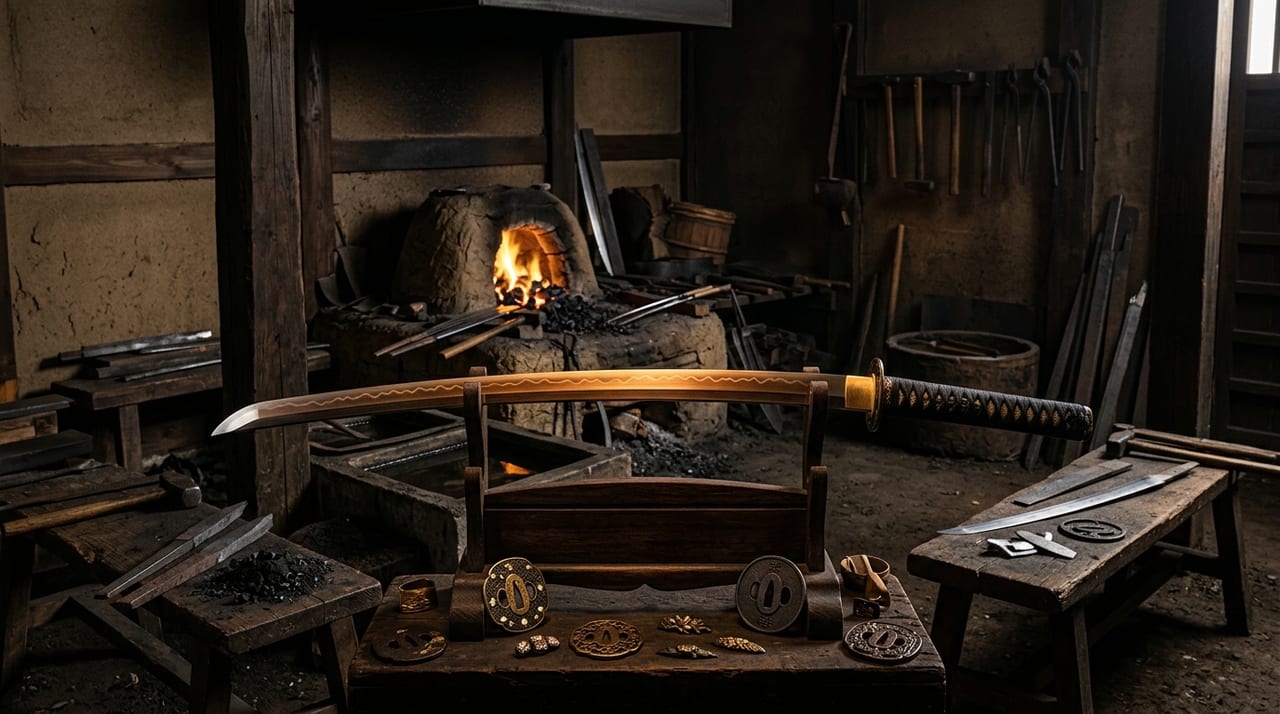
The tatara (furnace) structure consists of a clay furnace (1 to 1.5 m high, 2 to 3 m long) into which sand iron and charcoal are alternately fed, with air blown in via bellows dug underground, generating high temperatures (1,400 to 1,500°C). This process is called hitoyosagio (single-generation operation) and is normally carried out continuously for 72 to 76 hours (three days and nights).
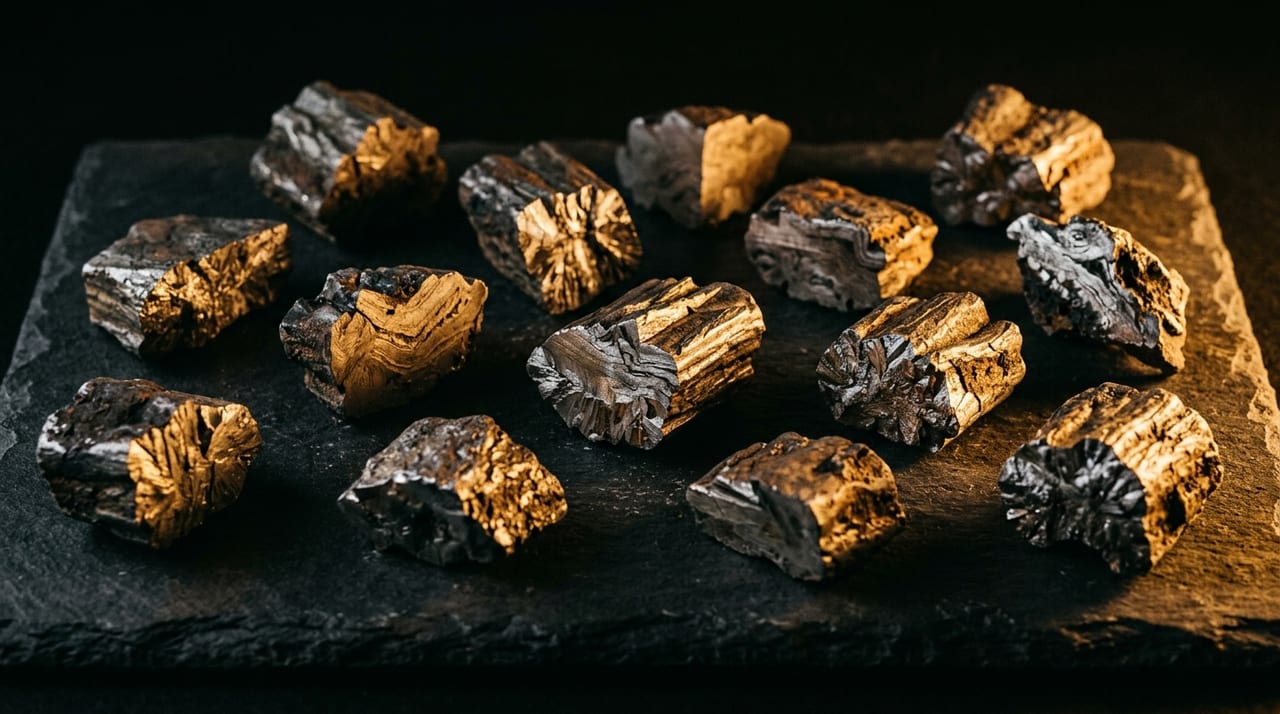
The lump of iron extracted by breaking open the furnace after smelting is called kera. Iron with varying carbon content is distributed within the kera, and the portions with a carbon content of 0.6 to 1.5% — optimal for sword manufacture — are selected and extracted as tamahagane. The selection of tamahagane relies on the eye and tactile sense of skilled craftsmen, who sort good pieces by their fracture pattern, the luster of the cross-section, and specific gravity.
The greatest factor determining the quality of tamahagane is the quality of the sand iron. Impurities in the sand iron — including titanium (TiO₂), manganese (MnO), and phosphorus (P) — greatly alter the properties of the steel after smelting. In particular, phosphorus causes cold brittleness, which makes steel brittle, so sand iron with a low phosphorus content is considered high quality. The sand iron of the Chūgoku Mountains contains less phosphorus and sulfur than that of other production areas and was therefore excellent as steel for sword-making.
The NBTHK Tatara and Modern Sand Iron Mining
The only modern production facility for tamahagane is the NBTHK tatara, operated by the public interest incorporated foundation NBTHK (Society for the Preservation of Japanese Art Swords) in Nita-gun Okuizumo-chō, Shimane Prefecture. Restored in Shōwa 52 (1977), it currently carries out hitoyosagio three times a year, centered on the winter months, producing and distributing approximately 3 tonnes of tamahagane annually.
The sand iron used by the NBTHK tatara is purchased from contracted farmers and forest landowners throughout the Chūgoku region, collected as residual kanna-nagashi sand iron or as river sand iron. In recent years, however, the procurement of this sand iron has become a serious problem.
As of 2026, the amount of sand iron collected as the raw material for tamahagane has fallen to less than one several-hundredth of its peak (Edo to Meiji period). The following compound factors are involved.
- High-quality sand-iron deposits that can be mined are becoming depleted
- The workforce for sand-iron collection is being lost due to depopulation in the farming and mountain villages that carry out such work
- Obtaining the water rights necessary for kanna-nagashi has become more difficult
Domestic procurement alone is making it increasingly difficult to maintain the operation of the NBTHK tatara, and research is advancing on whether sand iron from overseas (New Zealand, Australia, etc.) can be used. However, tamahagane made from raw materials other than Japanese sand iron may have different characteristics from conventional products, and the question of whether to protect "tamahagane as a purely Japanese sword material" or to prioritize securing supply is one of the most hotly debated topics within the industry in 2026.
A Scientific Perspective on Sand Iron Collection — The Intersection of Geology, Chemistry, and Physics
When the technologies of sand-iron collection and tamahagane production are analyzed with modern science, it becomes clear that the knowledge ancient craftsmen had acquired as practical rules of thumb was based on a high degree of scientific rationality.
For the beneficiation of sand iron (the work of removing excess sand and clay to concentrate the iron content), magnetic separation is common in modern factories, but in tatara smelting the main method was underwater gravity separation (kanna-nagashi). Magnetite (specific gravity 5.2) has approximately twice the specific gravity of quartz sand (specific gravity 2.6), allowing efficient separation by water flow. This technique is essentially the same in principle as modern fluidized-bed separation technology.
Smelting temperature was controlled by the "volume of air blown in" and the "ratio of sand iron to charcoal fed in." Too much charcoal (the carbon source) causes excess carburization, while too little results in incomplete reduction of the iron. The craftsmen's ability to judge this delicate balance from the color and brightness of the flame leaking from the furnace — called hiiro — is equivalent, from a modern thermodynamic perspective, to estimating furnace temperature and oxidation-reduction potential (Eh) in real time.
The Physical Properties of Tamahagane — Why It Is Ideal for Japanese Swords
The properties of tamahagane as viewed from modern metallurgy are markedly different from those of ordinary industrial steel. Tamahagane has a layered jigane (steel of the blade surface) structure produced by orikaeshi tanren (folding), forming an ultrafine laminated structure of steel and iron extending to 100,000 to 150,000 layers. This structure enables the combination of toughness (resistance to impact and fracture) and hardness (sustained sharpness of the blade) that is unique to Japanese swords.
Modern blast-furnace steelmaking can industrially remove impurities such as sulfur, phosphorus, and oxygen, but the "natural refining" of tamahagane is achieved through skillful control of the volatile components in the charcoal and the smelting temperature. This "low-temperature, long-duration refining" gives tamahagane a distinctive carbon distribution pattern, which, combined with the tōkō's tanren (forging) technique, produces the world's one-of-a-kind blade material.
The Future of Sand Iron Mining — The Fusion of Traditional Techniques and Scientific Approaches
In the modern tōshō (swordsmith) industry, debate continues over whether to prioritize the "scientific reproduction and improvement" of sand-iron mining and smelting technology or the "contextual preservation of tradition."
Materials engineering researchers from Tokyo Institute of Technology and Tohoku University are collaborating with the NBTHK to advance compositional analysis of tamahagane and the quantification of the smelting process. These studies aim to document traditional techniques as "reproducible procedures" and to improve sand-iron quality control scientifically.
On the other hand, there are cautious opinions among traditional tōshō about the excessive application of scientific analysis, from the position that "quantification and standardization negate the craftsman's intuition and experience." There is a view that it is precisely the "tacit knowledge" — the seasonal feel of sand-iron collection, the way of reading the condition of the furnace, the way of splitting the kera — that has upheld the quality of tamahagane.
The series of techniques from sand-iron mining to tamahagane production and through to the tanren (forging) of Japanese swords is not merely a manufacturing process but an "integrated knowledge system" optimized over several centuries by the geology, ecosystem, and craftsman culture of the archipelago. Simultaneously achieving its scientific elucidation and cultural transmission has become one of the greatest challenges facing the sword world of the 2020s.