The Techniques of the Nurishi — The World of Specialist Craftsmen Who Bring tōsōgu to Life through Lacquering, kawari-nuri, and Leather Wrapping
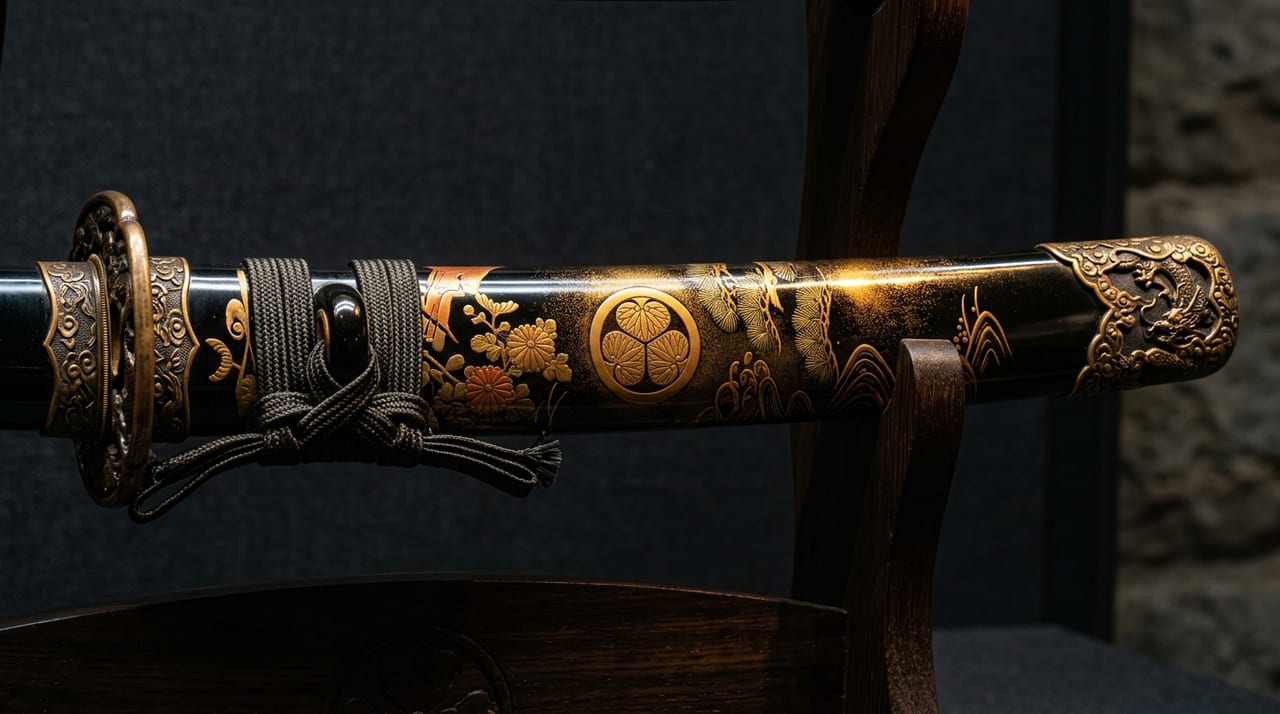 * Image is for illustrative purposes only.
Table of Contents
What Is a Nurishi?
One of the specialist craftsmen who make up a sword's koshirae is the nurishi (lacquerer). After the sayashi (scabbard maker) has carved the wooden core of the saya, the nurishi applies urushi lacquer to complete it. The finish of the saya determines the overall impression of the entire sword and was an important element that expressed the owner's social standing, tastes, and values.
The nurishi's domain extends beyond simply lacquering the saya: it can also include reinforcement lacquering of the tsuka, repair and re-lacquering of the saya, and applying urushi to peripheral items such as sword boxes and stands. Within the community of tōsōgu craftsmen, the nurishi has historically functioned as an independent specialty alongside the sayashi, tsukashi (hilt maker), kinkōshi (metalsmith), togishi, and others.
Types of Urushi and Application Techniques
The urushi used by the nurishi is primarily the sap of the urushi tree, known domestically as hon-urushi. Depending on the method of collection and refining, it is classified into categories such as suki-urushi (transparent lacquer), kuro-urushi (black lacquer), shu-urushi (vermilion lacquer), and roiro-urushi, each yielding a different hue and luster.
Application techniques are equally varied. Roiro-shiage (mirror-finish lacquering) is the highest-gloss finish: multiple layers of lacquer are built up and then brought to a mirror-like surface through charcoal polishing and burnishing. Ishime-shiage (stone-texture finish) is a matte-type finish that intentionally retains slight surface irregularities, and was widely used on the koshirae of warrior families who preferred a robust, unadorned aesthetic. Makie is a technique in which gold powder, silver powder, and colored powders are sprinkled onto a lacquer ground to create decorative patterns, and it developed as the highest-order ornament applied to koshirae.
The optimal environment for lacquer drying is approximately 20–25°C and 70–80% humidity; the nurishi manages the drying between each stage using a dedicated room called the urushi-muro. For high-quality finishes, multiple rounds of polishing are inserted even in the ground-coat alone, and it is not unusual for the total process to involve 10 to 15 or more stages. As a rule, lacquer is not applied to shirasaya intended solely for storage: lacquer impedes the wood's ability to breathe, making humidity management inside the saya difficult and leading to rust on the blade.
The Apprenticeship System and Transmission of Technique
Training as a nurishi has traditionally taken the form of becoming an apprentice under a master. Skills are acquired in stages, beginning with ground preparation (wood conditioning, rust-ground application, and hemp-cloth lamination), then progressing through mid-coats, top-coats, finish polishing, and burnishing. It was customary to apprentice under a master for five to ten years before being recognized as a fully qualified nurishi.
Today, education is also provided at urushi arts schools and craft specialist schools, but becoming an apprentice under a master is still considered the most reliable route to independence as a nurishi specializing in tōsōgu. Technical ties with the major domestic urushi-producing regions (Wajima, Aizu, Kyoto, and others) are deep, and local urushi craft culture and the lacquering techniques of tōsōgu are closely intertwined.
Historical Evolution of Tōsōgu Lacquering
The history of the nurishi's craft parallels the history of the Japanese sword. From the Heian period, examples of tachi koshirae survive in which the entire saya was lacquered to produce imposing works, as typified by the kuro-urushi no tachi and the ito-maki no tachi. During the Kamakura and Muromachi periods, practical battlefield koshirae were the norm, and durable, unpretentious lacquering was preferred.
As the Edo period ushered in an extended era of peace, the artistic value of koshirae rose, and lavish saya decorated with makie and taka-makie were commissioned by daimyo families. Presentation koshirae housed in the sword cabinets of daimyo families have been handed down to the present day as works of applied art that concentrate the skills of the nurishi and the makie-shi.
Modern Nurishi — Crisis of Survival and Efforts at Continuity
The number of nurishi who specialize in tōsōgu has become extremely small in the modern era. The contraction in demand for swords combined with the aging of craftsmen has meant that an increasing number of nurishi are closing their workshops without being able to secure successors. The Agency for Cultural Affairs and various traditional craft preservation bodies are working to provide successor-training subsidies and establish training programs, but support specifically targeting the nurishi as a profession is currently insufficient.
At the same time, as interest in tōsōgu grows, cases have begun to emerge of young urushi artists expanding their activities into saya lacquering for swords. A movement — slow but gradually spreading — is reappraising the nurishi's work as a "comprehensive creative undertaking" in which a single sword's entire process is handled in collaboration with a tōshō who produces gendaitō.
Types and Characteristics of Kawari-nuri
Kawari-nuri is the collective term for saya lacquering that uses special designs and techniques distinct from the standard single-color kuro-urushi finish. The major types are summarized below.
- Roiro-nuri: Considered the pinnacle of urushi finishing, it is a mirror finish. After the top coat is applied, the surface is polished with suruga-zumi (Suruga charcoal), then burnished further with tsuno-ko (deer antler powder) and other abrasives together with ki-urushi (raw lacquer), drawing out the inherent deep luster of the lacquer. Because it passes through dozens of stages, it is the finish that most demands both the nurishi's skill and time. It is also written "roiro," referring to the same technique.
- Ishime-nuri: A matte-type finish that intentionally retains fine surface irregularities. Because it also provides a non-slip effect, it was widely used on practical warrior koshirae and is a texture-focused finish also seen on the saya of Higo koshirae.
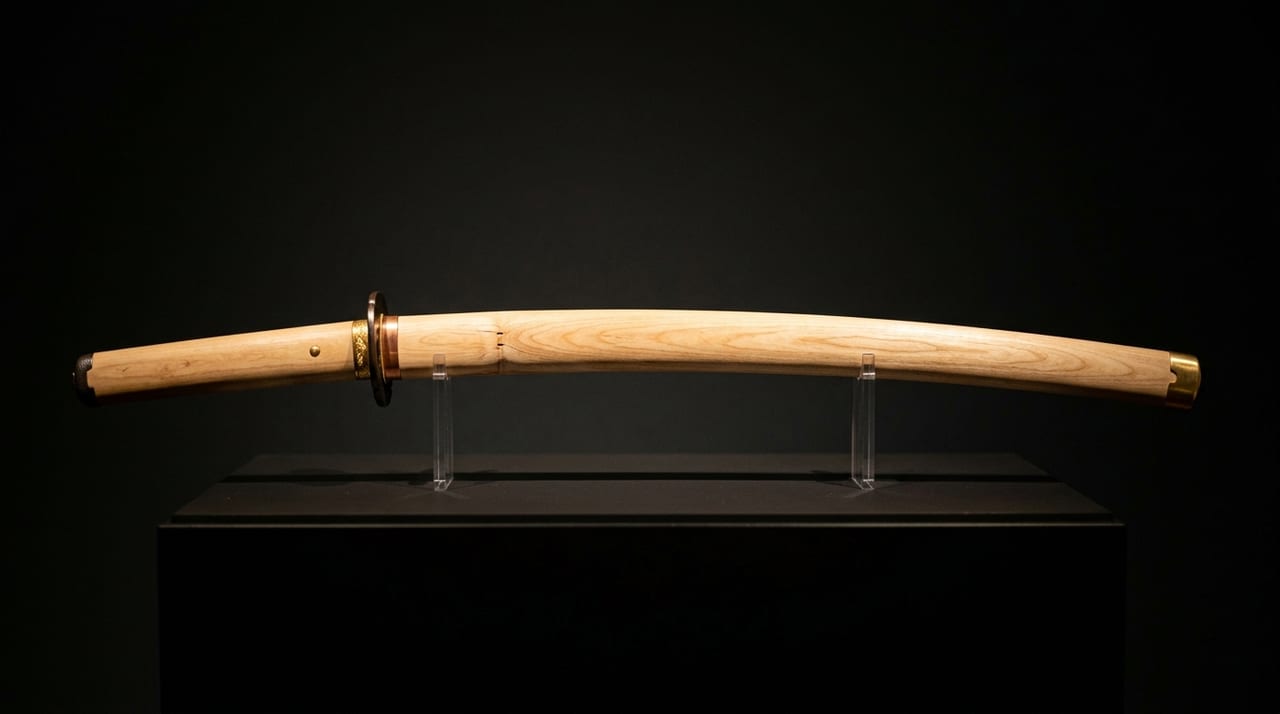
- Kawamaki-saya: A format in which samegawa (ray skin) or deer leather is wrapped around the wooden core rather than lacquered, characterized by a plain, robust quality different from urushi lacquering. When applying samegawa, the skin is softened in water before being pressed tightly against the core, where it adheres through the contraction of drying. Handling the seam lines and smoothing the surface require a high degree of skill. In the Satsuma domain, Satsuma koshirae favored deer-leather-wrapped saya, whose pale tan color produced an austere beauty distinct from black lacquer.
- Aogai-nuri: A type of raden technique. Shell — abalone, yakōgai (turban shell), chōgai (pearl oyster), and others — is ground to a thinness of approximately 0.1 mm and inlaid into the lacquer ground; because the shell is so thin, the black lacquer beneath shows through, producing a distinctive iridescent, bluish luster. The transmission of raden to Japan dates back to the Nara period, to the era of kentōshi exchange with Tang China, and the technique can also be seen in the Shōsōin treasures. In its application to sword saya, it was particularly widely used on ceremonial koshirae of daimyo families and on kaiken koshirae made for women.
Nurishi and Shiroganeshi — The Division of Labor in Sword Mounting
The nurishi's work is sustained within a system of division of labor with the sayashi, tsukashi, and kinkōshi. The craftsman most often mentioned alongside the nurishi within that division is the shiroganeshi. The shiroganeshi specializes in making the metal fitting called the habaki — the piece inserted at the junction of the blade and tsuka — working silver, shakudō, gold, and other metals into a shape that fits snugly against the blade. The habaki fixes the blade so it does not shift when the sword is housed in its saya and cushions the shock of drawing. As specialization advanced from the Muromachi period onward, the shiroganeshi emerged as an independent specialist in habaki production and, together with the nurishi and sayashi, underpinned the foundations of koshirae making.
Historical Examples of Lacquered Saya
The kuro-urushi no tachi is a representative koshirae of Heian-period warrior dress, in which the entire saya was finished in black lacquer, a dignified format. The Kamakura-period ito-maki no tachi has a format in which the upper portion of the saya is wrapped with braided cord, and is completed through the combination of the nurishi's urushi lacquering and the skill of the kumihimoshi (braider). In the makie koshirae produced by Edo-period daimyo families for wedding and ceremonial purposes, a collaboration took place in which the makie-shi scattered gold powder over the nurishi's top coat to complete the decorative design.