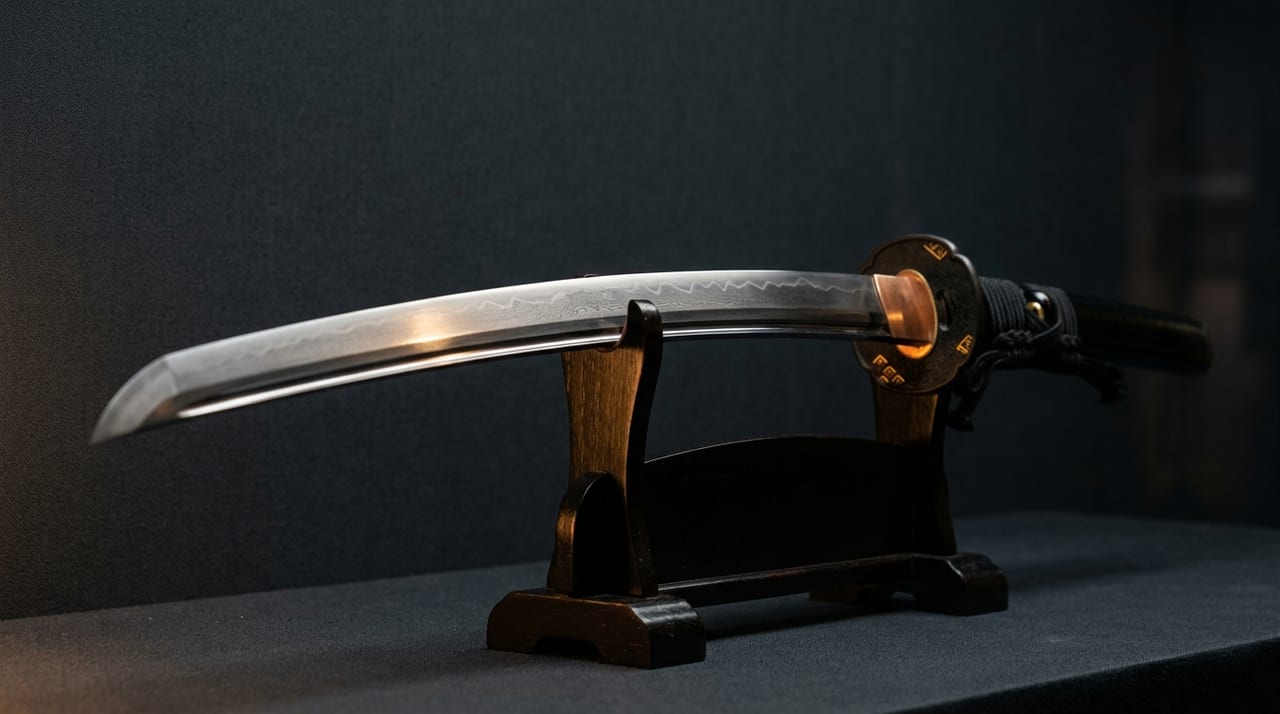
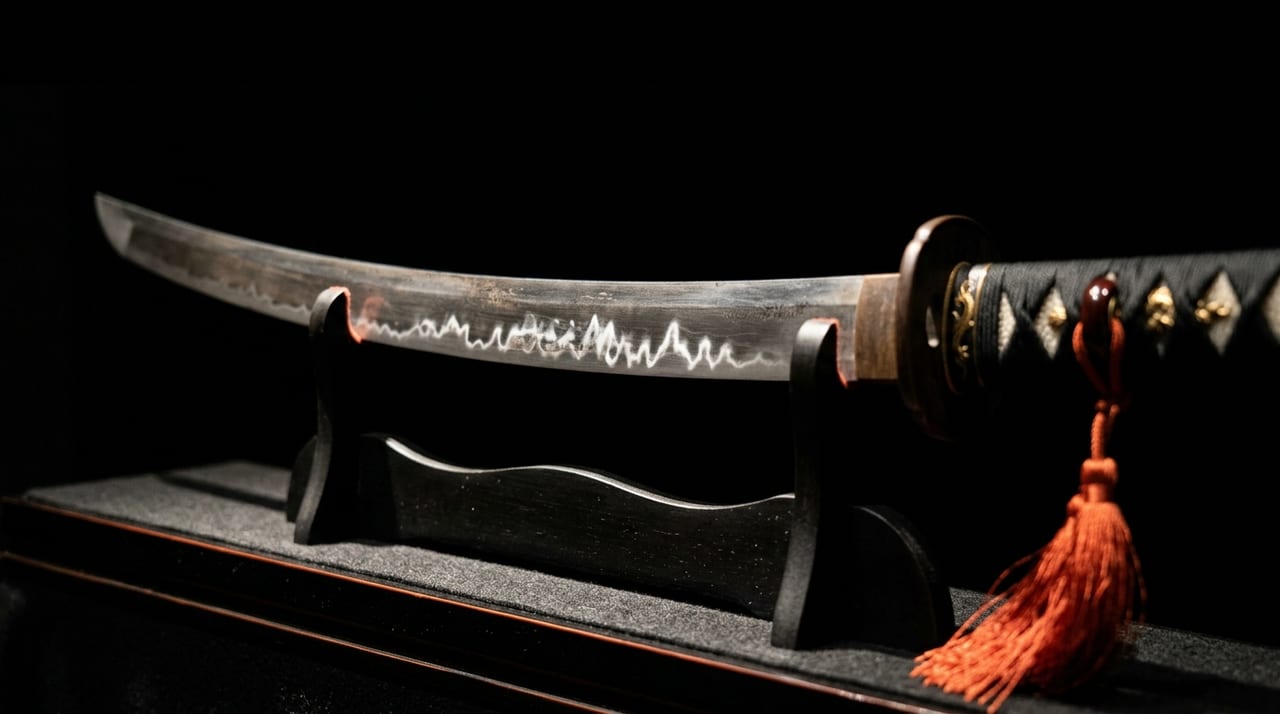
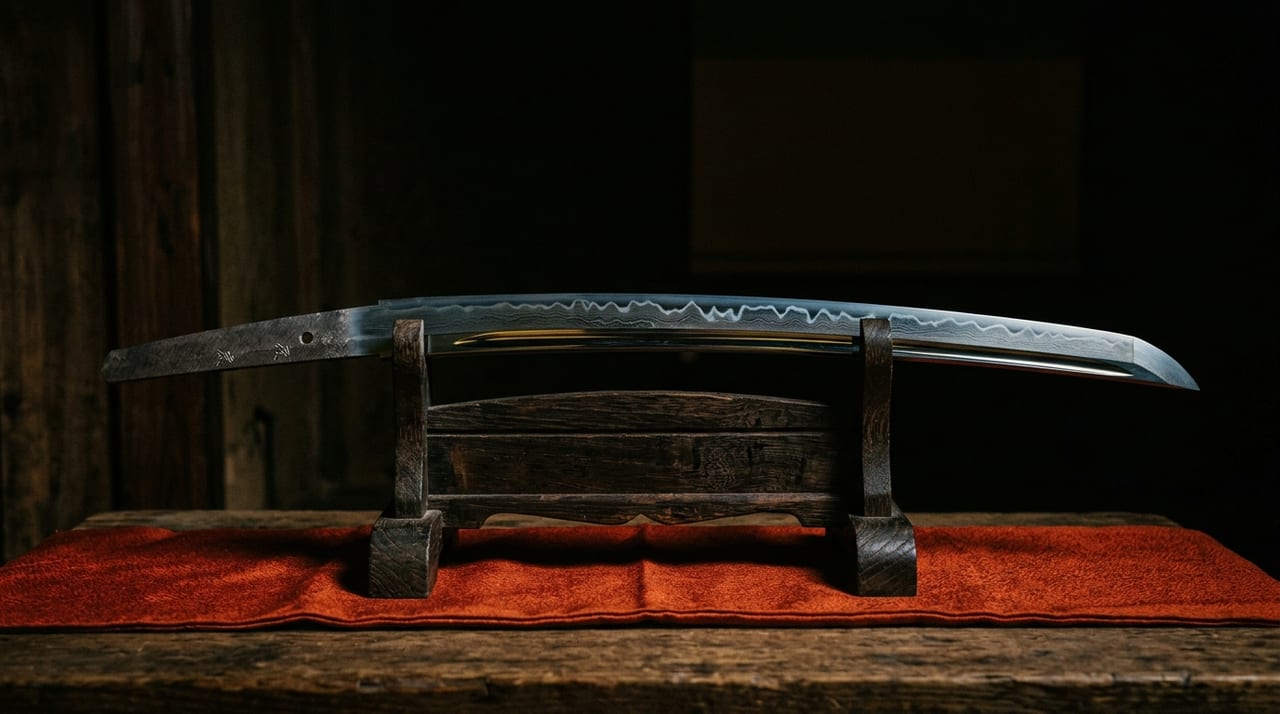
The Technique of Muneyaki — Purpose, Method, and Application to Famous Swords of the Special Yaki-ire Applied to the Mine (Mune)
 * Image is for illustrative purposes only.
Table of Contents
What Is Muneyaki — Definition and Basic Principles
The "mune" of a Japanese sword refers to the back of the blade, the side opposite the cutting edge. In standard yaki-ire, the hamon forms concentrated on the ha side (the face toward the cutting edge), and the mune side is kept in a state close to soft iron. This is the fundamental design principle of the Japanese sword: "the ha is hard, the mune is tough." By combining these two different properties — a hard ha and a resilient mune — within a single blade, both cutting ability and resistance to breakage are achieved.
However, in some swords, a technique called "muneyaki" is found, in which yaki-ire is intentionally applied to the mune as well. Muneyaki is a technique in which a small amount of yakiba-tsuchi (clay used for the hamon) is also applied to the mune side during tsuchioki (applying the clay coating before yaki-ire), causing a hardened hamon-like visual effect to appear on the mune during yaki-ire.
The yaki-ire portion that appears on the mune is likewise called "muneyaki," and like the hamon, it features nie and nioi, making it a point of appreciation.
Why Apply Yaki-ire to the Mune — Three Purposes
There are three main reasons why muneyaki is applied.
1. Adding Aesthetic Value
When a visual effect (keshiki) appears on the mune side, an additional perspective is added to sword appreciation. Because nie and ko-nie sparkle appear not only in the hamon but also on the mune, the overall appearance of the sword changes depending on the angle at which light is cast. Among swords from the kotō period (Kamakura to Sengoku), there are famous swords that actively utilized muneyaki as a decorative element and are still extant.
2. Accommodation for Combat Use (Various Theories)
When muneyaki is applied, the mune hardens as well, and there is an interpretation that this increases durability against muneuchi (a striking technique using the mune). Techniques using the mune side are documented in pre-early-modern kumiuchi (grappling combat) and uchigatana-jutsu, and the possibility that muneyaki responded to such practical combat demands has been noted. However, this interpretation is contested among researchers, and the view that the technique emerged from aesthetic considerations rather than practical ones remains strong. This should be understood as an issue for which no definitive conclusion has been reached.
3. Religious and Ritual Significance
The Japanese sword was not only a weapon but also an object invested with spiritual meaning. It has been suggested that in certain regions a folk belief existed that applying yaki-ire to the mune would imbue the sword with a special power, and that muneyaki may have been chosen in the making of swords dedicated to shrines or used in Shinto rites. However, documentary evidence is limited, and this is presented here as merely one interpretation.
The Method of Muneyaki — The Ingenuity of Tsuchioki
To achieve muneyaki, special measures are required at the tsuchioki stage (the arrangement of clay applied to the blade before yaki-ire).
The thickness of clay applied to each area and the resulting state after yaki-ire differ between standard tsuchioki and muneyaki tsuchioki as follows.
| Area | Clay Thickness | Cooling during yaki-ire | Condition after yaki-ire |
|---|---|---|---|
| Ha side (roughly a few mm to over ten mm from the cutting edge; standard) | Thin clay | Rapid cooling | Hardens to form the hamon |
| All other areas (including the mune side; standard) | Thick clay | Gradual cooling | Does not harden |
| Mune side (when muneyaki is applied) | Thin clay is applied (or clay is removed) | Rapid cooling | Hardens, and the mune also takes on a hamon-like appearance |
Because the cooling response varies with the lot and carbon content of the tamahagane, many tōshō confirm the reaction of the mune side through a prior tameshiyaki (test quench) before proceeding with the actual work.
The technical challenge is "bidirectional rapid cooling control." When yaki-ire is applied to both the ha side and the mune side, heat escapes from both sides of the blade at different rates, making it extremely difficult to control the distortion of the sori. This is one of the reasons muneyaki never became a general technique. Even for experienced tōshō, considerable experience is required to finish the sori of the blade as intended when applying muneyaki.
Famous Swords and Schools Where Muneyaki Is Found
Muneyaki tends to have been favored by certain schools and production areas.
Sōshū-den and Muneyaki
Among works by Masamune, the representative tōkō of Sōshū-den, and those of his lineage of disciples, there are pieces that display nie effects resembling muneyaki. Cases where the ōnie (large nie) and nie-kuzure (crumbling nie) characteristic of Sōshū-den extend toward the mune are technically considered distinct from intentional muneyaki, but it is thought that successor works exist that developed the beauty of such natural nie-kuzure into a decorative direction.
Bizen-den and Muneyaki
Kotō from Bizen (present-day Okayama Prefecture) with muneyaki also survive. In particular, some tachi from the late Kamakura period through the Nanbokuchō period retain nie effects close to muneyaki.
Inheritance into Gendaitō
Among contemporary tōkō there are those who undertake muneyaki. However, in the present day muneyaki falls within the category of "special order" and is not part of the general sword-making routine. When a client requests muneyaki, it is customary for sufficient prior consultation with the tōshō to take place.
How to Appreciate Muneyaki — What to Look For
To appreciate muneyaki, tilt the blade using a light source (incandescent bulb or sunlight) and illuminate the mune side in the same manner as when appreciating the hamon.
On a sword where muneyaki has been finely applied, the nie on the mune shines uniformly and brightly, spreading a visual scene that evokes a dialogue with the hamon. By contrast, failed muneyaki produces rough nie or flaws resembling blade cracks. The quality of muneyaki is often cited in appreciation contexts as one indicator of a tōshō's level of mastery.
Conclusion — What Muneyaki Asks of Us
Muneyaki is a technique that deliberately departs from the design philosophy of the Japanese sword — "the ha is hard, the mune is tough." The tōkō who chose it imbued the sword with beauty and spirituality, not merely function. To this day, muneyaki is treated with respect as a special and advanced technique. By turning one's attention not only to the hamon but also to the mune, the wealth of information that a single sword conveys expands greatly.