Comparing Mune Types: Era-by-Era Usage Trends of Iori-mune, Maru-mune, Kaku-mune, and Mitsu-mune
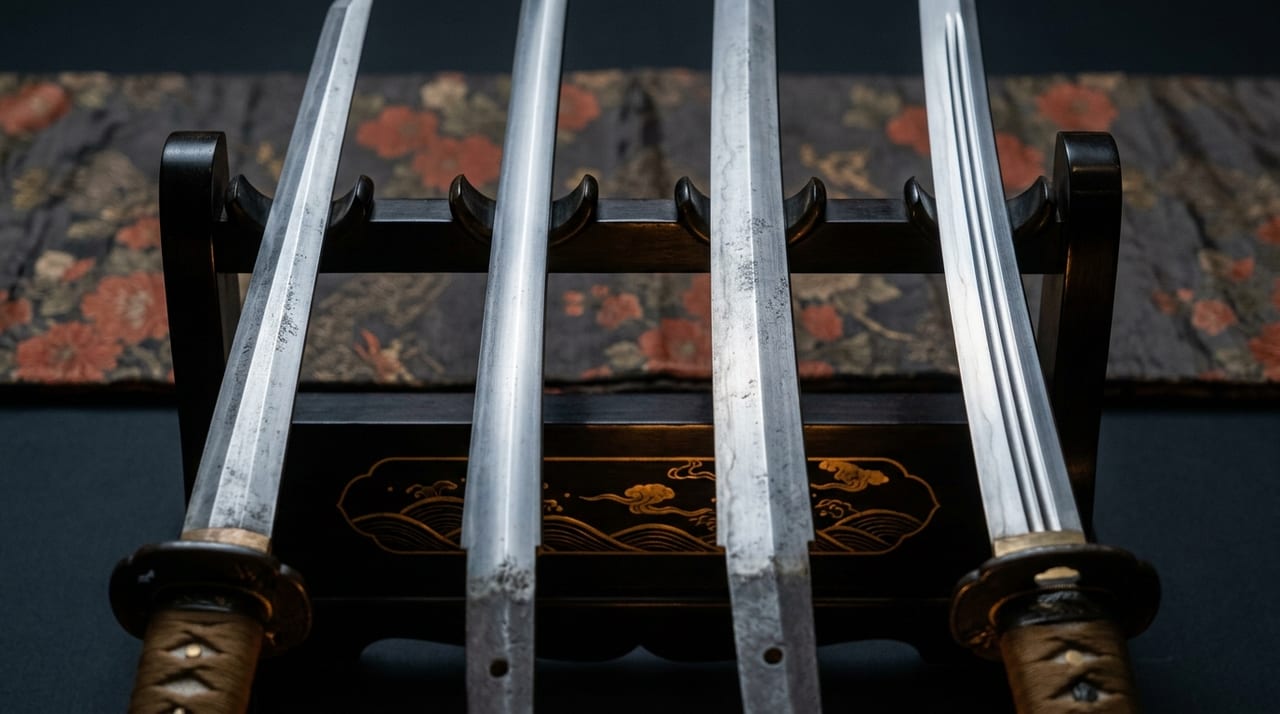 * Image is for illustrative purposes only.
Table of Contents
What Is the Mune? — An Overlooked but Important Feature
When appreciating Japanese swords, attention tends to fall on the hamon and jigane, but the mune — the shape of the rear surface of the blade, opposite the edge — is also an important appraisal point. The cross-sectional shape of the mune differs by era, region, and school of tōkō, and a trained eye can determine the general era and school from the mune shape alone.
This article explains the main mune forms and provides a detailed account of the era-by-era usage trends and technical background of each.
Overview of Basic Mune Forms
The mune forms of Japanese swords are broadly classified into five types:
| Form | Reading | Characteristics of cross-section |
|---|---|---|
| Iori-mune | iori-mune | Triangular cross-section resembling a roof (iori) |
| Maru-mune | maru-mune | Semi-circular cross-section with a rounded apex |
| Kaku-mune | kaku-mune | Flat, rectangular cross-section |
| Mitsu-mune | mitsu-mune | Compound cross-section: iori-mune with small stepped facets added |
| Katakiriha-mune | katakiriha-mune | Asymmetric cross-section with a edge on one side only |
Iori-mune — The Most Common Form
Characteristics of Cross-Section
The iori-mune has a "rooftop (iori-shaped)" cross-section in which the apex of the mune comes to a gentle point, with both flanks sloping evenly downward. Viewed in cross-section, the shape is close to an inverted triangle, with the mune apex slightly pointed.
The name "iori" derives from the resemblance to the gabled roof (kiritsuma-yane) of traditional Japanese wooden architecture.
Era-by-Era Usage Trends
The iori-mune is the most versatile mune form throughout the history of Japanese swords, and its distribution is as follows:
- Heian-Kamakura period: Widely adopted for both tachi and tantō. Many famous swords of this era have iori-mune.
- Muromachi–Edo period: Established as the standard form for uchigatana.
- Gendaitō: Widely adopted by tōkō who carry on the traditional style.
Relationship to Bizen-den: Tōkō of the Bizen Osafune line show a strong preference for iori-mune, and confirming the iori-mune is one of the basic checklist items in the appraisal of Osafune-school swords.
Technical Background
The formation of the iori-mune shape is closely related to the orikaeshi tanren (folding) of the steel during the forging process. Shaping the mune into a triangle while maintaining uniform blade thickness achieves a balance between overall rigidity and light weight.
Maru-mune — A Form with a Gentle Impression
Characteristics of Cross-Section
The maru-mune has a semi-elliptical cross-section with a rounded apex. Unlike the iori-mune, it has no point, describing a gentle curve. The longitudinal profile of the blade (viewed from the side) gives a soft impression.
Era-by-Era Usage Trends
- Heian-Kamakura period: Widely used as the mune for tachi. Tachi of Yamashiro-den (Rai School, Awataguchiha) in particular often have maru-mune.
- Tantō: Maru-mune is also frequently seen on tantō from the Kamakura–Nanbokuchō period.
- Characteristic of the Rai School: Swords by Rai School tōkō such as Rai Kuniyuki and Rai Kunitoshi often have maru-mune, and confirming the maru-mune is an important checkpoint in Rai School appraisal.
Relationship to hamon: Maru-mune is frequently paired with the suguha-type hamon of Yamashiro-den, creating an overall calm and pure atmosphere.
Kaku-mune — A Form with a Powerful Impression
Characteristics of Cross-Section
The kaku-mune (also called hira-mune) has a flat apex and a cross-section close to a rectangle. Because the mune face is wide and flat, the blade as a whole gives a "heavy" and "imposing" impression.
Era-by-Era Usage Trends
- Nanbokuchō period: Widely used on ōdachi and tachi. The bold, large swords of this era often have kaku-mune.
- Relationship to Sōshū-den: Swords of Sōshū-den such as those by Masamune of Okazaki and Sadamune often have kaku-mune. Combined with the strong nie and active jigane of Sōshū-den, it emphasizes a powerful impression.
- Bakumatsu and Shinshintō period: Cases of tōkō aiming to revive Sōshū-den adopting kaku-mune increased.
Significance in appraisal: When examining a sword with kaku-mune, it may call to mind Sōshū-den or the Nanbokuchō period. However, it cannot stand as evidence on its own; a comprehensive judgment together with the jigane and hamon is necessary.
Mitsu-mune — A Special Form with a Compound Cross-Section
Characteristics of Cross-Section
The mitsu-mune is a compound cross-sectional form in which small stepped facets ("ko-iori") are added to both flanks of the iori-mune. Viewed in cross-section, small flat planes are added on either side of the main iori-shaped section, producing a total of three ridgelines. The name "mitsu-mune" derives from these three ridgelines.
Era-by-Era Usage Trends
From the Heian period onward, the mitsu-mune became a mainstream mune form alongside the iori-mune and is widely seen on swords and tantō of Yamashiro-den and Sōshū-den:
- Characteristic of Yamashiro-den and Sōshū-den: Mitsu-mune is frequently seen on swords and tantō of Yamashiro-den (Awataguchiha, Rai School, etc.) and Sōshū-den, making it an important checkpoint when appraising these schools.
- Kotō period (pre-Muromachi): Less common in the shintō and shinshintō periods; more prevalent in the kotō period.
- Both tachi and tantō: Found in Yamashiro and Sōshū lineages regardless of sword type.
Relationship to manufacturing technique: Forming the mitsu-mune is more complex than forming the iori-mune, requiring additional shaping work to produce small shinogi on both sides of the mune.
Katakiriha-mune — A Form Unique to Single-Edged Blades
Characteristics of Cross-Section
The katakiriha-mune is a special mune form found on swords made in the "katakiriha-zukuri" style — unlike an ordinary sword, the edge is applied to only one face (the omote face) of the blade. The cross-section is asymmetric, with one side (the ura face) being thick and flat.
Usage Contexts
- Naginata: Most naginata have a katakiriha construction.
- Special tantō: Seen on some thrusting-type tantō and self-defense blades.
- Relationship to modern kitchen knives: It can be said that Japanese kitchen knives (especially single-bevel knives) represent the application of the katakiriha-zukuri technique to culinary tools.
Correspondence Table of Mune Forms, Schools, and Eras
For reference in appraisal, the typical correspondences between mune forms, schools, and eras:
| Mune form | Main school | Main era | Hamon tendency |
|---|---|---|---|
| Iori-mune | Bizen / general | All eras | Chōji-midare, gunome |
| Maru-mune | Yamashiro (Rai School, etc.) | Heian–Kamakura | Suguha type |
| Kaku-mune | Sōshū | Nanbokuchō onward | Ō-midare, hitatsura |
| Mitsu-mune | Yamashiro, Sōshū | Kotō period | Suguha type |
In addition to the mune, the shapes of the hamachi and munemachi also provide clues for period identification (their interpretation is explained in this article).
Conclusion — The Mune Speaks
The shape of the mune is a small detail on the "rear face" of the blade, yet in it are concentrated the school, era, and lineage of the tōkō. Collectors whose eye is drawn first to the beauty of the hamon are encouraged to turn their attention to the mune as well.
"Iori, maru, kaku, or mitsu?" — confirming this single point dramatically deepens the appreciation of a sword. The skill of reading the mune becomes a sure foundation for the appraisal of Japanese swords.