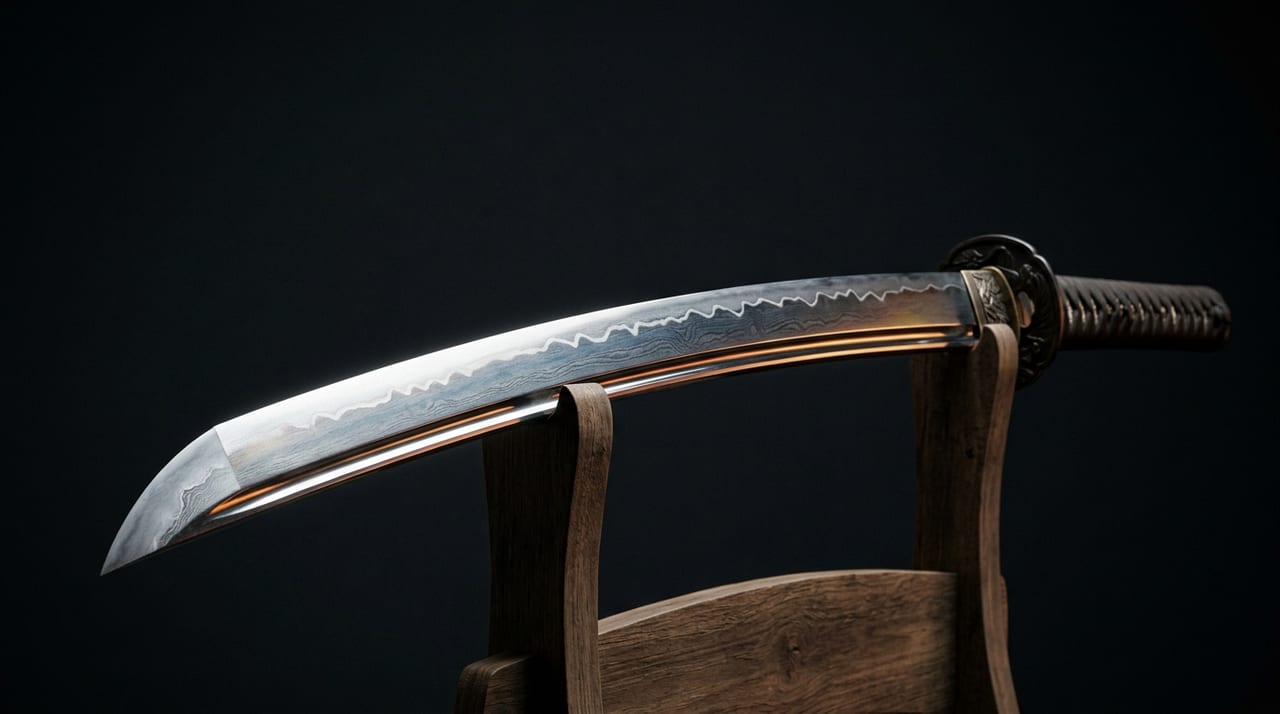
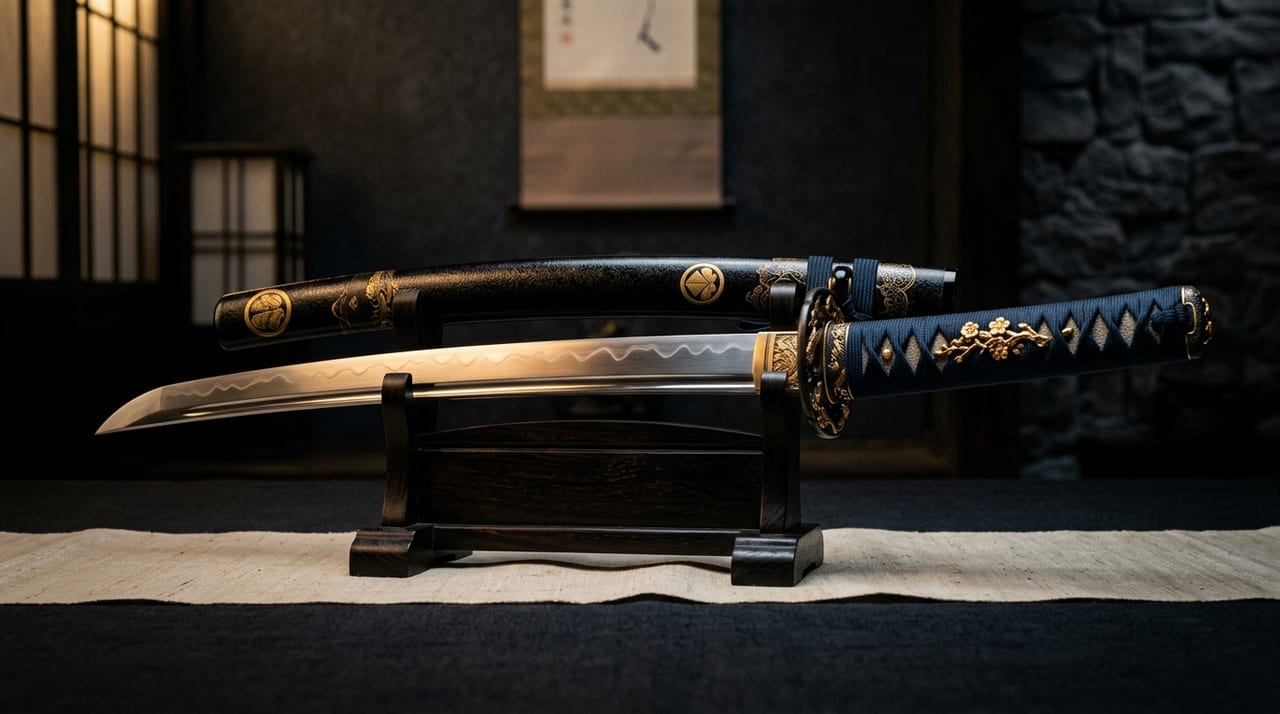
Nagasa and Forging Temperature: The Craftsman's Fire-Control Technique for Uniform Heat Treatment of Long Swords
 * Image is for illustrative purposes only.
Table of Contents
Japanese sword production involves multiple heating and cooling processes. Among these, the relationship between nagasa and forging temperature is one of the most important areas of craftsmanship that determines the quality of a sword. The longer the sword, the more difficult the management of heating and cooling becomes, putting the tōkō's experience and intuition to the test.
What Is Forging: The Basic Process of Making a Sword
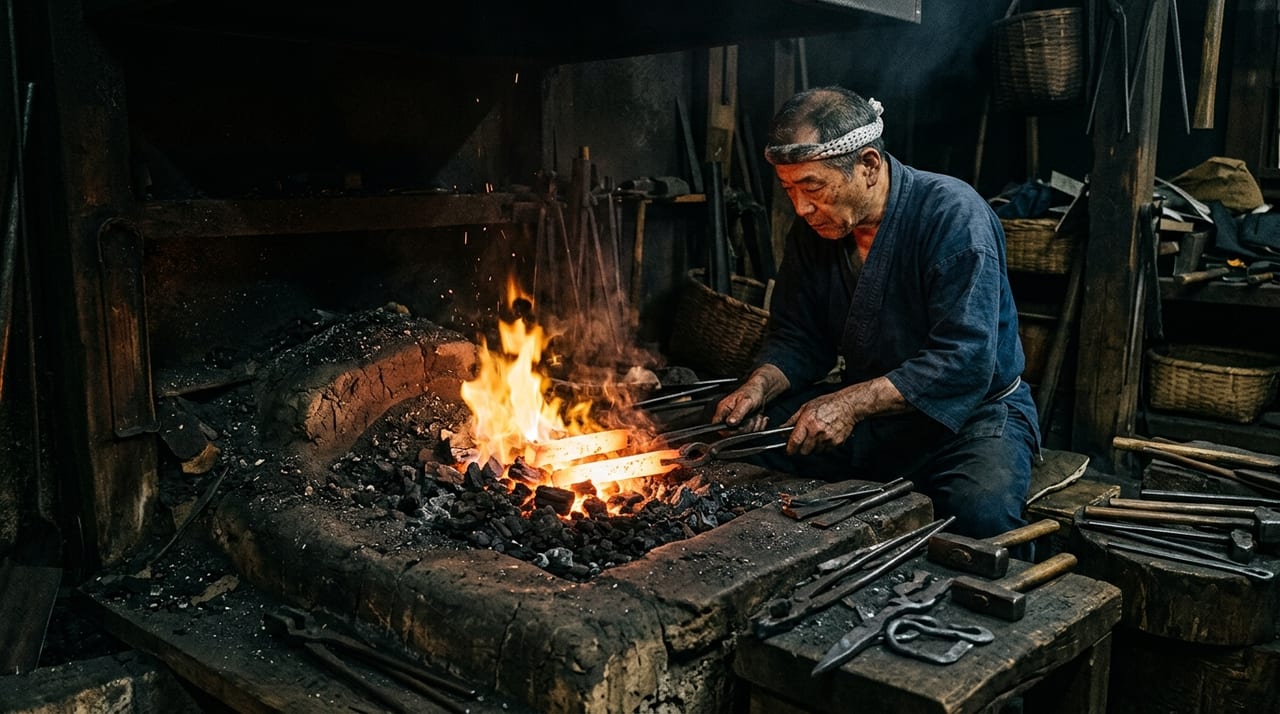
The tōkō shapes a sword through "forging," in which steel (tamahagane) is repeatedly heated, folded, and hammered out. Through this repeated process, impurities are expelled from the steel, the crystal structure is refined, and an ideal sword is produced.
Basic forging procedure:
- Heat tamahagane in the furnace (red-hot state, approximately 1,000°C)
- Hammer out on an anvil
- After cooling, fold and stack
- Heat again and hammer out
- Repeat this process several times
At each stage of forging, the management of heating temperature — known as hikagen — is of paramount importance.
Differences in Heating Difficulty by Nagasa
The difficulty of the heating and cooling process during forging differs entirely between tantō and long swords.
Advantages of the tantō: The entire blade is relatively easy to heat evenly, with minimal temperature gradients. As a result, even novice tōkō can forge with relative stability.
Challenges of the long sword: Heating the entire sword uniformly is extremely difficult. Even within the same furnace, the heat received differs between the base and the tip. Because the base is thick, it takes time to heat all the way through. The tip, on the other hand, is thin and at risk of being overheated. Forging must proceed while minimizing this temperature differential.
The Craftsman's Art of Hikagen: Temperature Control and Color Judgment
Temperature measurement in the forging furnace still relies primarily on the craftsman's experiential judgment even today. Pyrometers have coarse scales and are of little use for subtle temperature adjustments.
Temperature judgment by color:
- Pale purple (approximately 900°C): Relatively low temperature. A temperature at which ductility remains.
- Reddish-brown (approximately 1,000°C): Standard forging temperature. Steel flows well.
- Yellow (approximately 1,100°C): High temperature. Risk that the steel will burn and become brittle if overheated.
The tōkō instantly judges the color of the sword as it is removed from the furnace, making determinations such as "still not heated enough," "just right," or "should be cooled a little more before striking." This judgment can only be cultivated through experience.
Countermeasures Against Temperature Gradients in Long Sword Forging
When forging a long sword, the tōkō employs several techniques to maintain temperature uniformity.
Multi-stage heating method: The base and tip are heated separately. The base is inserted into the furnace first and heated sufficiently before the tip is additionally inserted. This reduces the overall temperature differential.
Hammering sequence technique: Because the base cools more easily, hammering proceeds from the base toward the tip. By prioritizing the cooler sections, work proceeds while maintaining the overall heated state.
Multiple heatings: Because a single heating is insufficient, the sword is returned to the furnace many times. Each time, the color is checked to read the temperature, and the sword is removed at the optimal moment.
All of these are based on the tōkō's many years of experience and the "intuition" of that moment.
Effects of Heating Errors and the Limits of Correction
If temperature management during forging goes wrong, restoration is extremely difficult.
Occurrence of burning: If the temperature is too high, the steel burns and becomes brittle. A section that has once burned cannot be fully restored by subsequent togi or heat treatment.
Fracturing and bending: If heating is insufficient, the steel lacks ductility and may fracture midway through striking.
Distortion: If the temperature gradient is too large, distortion develops during heating and the overall sori is thrown out of alignment.
To avoid such failures, even skilled tōkō take more time forging long swords than tantō, repeating multiple cycles of heating and cooling.
Tōkō Training and the Acquisition of Hikagen
The ability to judge hikagen is one of the skills that takes the longest to acquire in the course of a tōkō's training.
Initial stage: The basics are learned through forging tantō. Color judgment and the feel of striking are instilled in the body.
Middle stage: Progress is made to somewhat longer swords. Temperature gradients begin to appear, and the importance of localized judgment is learned.
Advanced stage: Long swords such as tachi and ōdachi are attempted. Complex judgment and adjustments become necessary, including multiple heatings, the multi-stage heating method, and optimization of the hammering sequence.
To become a first-rate tōkō, acquisition of this "ability to read hikagen" is indispensable, and it is said to require decades of experience.
The Challenge of Transmission to the Present Day
In the present day, some tōkō continue to uphold the ancient forging techniques, but there is a tendency for the development of young successors to fall behind, owing to the difficulty of temperature management. At the same time, the introduction of more efficient heating methods (such as electric furnaces) is advancing, but how this will change traditional techniques is a challenge for the future.
The relationship between nagasa and forging temperature is an important technique that reveals the essence of sword production, and stands as a symbol of the value of a craftsman's experience and intuition.