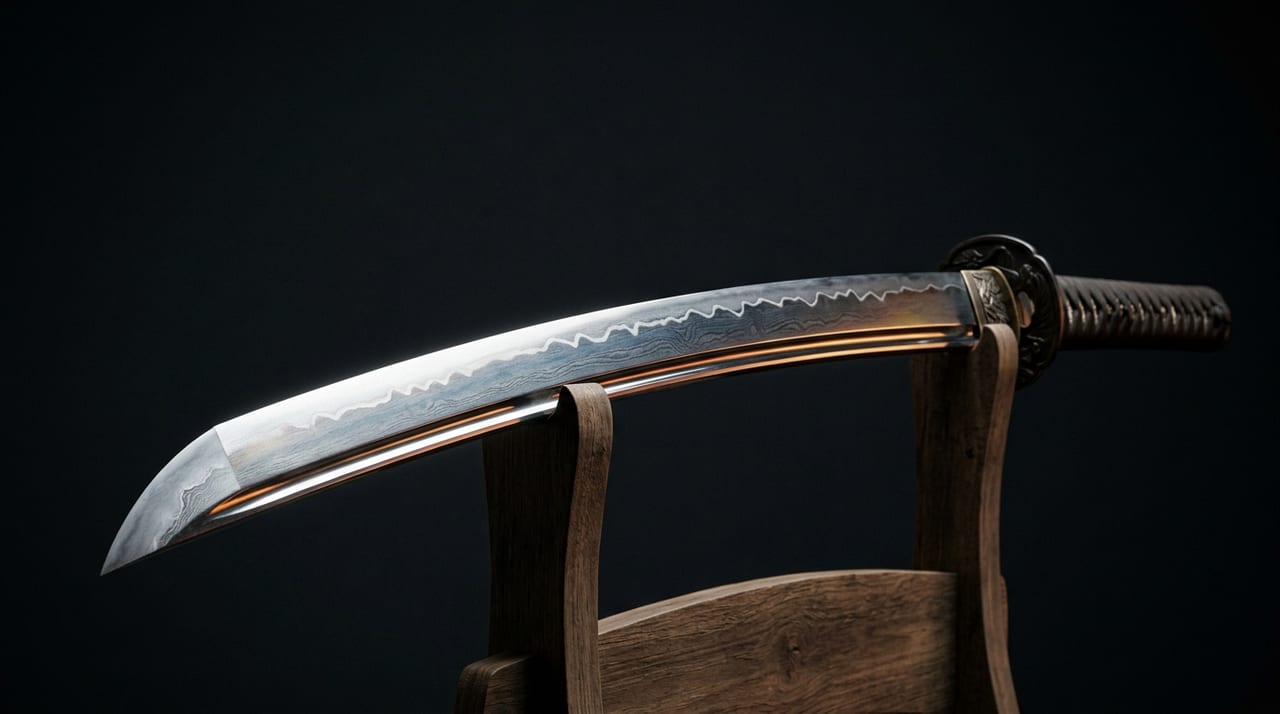
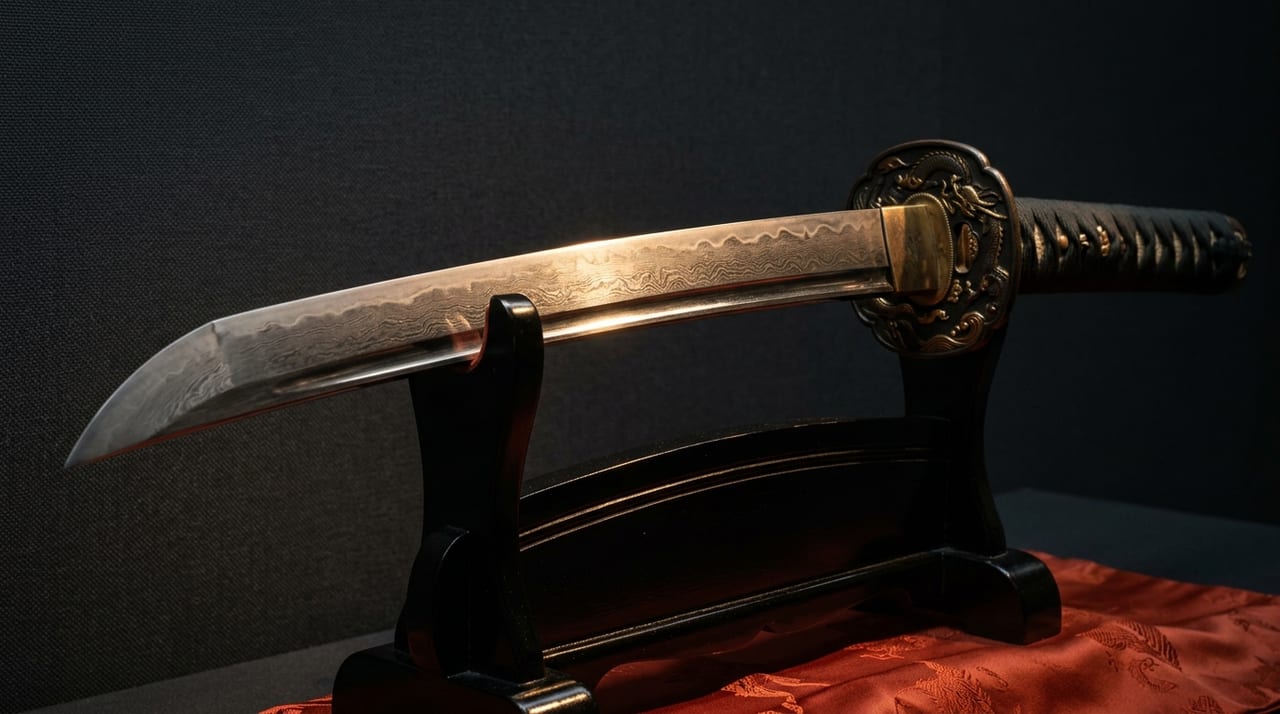
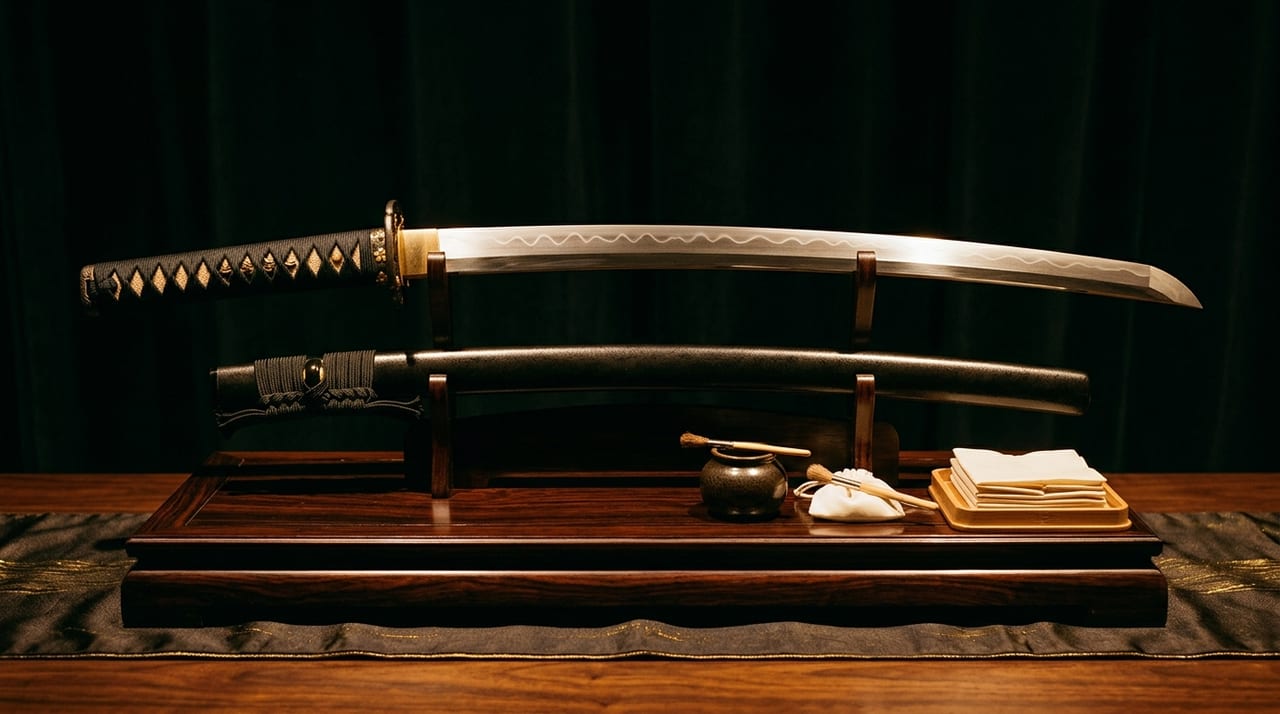
Yaki-modoshi (Tempering): The Third Stage of Heat Treatment That Gives Japanese Swords Their Toughness
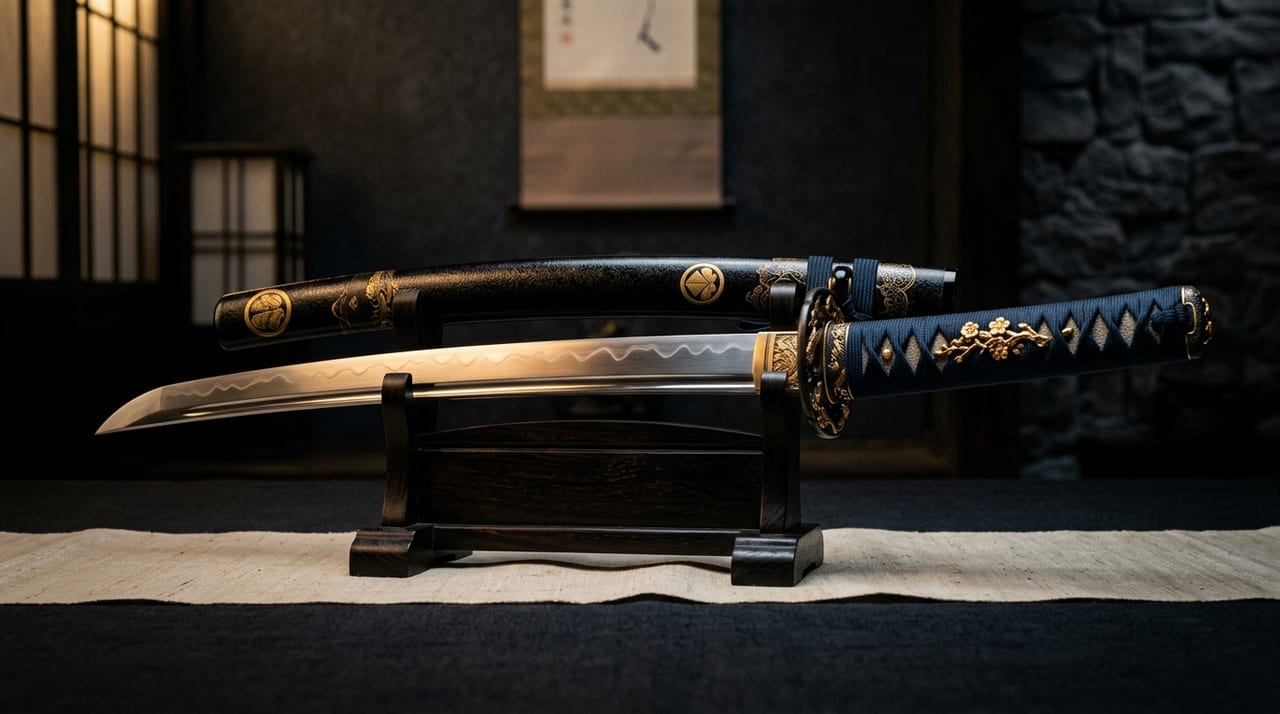 * Image is for illustrative purposes only.
Table of Contents
What Is Yaki-modoshi? — The Third Stage of Heat Treatment
In the production of a Japanese sword, the heat treatment that transforms iron into steel can be broadly divided into three stages:
- Yaki-naramashi (annealing): The process of removing internal stress from the steel during forging to make it easier to work
- Yaki-ire (quenching): The most critical process, in which rapid cooling generates a martensitic structure to harden the blade
- Yaki-modoshi (tempering): The process that controls the excessive brittleness after yaki-ire and imparts toughness (resilience)
This article focuses on the third stage, yaki-modoshi (tempering).
Why Is Yaki-modoshi Necessary? — The Brittleness of Martensite
The martensite generated by yaki-ire (rapid cooling) is an extremely hard steel microstructure, but it also has the drawback of being extremely brittle.
Martensite is in a supersaturated state in which carbon atoms are forcibly trapped in the iron crystal lattice. In this state, while hardness is high (HRC 60 or above), the internal stress within the crystals is large and the steel is prone to cracking under impact. In actual combat, the risks of "breaking" and "chipping" are high, and it would be dangerous to use a blade directly after yaki-ire. Through yaki-modoshi, the crystal structure of martensite is relaxed and toughness is greatly improved while a slight degree of hardness is sacrificed — this is the objective.
The Scientific Mechanism of Yaki-modoshi
Yaki-modoshi is the process of heating the blade after yaki-ire to a relatively low temperature (generally around 150–350°C) and holding it there.
Relationship Between Temperature and Microstructural Change
| Temperature Range | Microstructural Changes | Effect |
|---|---|---|
| ~100°C | Partial relaxation of residual stress | Slight improvement in brittleness |
| 150–250°C | Carbon begins to precipitate as ε (epsilon) carbides | Toughness improves while hardness is maintained |
| 250–350°C | Decomposition of retained austenite, onset of carbide coarsening | Significant improvement in toughness, decrease in hardness |
| 350°C and above | Precipitation of cementite (Fe₃C), formation of pearlite | Temper embrittlement zone (to be avoided) |
The yaki-modoshi of Japanese swords is carried out in the temperature range where the balance of hardness and toughness is optimized (generally 150–300°C).
Traditional Methods of Yaki-modoshi
Before modern temperature-control equipment existed, how did tōkō manage the yaki-modoshi temperature?
Judging by Color Temperature (Color Tempering)
When iron and steel are heated, an oxide film forms on the surface displaying characteristic colors (the so-called "heat tint"):
- Straw yellow (mugiwarairo): approximately 220°C
- Golden yellow (koganeiro): approximately 240°C
- Purplish brown (shisekishoku): approximately 260–280°C
- Blue (aoiro): approximately 300°C
- Grayish blue (haiaoiro): approximately 320°C
Traditional tōkō used these color changes as a guide to judge the yaki-modoshi temperature. Rules of thumb such as "remove it when it turns straw yellow" and "if it turns blue, you have gone too far" were passed down orally from master to apprentice.
Sand Bath Furnaces and Heating in Ash
To achieve uniform heating, the traditional methods used were a "sand bath furnace," in which the blade was buried in a container filled with sand, and heating within charcoal ash. These methods have the effect of distributing heat uniformly and preventing sudden temperature changes.
Effects on the Hamon — The Relationship Between Yaki-modoshi and the Hamon
Yaki-modoshi also has a subtle influence on the appearance of the hamon.
Changes in Nie and Nioi
Immediately after yaki-ire, the nie in the hamon (nie: coarse, granular martensite) is in a highly active state. When yaki-modoshi is applied, the nie particles stabilize slightly, and in some cases the edge of the hamon may become slightly softened, or the boundary with the nioi (nioi: a band of fine martensite particles) may change.
For this reason, the temperature and duration of yaki-modoshi must be managed within a range that does not compromise the beauty of the hamon, making this a process that demands the experience and aesthetic judgment of the tōkō.
Yaki-modoshi by Modern Tōkō — A Fusion of Tradition and Science
Modern tōkō can achieve more precise temperature management by using thermocouples and electric furnaces. However, many traditional-school tōkō, while using modern equipment in a supplementary role, continue to center their practice on the traditional technique of color temperature judgment.
Key points that modern tōkō emphasize in yaki-modoshi:
- The time from yaki-ire to yaki-modoshi (too soon and the residual stress will not have stabilized; too late and it can cause white rust)
- Uniformity of heating (managed so that no temperature differential arises along the length of the blade)
- Cooling rate (if cooling after yaki-modoshi is too rapid, brittleness will increase again)
Conclusion — An Invisible Process That Determines the Life of the Sword
Yaki-modoshi is an "invisible process" that does not directly appear in the hamon of the completed sword. Yet it is this process that determines whether the sword possesses the toughness to withstand actual combat, or whether it will break on a single blow.
Rather than the simple logic of "the harder the better," creating a balance of hardness and resilience through heat treatment — this is the metallurgical core of the Japanese sword, and yaki-modoshi plays a decisive role as the final adjustment process in that endeavor. Even now in 2026, the figure of the tōkō who continues to refine their art by fusing traditional color-temperature judgment with the insights of modern science speaks to the profound depth of this process.