Mizubeshi and Kowari — Preparatory Work and Material Selection Before Forging Tamahagane
 * Image is for illustrative purposes only.
Table of Contents
The Process That Comes Before Forging Begins
When one thinks of making a nihontō, the image that comes to mind is orikaeshi tanren — striking red-hot steel with a hammer. But before entering that dramatic stage, the tōshō performs the unglamorous preparatory work of making the tamahagane easier to forge and more consistent in quality. The most representative steps of this preparation are mizubeshi and kowari.
Mizubeshi——Flattening the Mass
Tamahagane, broken from the kera produced in tatara smelting, consists of irregular lumps. These are first heated in a furnace and hammered out into thin, flat slabs. This process is called mizubeshi.
Mizubeshi serves two purposes. The first is to make the material easier to handle: as a lump, heat cannot penetrate evenly to the interior, and the contents cannot be confirmed by splitting. The second is to drive impurities within the steel to the surface through heating and hammering, removing a portion of them. With each blow, slag flies off in sparks, and the steel is gradually purified.
The name "mizubeshi" is often explained as deriving from the practice of quenching the hot steel in water before splitting it. Steel that has been rapidly quenched becomes brittle, making it easier to break apart in the subsequent kowari step.
Kowari——Splitting and Assessing Quality
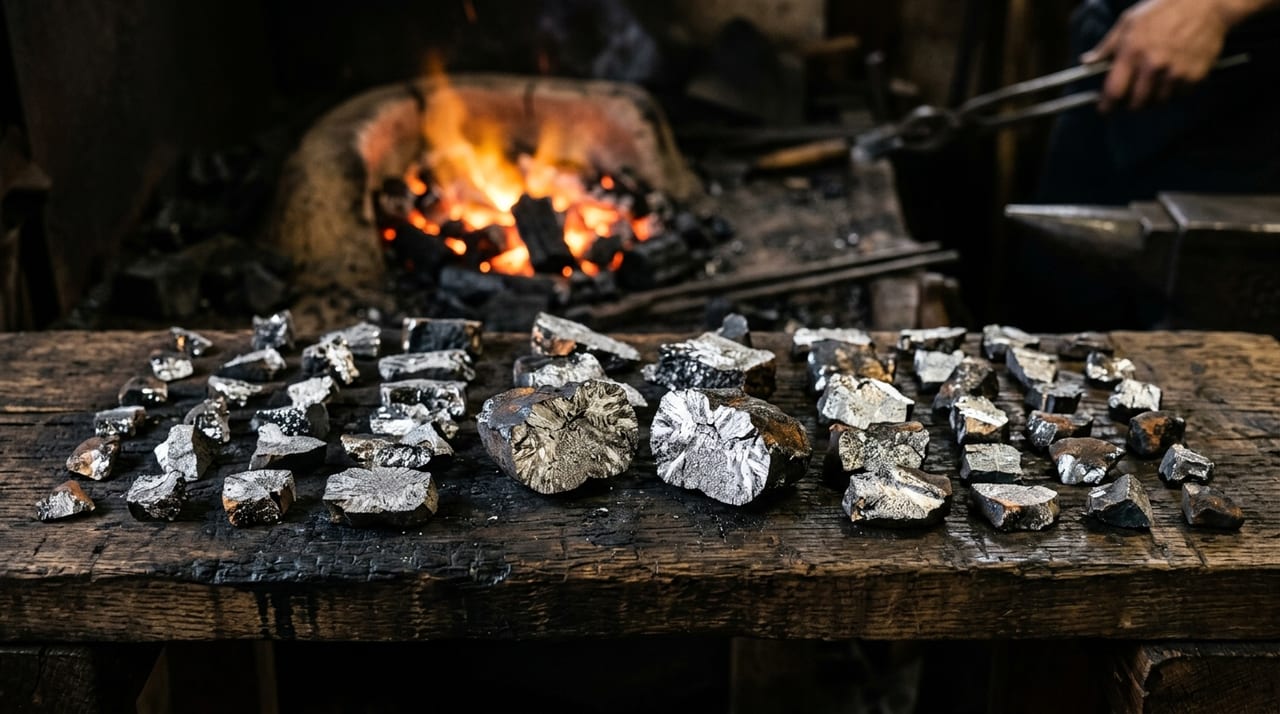
The tōshō breaks the slabs flattened by mizubeshi into small fragments. This is kowari.
The essence of kowari lies not simply in the breaking, but in selection. The tōshō examines the fracture face — the broken cross-section — of each fragment one by one, checking its color, the grain of the crystals, and its luster. From the fracture face, the tōshō reads whether a piece has high or low carbon content, or many impurities, and sorts the fragments according to their intended use.
An experienced tōshō can tell, from the silvery-white gleam and texture of a fracture face, how hard that fragment is. This is tacit knowledge — something learned through the eyes and hands that cannot be fully conveyed in words.
Sorting into Kawagane and Shingane
The tamahagane sorted during kowari is distributed according to which part of the blade it will be used for. Most nihontō have a composite construction (tsukurikomi) in which the hard, high-carbon kawagane wraps around the soft shingane. The detailed workings of this structure are explained in the article on the composite structure of kawagane and shingane.
High-quality fragments with high carbon content go to the kawagane, which provides cutting sharpness; fragments with low carbon content go to the shingane, which provides resistance to breaking. The accuracy of this sorting determines the success of subsequent tanren and yaki-ire, and ultimately the performance of the finished blade. It is fair to say that much of a blade's potential is already decided at the preparation stage.
Toward the Next Step——Tsumiwakashi and Orikaeshi Tanren
The fragments sorted during kowari are stacked on a platform attached to the end of a lever rod, coated with rice-straw ash and doused with clay water, then heated in a furnace. This process of heating the fragments to a temperature high enough for them to forge-weld into a single mass is called tsumiwakashi. From this point begins the well-known orikaeshi tanren. By repeatedly hammering the steel out flat and folding it back, the carbon content is evened out, impurities are further expelled, and a layered, tough steel develops. It is precisely because mizubeshi and kowari have levelled the quality of the material that the forge-welding in tsumiwakashi becomes stable, and the full benefit of tanren can be drawn out. The preparatory work and the main process form one continuous, unbroken flow.
The Unglamorous Steps That Define a Sword
Mizubeshi and kowari receive far less attention than the more spectacular tanren or yaki-ire. Yet it is precisely this first act of selection — gauging the quality of the material and sorting it by intended use — that lays the foundation of a blade. The accumulated judgments of choosing good material and discarding poor sections create differences that cannot be recovered in later steps.
Once one understands the weight of this preparation, one begins to sense, in the jigane and hamon of a finished blade, the countless fragments the tōshō broke apart and the careful attention directed at each one.
A Guide to Appreciation——Traces of Preparation Left in the Jigane
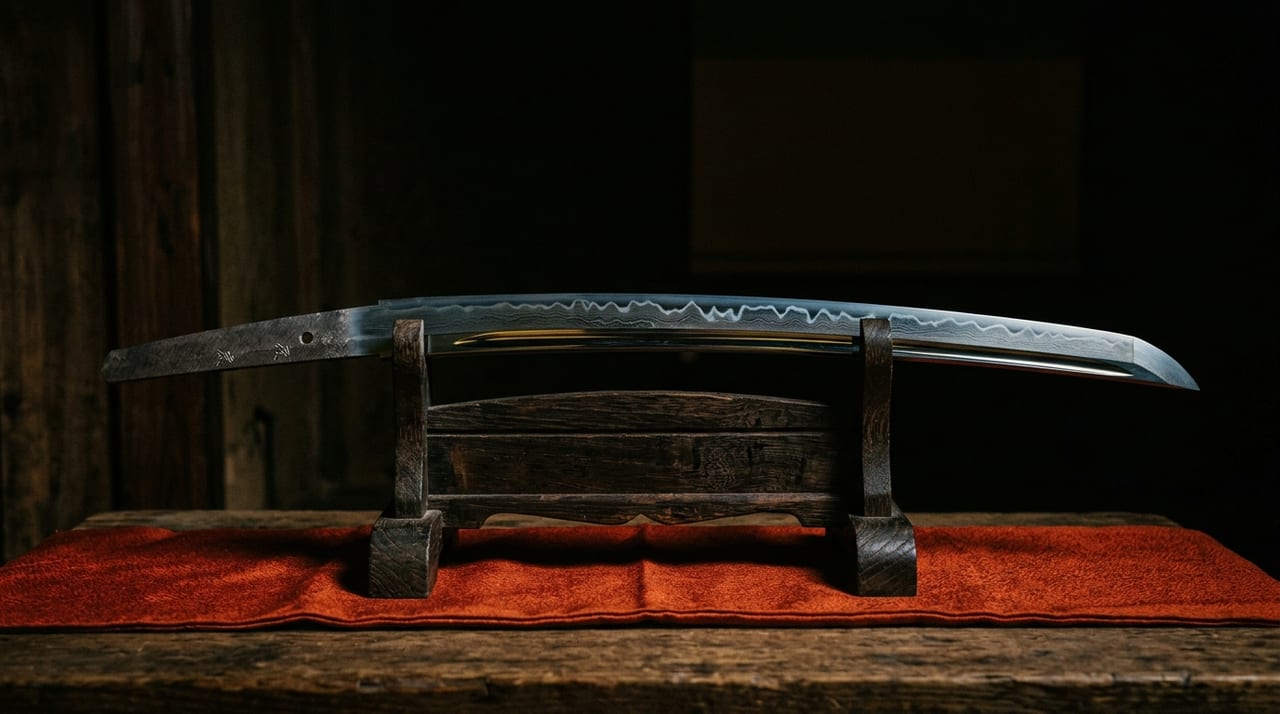
The surface of a finished blade bears the grain patterns produced by tanren — itame, masame, mokume, and others. A jigane that is close-grained and conveys a sense of luster is said to be the result of material selection and tanren working together at a high level. When viewing a sword at an exhibition or in photographs, try looking not only at the hamon but also at the grain and flow of the jigane. If you can come to imagine from these the reliability of invisible processes such as mizubeshi and kowari, your appreciation of swords will rise by a level.
Brief Glossary of Terms
- tamahagane: The high-quality portion of the steel obtained from tatara smelting that is suited for use as sword material.
- kera: The mass of iron formed inside the tatara furnace. It is broken apart and sorted by content, yielding tamahagane and other grades.
- kawagane / shingane: The harder steel that wraps the outside of the blade, and the softer steel placed inside. A structure that allows the contradictory demands of "cuts well and does not break" to be met simultaneously.
- wakashi: Heating the steel to the high temperature at which it can forge-weld. The temperature is judged by experience from the color of the flame and the steel.
- orikaeshi tanren: The repeated process of hammering out heated steel, scoring it, folding it back, and forge-welding it again. Each repetition increases the number of layers and makes the steel more homogeneous.
Exploring the Craft of Swords
TOUKENZA (operated by M Assets Co., Ltd.) is a sword marketplace that sells nihontō online. Understanding the craft of forging a sword is a guide to enjoying each blade more deeply. Swords currently listed can be viewed in the online catalog and are available for purchase. If you have a blade that interests you or any questions, please feel free to contact us via the inquiry form.