Kera-oshi and Zuku-oshi: The Two Operating Methods of Tatara Smelting and How Tamahagane Is Produced
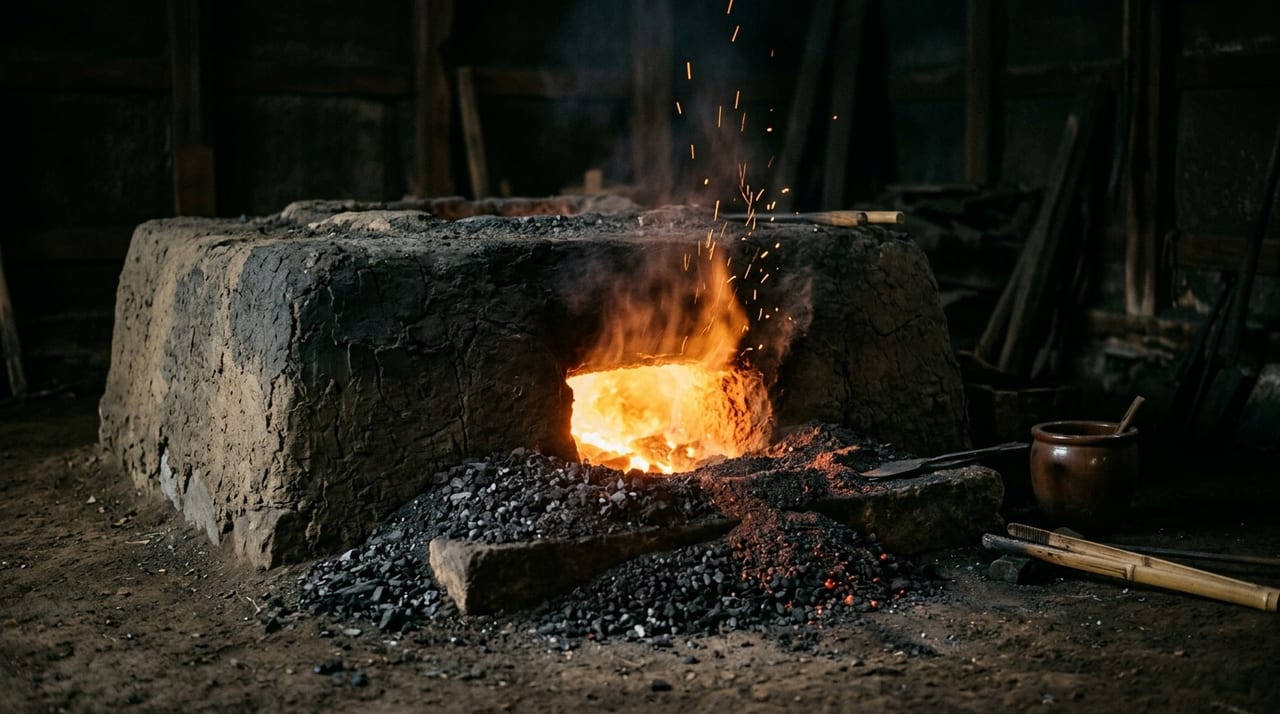 * Image is for illustrative purposes only.
Table of Contents
Tatara Has Two "Operating Methods"
Tamahagane, the material for Japanese swords, is produced by tatara smelting, in which iron sand (satetsu) and charcoal are alternately fed into a furnace to extract iron. Yet this smelting method, often spoken of as a single thing under the name "tatara," encompasses two operating methods with different purposes: kera-oshi and zuku-oshi.
Both use the same box-shaped furnace and the same iron sand and charcoal, yet by altering furnace temperature management and the manner of feeding iron sand and charcoal, they yield different main products. Understanding this difference reveals why tamahagane is such a precious and special material.
Kera-oshi: The Operating Method for Obtaining Tamahagane
Kera-oshi is an operating method aimed at producing a large iron mass called kera at the bottom of the furnace. Iron sand and charcoal are fed continuously over three days and three nights, and the iron grows inside the furnace as a semi-molten mass.
When the operation ends, the furnace is dismantled and the kera, weighing several tons, is removed. The kera is then broken apart, and the pieces are graded by examining the color and quality of the fracture surfaces; the finest portions are selected as tamahagane. The tamahagane used for Japanese swords is the steel obtained through kera-oshi, with a carbon content held relatively low at approximately 1–1.5%. It is rather the zuku (pig iron) obtained through zuku-oshi that has a high carbon content (approximately 3–4%) and is too hard and brittle to be forged as-is. Kera-oshi is characterized by operating at a relatively low temperature range, extracting the iron in a near-solid state without fully melting it.
Zuku-oshi: The Operating Method for Drawing Off Pig Iron
Zuku-oshi, by contrast, maintains the furnace interior at a higher temperature and has as its main purpose the drawing off of iron with a high carbon content and a lowered melting point as liquid zuku (pig iron). The resulting pig iron served as a casting material and was also processed into forgeable iron through decarburization, as described below.
Pig iron has a high carbon content and is too hard and brittle to be forged into a sword as-is. The iron obtained through zuku-oshi was therefore processed in a step called okaji (large forging), in which carbon was removed to transform it into more workable materials such as hochotetsu (blade iron) before use.
What the Difference in Products Means
The greatest difference between kera-oshi and zuku-oshi lies in whether the iron is obtained as a solid mass or drawn off as a liquid. This distinction was achieved through the management of furnace temperature, operating time, and the ratio of iron sand to charcoal. The differences between the two are summarized below.
| Item | Kera-oshi | Zuku-oshi |
|---|---|---|
| Main product | Kera | Zuku (pig iron) |
| State obtained | Near-solid mass | Liquid |
| Carbon content | Approx. 1–1.5% | Approx. 3–4% |
| Temperature range | Relatively low | High |
| Subsequent process | Broken apart and graded to select tamahagane | Decarburized in okaji and processed into hochotetsu and similar materials |
The tamahagane best suited for Japanese swords is obtained through kera-oshi. Because the steel does not fully melt, unevenness remains in the distribution of impurities and carbon, and that very inhomogeneity becomes the foundation that gives rise to the refinement of the steel's structure through orikaeshi tanren and to the landscape of the jigane. The starting point is entirely different from that of modern steel, which is made by melting uniformly.
From Tamahagane to a Finished Sword
The tamahagane obtained through kera-oshi does not become a sword as-is. Once the tamahagane passes into the hands of a tosho, it is transformed into a sword through several processes.
- Mizuheshi (water reduction) and small splitting — The steel is heated, hammered thin, quenched to make it easy to break, and divided into small fragments
- Fracture surface grading — The tosho examines the fracture surfaces to sort the fragments by carbon content
- Tsumi-wakashi (stack welding) — The selected fragments are stacked and forge-welded into a single piece
- Orikaeshi tanren — The steel is hammered out, folded, and stacked repeatedly, expelling impurities as sparks, evening out the carbon content, and producing a layered structure of many strata
It is precisely because the starting point is the inhomogeneous steel of the tatara that these painstaking refinement processes carry meaning.
The Connection to the Landscape of the Jigane
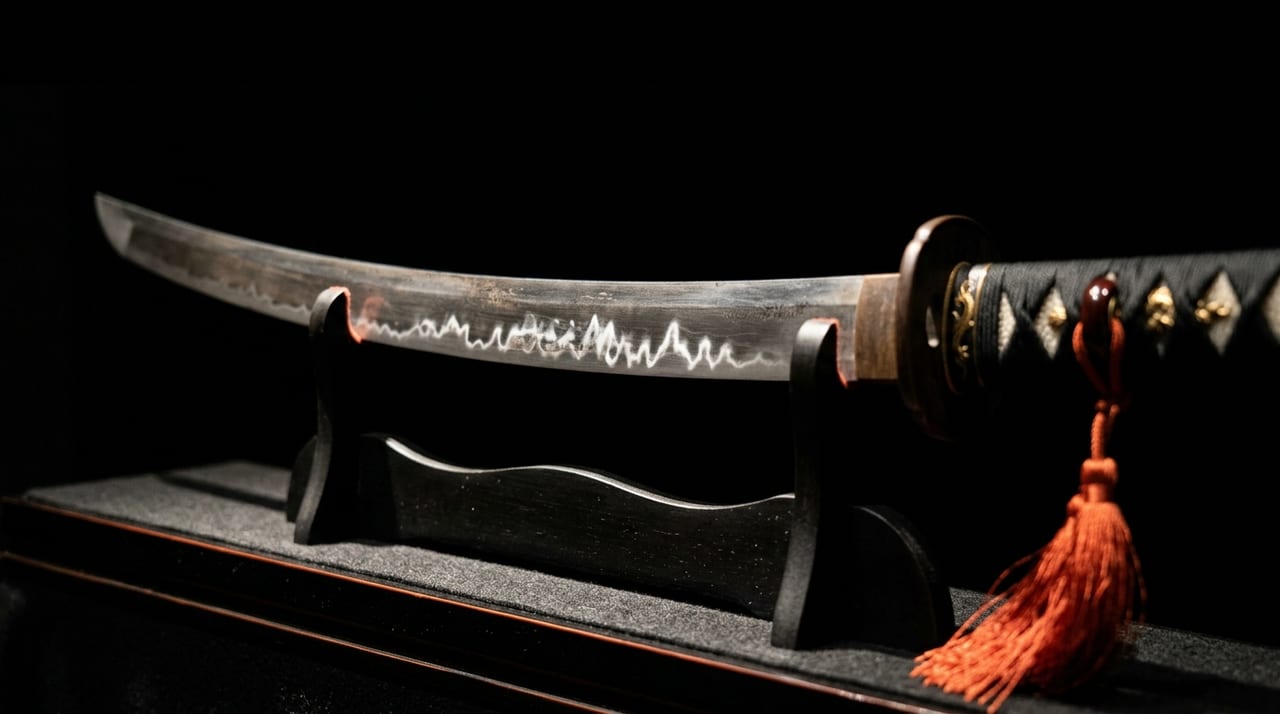
The layers produced by orikaeshi tanren appear on the polished blade surface as jihada. Surface patterns such as itame-hada (a pattern resembling the grain of flat-cut lumber), mokume-hada (a ring-like pattern), and masame-hada (a straight-running pattern) are landscapes born from the combination of forging technique and the properties of the steel. Furthermore, the finely glittering particles within the jihada are called ji-nie, and the dark activity running through it like inazuma is called jikei; both are regarded as highlights born from the quality of the steel and the artistry of the forging.
When appreciating a sword, if you look closely not only at the hamon but also at the surface of the jigane, you can read the traces of the sword's history: what kind of steel it was forged from and how it was worked. The final point of a long process beginning at the tatara of kera-oshi is etched into the surface of the blade in your hands.
Tatara That Survives Today
Today, the tatara operation that supplies tamahagane for Japanese swords is carried out in winter by the NBTHK (a public interest incorporated foundation) at the "Nittoho Tatara" facility in Okuizumo, Shimane Prefecture. What is practiced there is kera-oshi, and it is the principal source of tamahagane supplied to tosho across Japan.
Understanding the two operating methods of kera-oshi and zuku-oshi allows one to see that tamahagane is not "just iron" but a material selected according to a specific philosophy of operation. When you gaze at the jigane of a sword, consider also the smelting choices that lie behind it.
Encountering the Craft of Swords
TOUKENZA (operated by M-Assets Co., Ltd.) is a sword marketplace that sells Japanese swords online. Learning the craft of sword-forging becomes a key to appreciating each sword more deeply. The swords on offer can be viewed in the online catalog, and purchases are possible. If you have a sword that catches your eye or any questions, please feel free to contact us via the inquiry form.