The Sacred Swords of Shōsōin — Emperor Shōmu's Cherished Blades and the Court Sword Culture of the Tenpyō Era
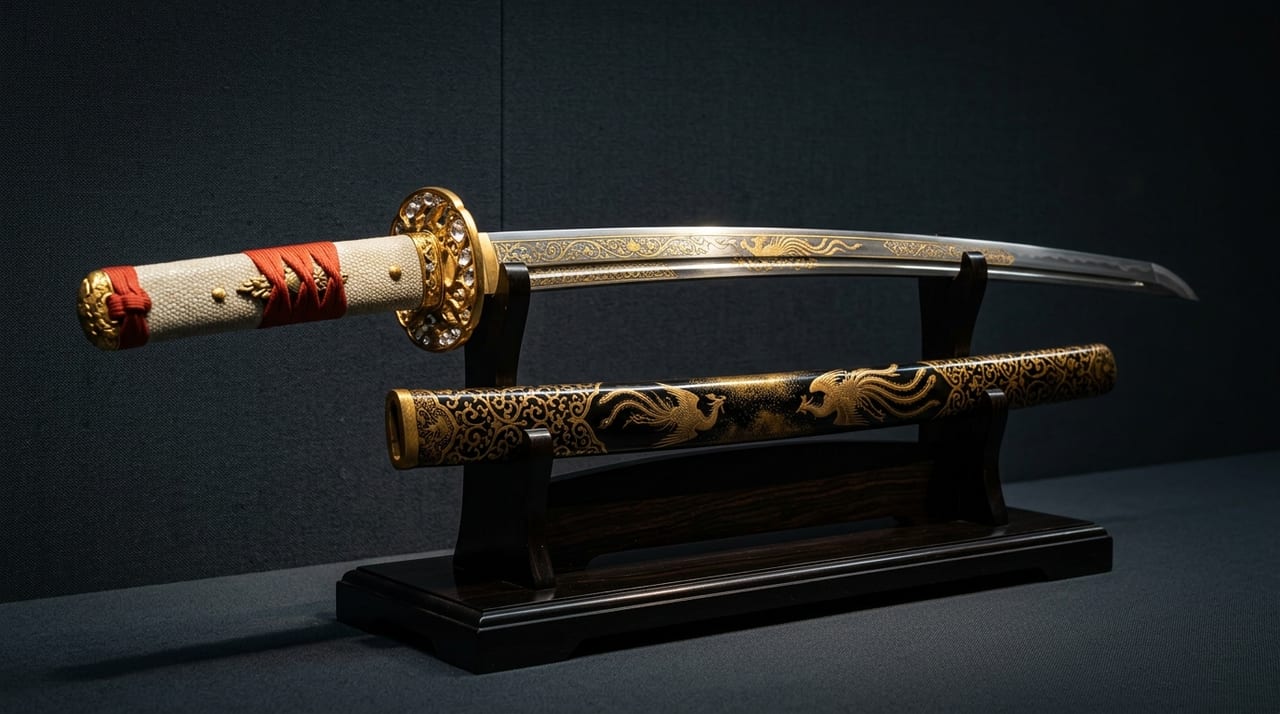 * Image is for illustrative purposes only.
Table of Contents
The treasures preserved at Tōdaiji Shōsōin have as their foundation the personal effects cherished by Emperor Shōmu, which Empress Kōmyō dedicated to the Great Buddha on the occasion of the forty-ninth day memorial following the Emperor's death in Tenpyō Shōhō 8 (756). Among these treasures are precious swords that convey to us the court sword culture of the Nara period.
Swords Recorded in the Kokka Chinpōchō
The "Tōdaiji Kenmotsu-chō" (inventory of dedicated items), commonly known as the "Kokka Chinpōchō," records the types and forms of the dedicated swords. The following entries can be found therein, suggesting that the court of the time placed great importance on continental-style swords as ceremonial implements.
- Karatachi (Tang great swords): 13
- Karayō no tachi (Tang-style great swords): 6
Kingin Den Kazari no Karatachi
Among the Shōsōin swords, the most renowned is the Kingin Den Kazari no Karatachi. It is a ceremonial sword approximately 99.9 cm in overall length, adorned as follows.
- Tsuka (hilt): wrapped in rayskin
- Saya (scabbard): decorated with birds, animals, and arabesque patterns using the togidashi-makie lacquer technique
- Metal fittings: openwork carving inlaid with rock crystal and glass beads
It is believed to have been made not as a weapon for actual combat but as a sword of authority to be worn on ceremonial occasions.
Rediscovery of the Yōhōken and Inhōken
The "Yōhōken" and "Inhōken," considered personal effects of Emperor Shōmu, were taken out of Shōsōin after being dedicated there, and their whereabouts had long been unknown. In 1907–08, a complete set of chindangu (altar foundation objects), including six tachi, was excavated from near the shumidan (altar platform) of the Rushanabutsu (Great Buddha) at Tōdaiji. These were designated as the kokuhō (National Treasure) "Tōdaiji Kondō Chindangu," but when an X-ray examination was conducted in 2010, gold-inlaid mei (signatures) reading "Yōken" and "Inken" were confirmed on the blades of two of the swords. This revealed that they were the same as the Yōhōken and Inhōken, whose whereabouts had long been unknown since being removed from Shōsōin, and the case became known as a dramatic episode in the transmission history of ancient swords.
Why Have They Survived for Over Twelve Hundred Years — Chokufū and Azekura
The background to how the Shōsōin treasures have survived to the present day retaining their Nara-period appearance lies in a tradition of strict management. The Shōsōin repository was protected by "chokufū" (imperial sealing), which prohibited opening without the Emperor's permission, and the occasions for opening were themselves strictly limited. The elevated azekura-zukuri (log-cabin style timber) repository and the protection afforded by the karabitsu (Tang-style storage chests) in which the treasures were stored are also thought to have contributed to the preservation of treasures containing many organic materials, as they moderated sudden changes in temperature and humidity. It is extremely rare worldwide for metal and wood combined with leather and silk thread — as in the case of swords — to survive together as transmitted objects rather than excavated finds, and the greatest value of the Shōsōin swords lies in conveying the very appearance they had when they were in actual use.
The Form of Jōkotō — The World of Straight Swords Without Curvature
The Shōsōin sword collection exhibits the style of jōkotō, the form of Japanese swords before sori (curvature) developed. The blades are essentially straight, and among their cross-sectional construction forms can be seen kiribazukuri, in which the cutting-edge side is beveled at an angle. The structure differs from that of the later shinogi-zukuri tachi, and the influence of continental sword styles can be discerned. The fact that both ceremonial tachi emphasizing the decoration of the hilt and saya (scabbard) and tachi intended for practical use as weapons were dedicated together also speaks to how the swords of that era had two faces: ceremonial implement and weapon.
The Two Writings of "Tachi" — What Orthography Tells Us About Sword History
In sword history, there is a convention of distinguishing in writing between the straight ancient sword (written with characters meaning "great sword," read "tachi") and the curved sword that emerged from the Heian period onward (written with different characters but also read "tachi"). The entries "karatachi" and "Karayō no tachi" seen in the Kokka Chinpōchō correspond to the former, and it is understood that Tang imports and domestically made swords fashioned after them were recorded as distinct categories. From this written distinction in the inventory, one can infer that the Nara court was keenly aware of the difference between imported articles and their domestic reproduction, making this a fascinating prelude to the later process by which the Japanese sword absorbed continental styles and evolved into its own distinctive form.
A Perspective for Appreciation — Viewing the Fittings and Blade Separately
When appreciating the Shōsōin swords, it is useful to view the fittings and the blade separately.
| Perspective | Points of focus |
|---|---|
| Fittings | Rayskin hilt, pattern composition of lacquerwork and inlay, precision of openwork carving on metal fittings |
| Blade | The upright, austere form unique to straight swords, the cross-sectional construction |
In contrast to later Japanese sword appreciation, which focuses on the hamon (temper line) and the qualities of the jigane (steel of the blade surface), the fundamental approach to appreciating jōkotō is to savor them as a comprehensive craft encompassing both blade and fittings together.
Opportunities to View Shōsōin Treasures in Person
The Shōsōin treasures are not on permanent public display; each autumn the Nara National Museum holds the "Shōsōin Exhibition," at which a selection of treasures chosen for that year is displayed. In years when swords and tōsōgu (sword fittings) are exhibited, it becomes a precious opportunity to observe the details of Tenpyō craftsmanship up close. When viewing the exhibition, if one consciously attends not only to the lacquerwork on the saya (scabbard) and the detail of the metal fittings, but also to the silhouette of the straight sword without curvature itself, one should be able to directly feel the difference from the later tachi.
The Pinnacle of Tenpyō Sword Culture
The sacred swords of Shōsōin demonstrate that the Nara court, while absorbing continental culture, had achieved a high degree of refinement of the sword in terms of ceremony and decoration. They can be said to represent the apex of the world of jōkotō with its basis in straight swords, before the curved tachi came to be established.