The World of Koshirae: A Complete Guide to the Art, Types, and Part Names of Sword Mountings
 * Image is for illustrative purposes only.
Table of Contents
What is Koshirae: The Complete Beauty That Envelops the Blade
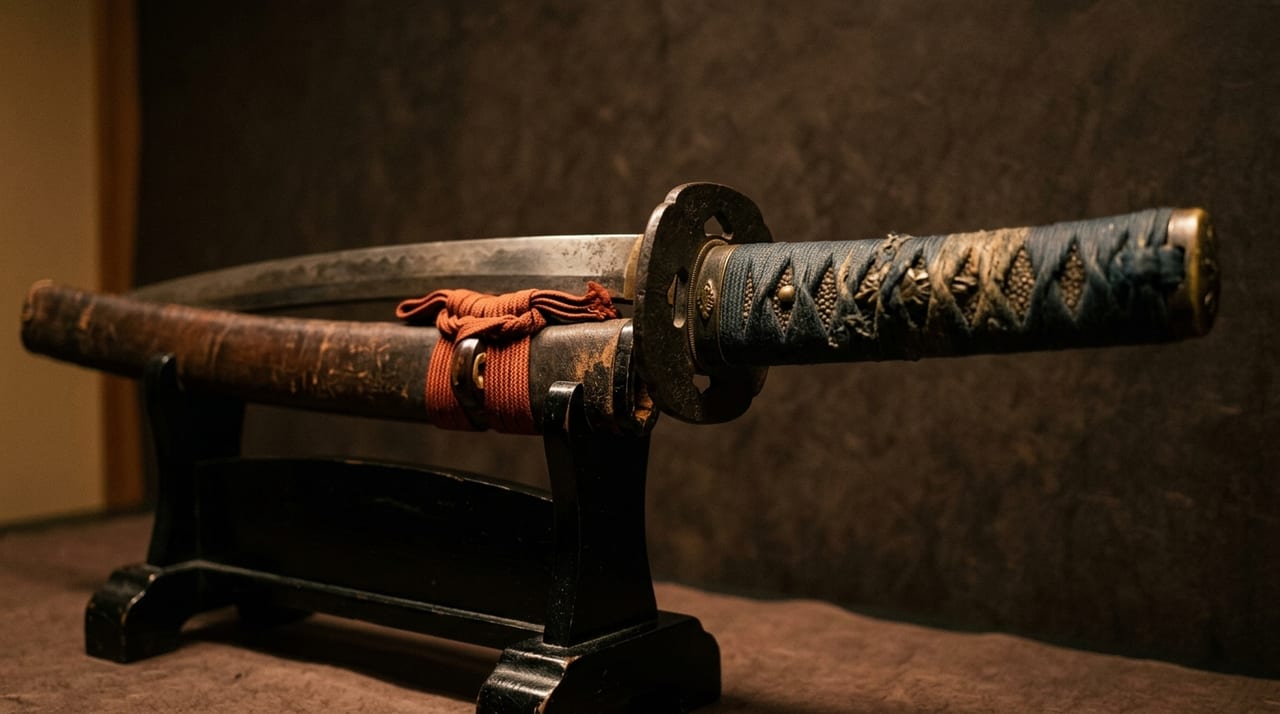
A Japanese sword consists of two elements: the blade (tōshin) and the koshirae. If the blade is the technical crystallization of iron and steel, the koshirae is the "garment" for using, carrying, and appreciating the sword in society, and is at the same time an outstanding work of craft in its own right.
The word "koshirae" derives from the verb "koshiraeru" (to make; to put in order), and refers to the entire outer mounting of a sword. In English it is called "sword mounting" or "koshirae," the latter having become established as the standard term in international Japanese sword studies.
Koshirae includes the saya (scabbard) into which the blade is inserted, the tsuka (hilt) that is gripped, the tsuba (hand guard) at the boundary between the blade and the hilt, and numerous other metal fittings. Each of these parts is crafted by artisans who represent the finest of Japan's traditional crafts — lacquerwork, metalwork, leatherwork, and braided cord — and together they express a unified beauty as a complete mounting.
The Parts of Koshirae and Their Names
Saya (Scabbard)
The saya (scabbard) is the outer casing that houses the blade, with a wooden core (primarily magnolia) finished with lacquer. The shape, lacquer finish, and decoration of the saya allow one to discern its period and intended use.
- Kuronuri saya: A simple black lacquer finish. Common in practical koshirae of the warrior class.
- Shunuri saya: A vermilion lacquer finish. Used for high-ranking ceremonial purposes.
- Makie saya: Decorated using the makie technique, in which gold and silver powders are sprinkled onto lacquer to create patterns. Frequently seen in koshirae of daimyo and shogun rank.
- Samekawa saya: A saya wrapped in samekawa (ray skin, though commonly called shark skin). Used for tachi koshirae and warrior-class ceremonial purposes.
At the tip of the saya is fitted a metal piece called the kojiri, which serves both to protect the saya and as decoration. Note that "ishizuki" is the name for the metal cap fitted to the butt end of a spear or naginata haft, and is a different fitting from the kojiri of a sword saya; the two should not be confused.
Tsuka (Hilt)
The tsuka (hilt) is the part gripped when wielding the sword; it is finished by wrapping samekawa (ray skin, though commonly called shark skin) over a wooden core and then wrapping tsuka-ito (hilt cord) over that.
- Samekawa: Dried ray skin. Characterized by its granular projections, which help stabilize the grip. It exists in a variety of colors including white, black, green, and blue-dyed.
- Tsuka-ito: The most common wrapping is "hishimaki," in which silk or cotton cord is wound in a diamond pattern. Colors vary widely, including black, brown, purple, and white.
- Menuki: Decorative metal ornaments fitted to both sides of the tsuka. They feature diverse designs such as flowers, animals, and weapons, and also contribute to stabilizing the grip.
Tsuba (Hand Guard)
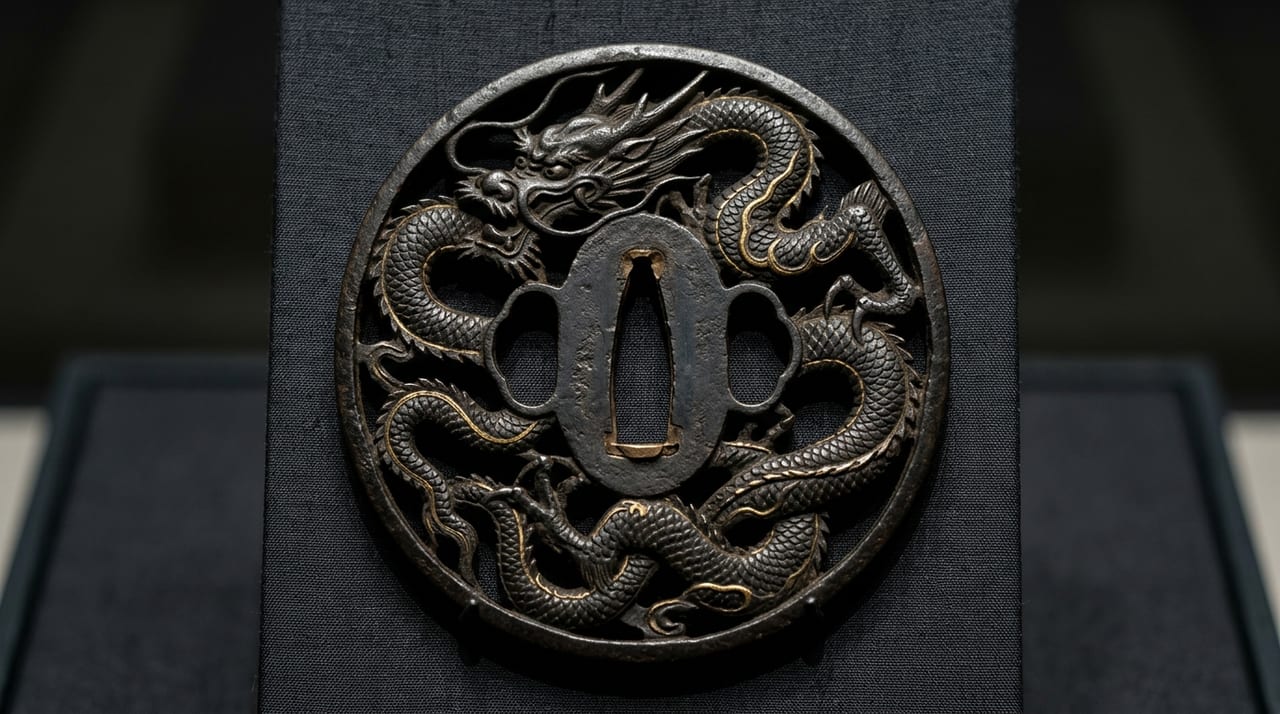
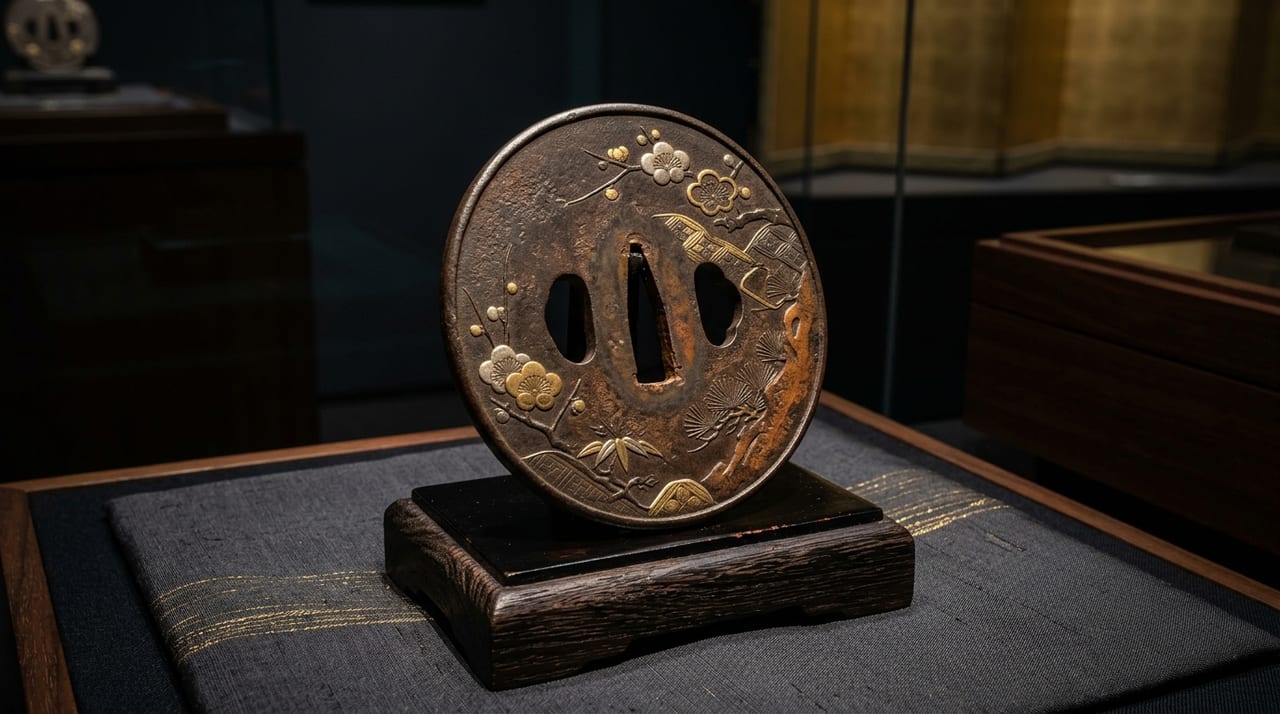
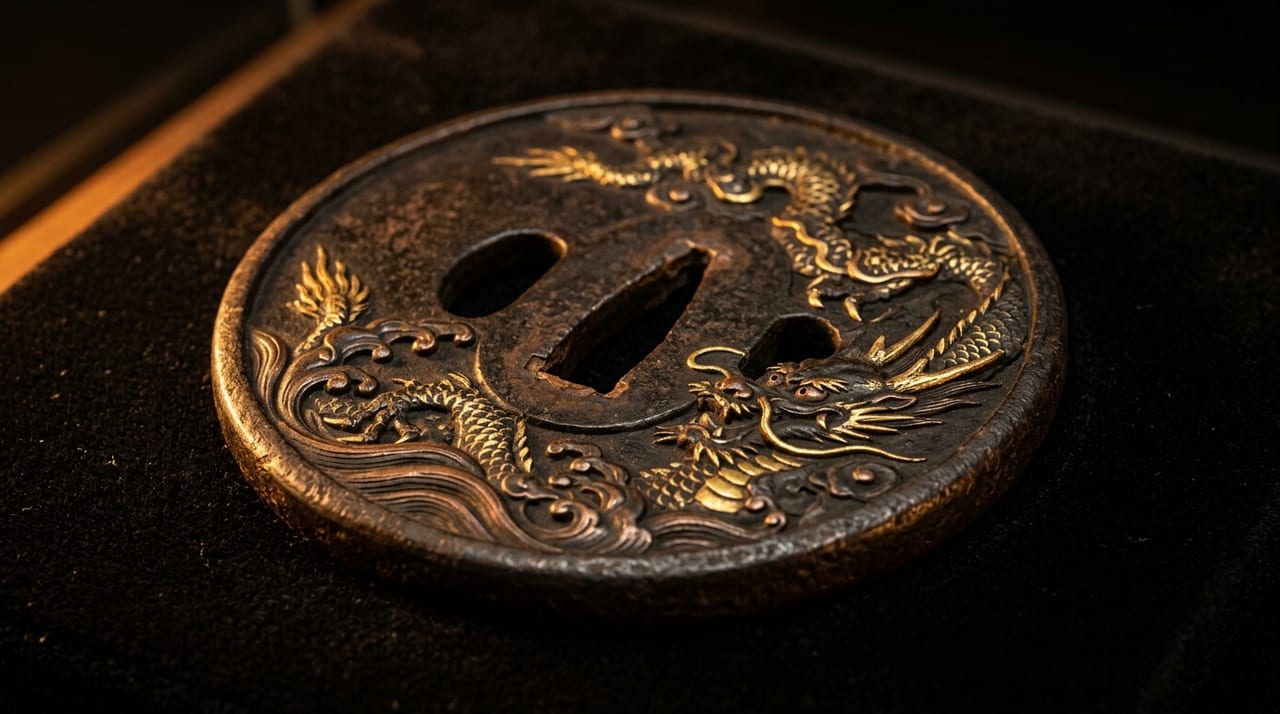
The tsuba (hand guard) is the oval or circular guard positioned at the boundary between the tsuka and the blade, and is the component of Japanese sword koshirae most highly regarded as a work of art.
The materials used for tsuba are diverse — iron, brass, copper, and gold-silver alloys (shibuichi, shakudō, and others) — and they are decorated with elaborate techniques such as openwork (sukashibori), high relief carving (takabori), inlay (zōgan), and scooped relief (sukidashi). In the Edo period, specialist metalworkers (kinkōshi) in tsuba and small fittings such as the Gotō family, the Hirata family, and Yokoya Sōmin became established, each forming their own distinct school.
Fuchi-kashira
The fuchi is the metal fitting attached to the tsuba-side end of the tsuka, and the kashira is the metal fitting attached to the bottom end of the tsuka. These are normally made and appreciated as a matching pair, and are frequently unified with the same design.
The materials for fuchi-kashira are as diverse as those for tsuba, making them an important component in which the individuality of the metalworker is expressed. Fuchi-kashira, menuki, kozuka, and kōgai are collectively called "kodōgu" (small fittings), and are often made as a matching set with a unified design.
Kozuka and Kōgai
The saya sometimes has grooves into which a kozuka and a kōgai can be inserted.
- Kozuka: A tool fitted with a small blade (kogatana) and used for everyday cutting tasks. It is carried by inserting it into the side of the saya.
- Kōgai: A tool for dressing the hair. It is a flat-plate metal fitting that was also highly valued as a decorative element.
Other Parts
- Sageo: A braided cord attached near the koiguchi of the saya. It is used to secure the saya through the belt.
- Kiriha: Thin metal spacers inserted between the tsuba and the blade and tsuka. They serve to adjust the fit.
Types of Koshirae
Koshirae are broadly classified by purpose, period, and formal rank.
Uchigatana Koshirae
The most widely used koshirae in the Edo period. Its shape corresponds to the "sashikata" wearing style — carrying the sword edge-up through the belt — and features a practical design that takes into account the weight balance of the sword. It is still widely recognized today as the standard koshirae for Japanese swords.
Tachi Koshirae
A koshirae designed for carrying the tachi suspended at the hip. It corresponds to the carrying method called "haku" — suspending the sword edge-down from the waist. The saya is fitted with hanging fixtures called "ashikanamono," and this is an older form used primarily by mounted warriors of the Kamakura through Muromachi periods.
Jintachi Koshirae
A tachi koshirae for generals and daimyo used on the battlefield. It is characterized by lavish decoration making generous use of gold and silver, and functioned as a symbol of authority.
Special Koshirae
- Shirasaya: A plain magnolia-wood saya with no lacquer or decoration. It is a "resting koshirae" intended for the preservation and storage of the blade, and is used to protect the blade when it circulates as an art object.
- Aikuchi koshirae: A koshirae for tantō that has no tsuba. Used by women, court nobles, Buddhist monks, and others.
The Artistic Value of Koshirae
Koshirae is highly valued as a work of art independent of the blade. During the Edo period, a collector's culture developed that valued the splendor of the koshirae over the quality of the blade, and koshirae by renowned metalworkers were bought and sold as independent works of art.
Even today, koshirae are sometimes offered individually (without the blade) at sword markets and art auctions. Kodōgu by the master craftsmen of the Gotō family, tsuba and fuchi-kashira by Yokoya Sōmin, and cloisonné menuki by the Hirata family in particular can sometimes command valuations exceeding that of the blade itself.
Koshirae are also an important source of information that conveys the "context" of a sword. From the style, materials, and design of the koshirae, one can infer in what period the sword was used, by a person of what rank, and through what path of distribution it has traveled.
The Production and Appreciation of Koshirae in the Modern Day
Contemporary sword-mounting craftsmen (tōsōshi) continue to produce new koshirae while passing down traditional techniques. Specialist craftsmen — sayashi (scabbard makers), tsukamakishi (hilt wrappers), kinkōshi (metalworkers), and kumihimoshi (braided cord makers), among others — each take their own specialty, collaborating to complete a single koshirae.
In addition to appraising blades, NBTHK (Society for the Preservation of Japanese Art Swords) also examines tōsōgu (sword fittings) and koshirae, granting designations such as "tokubetsu jūyō tōsōgu" to outstanding works.
When appreciating a sword, it is important to view not only the blade but the koshirae as a whole as a single work of art. When the hamon (temper line) and jihada (grain pattern of the steel) of the blade harmonize with the design, materials, and craftsmanship of the koshirae, the Japanese sword radiates its supreme artistic brilliance.
Summary: Koshirae Tells the Sword's Story
Koshirae is not merely a "container"; it is a total art form that embodies the history of the sword, the standing of its owner, and the aesthetic sensibility of its era. If the blade tells the "story of iron," the koshirae tells the "story of culture."
To understand the Japanese sword deeply, it is indispensable to grasp the parts and meaning of the koshirae and to turn one's attention to the craftsmanship of metalwork, lacquerwork, and braided cord alike. When the blade and koshirae become completely unified, the Japanese sword shines in its true form.