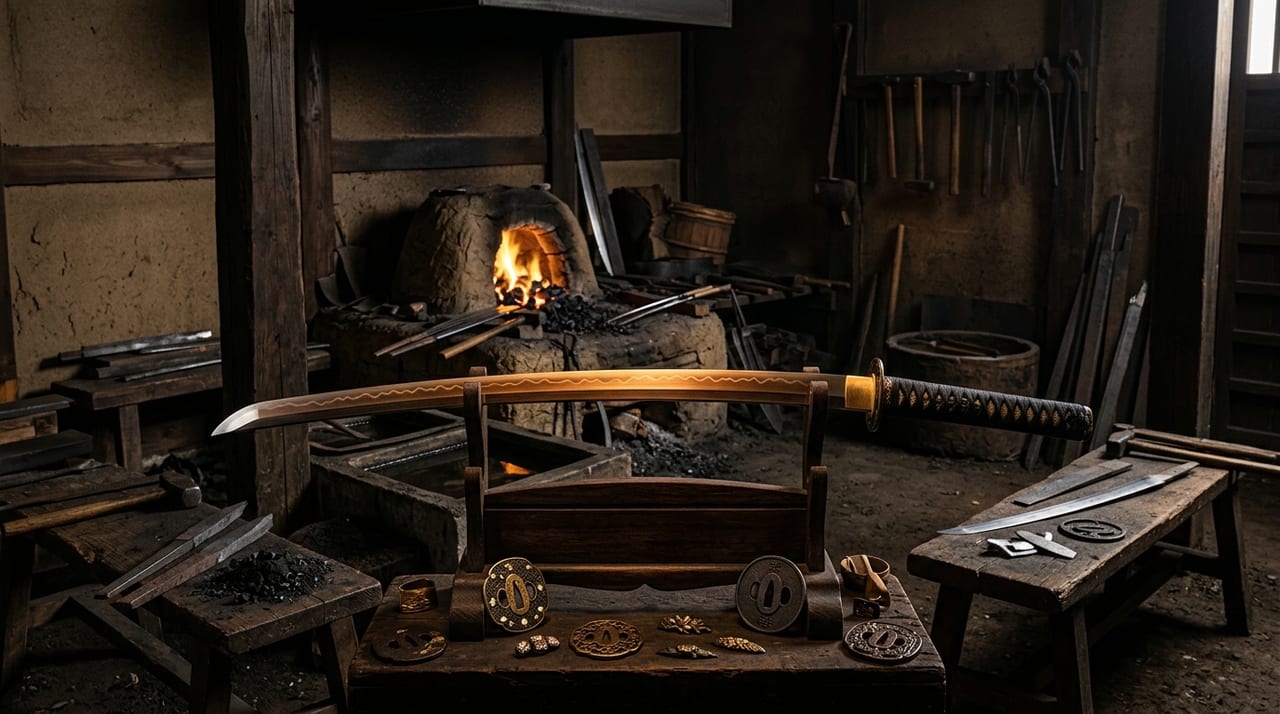
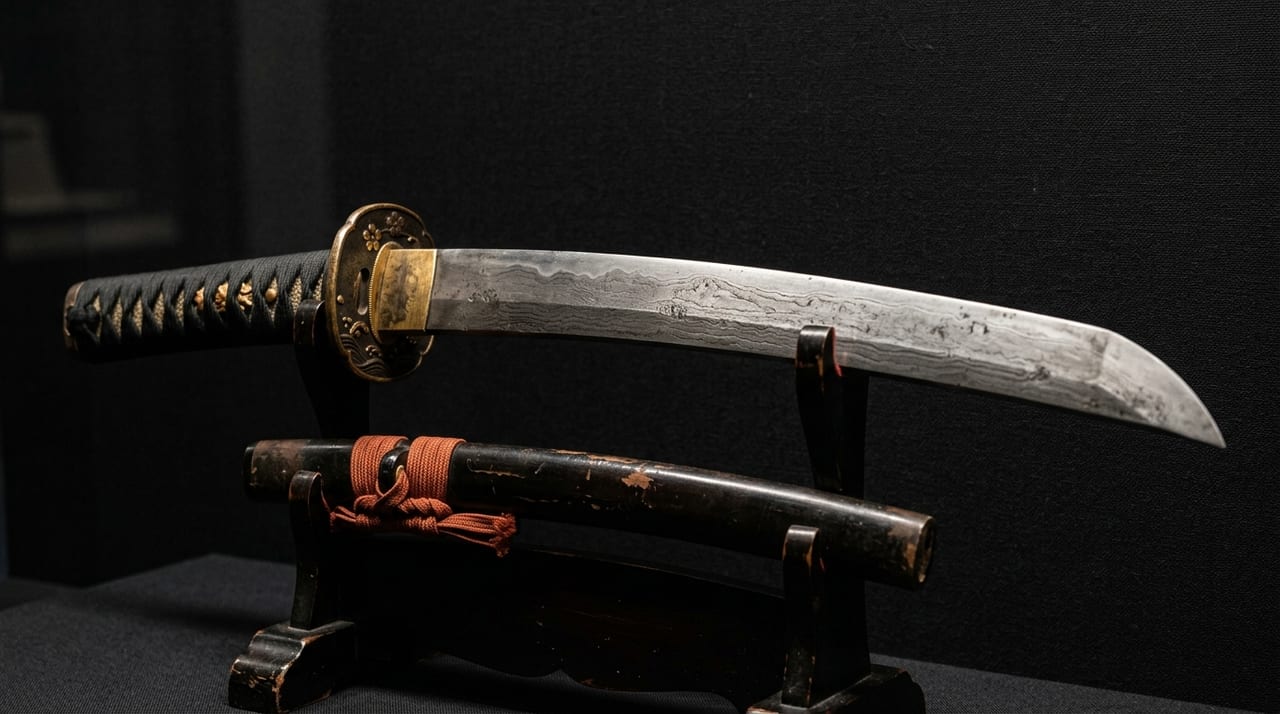
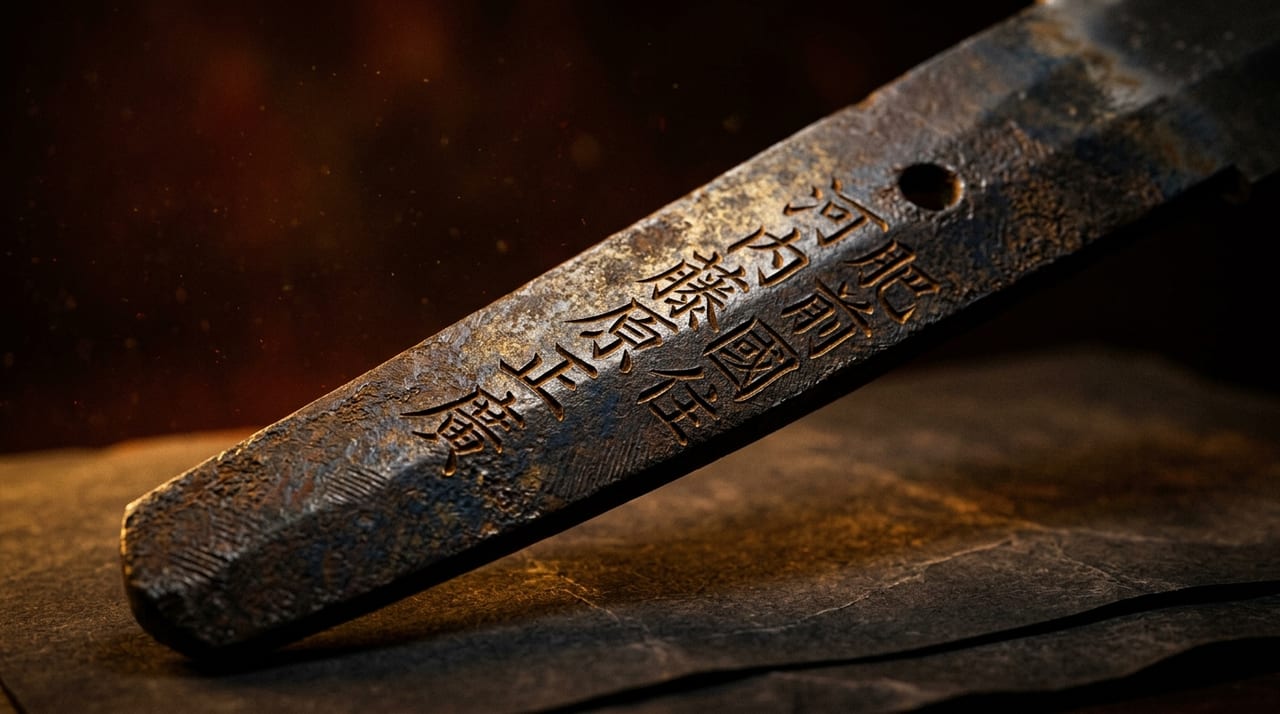
Tools and Materials of Horimono (Blade Carving) — Types of Chisels, Knives, and Whetstones, Working Conditions, and the Reality of Modern Carvers' Practice
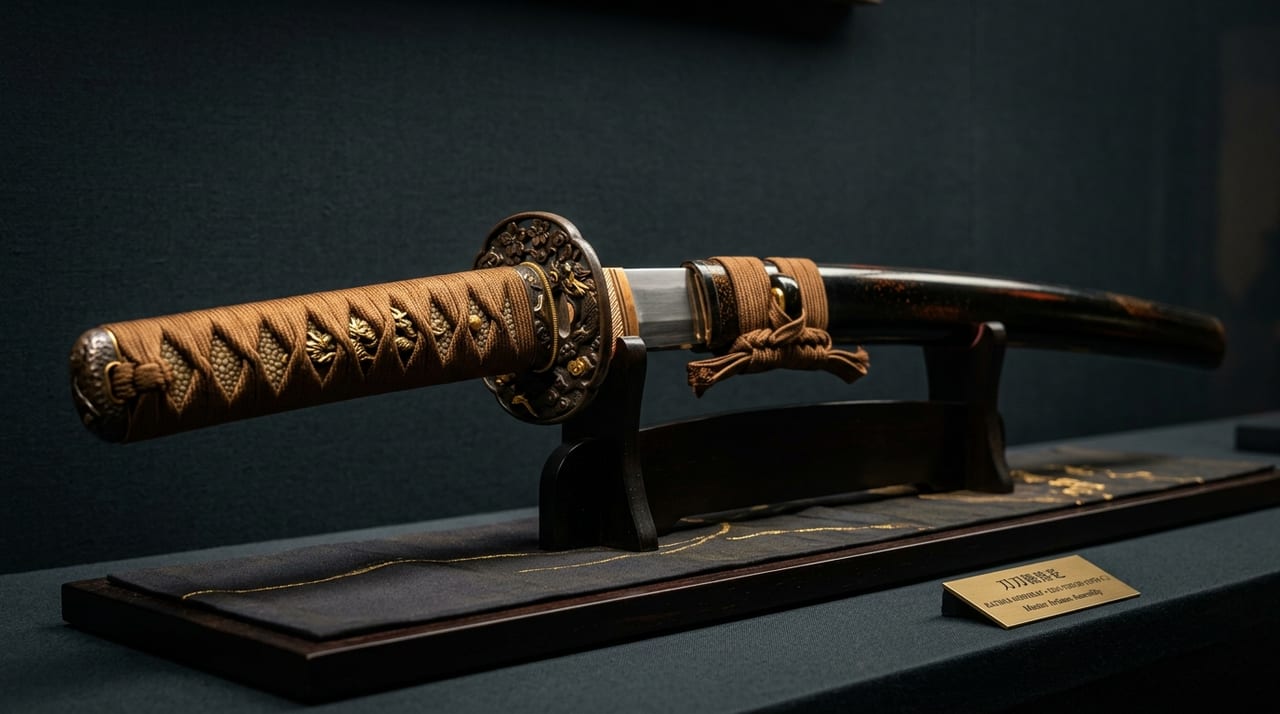 * Image is for illustrative purposes only.
Table of Contents
The Work of the Horimono Specialist — Inscribing Life onto a Polished Blade
Horimono refers to the specialized craft of incising patterns, characters, and designs onto the surface of a fully polished blade using cutting tools such as chisels (nomi), carving knives, and small knives (kogatana). The range of motifs carved into a blade is wide — dragons, ken (swords), Sanskrit characters, kurikara (a dragon coiling around a sword), gomabashi (ritual chopstick forms), bōhi (a single wide groove), soehi (a secondary groove), and more — each carrying religious, apotropaic, or aesthetic meaning.
The horimono specialist is neither a tōkō (kaji) nor a togishi, but an independent professional responsible for one of the final stages of sword production. Becoming a fully qualified carver is said to require at least ten years of training, and today the number of active full-time horimono specialists in Japan is extremely small. They are counted among the rarest craftspeople in the world of Japanese swords.
The placement of horimono also varies. Whether a motif is positioned on the shinogi-ji near the edge, on the hira-ji (flat), or near the nakago has historically been determined by the patron's faith, personal preference, and the stylistic conventions of the era. Motifs such as dragons and kurikara frequently carry meanings of warding off evil or praying for victory, while Sanskrit characters are said to carry Buddhist protective significance. The judgment of which motif to select and where to place it is itself one of the critical skills demanded of a horimono specialist.
The Carver's Tools — Types and Selection of Chisels and Carving Knives
The tools used in horimono are in many cases made or adjusted by the carver personally. Commercially available carving tools are rarely used as-is, because specialized tools suited to the hardness and curved surface of the blade are required.
The nomi (chisel) is the primary tool in blade carving. Multiple sizes are used, ranging from extremely fine blades of under 1 mm in width to those of around 5 mm. They are classified by the cross-sectional shape of the blade as follows:
- hira-nomi (flat chisel)
- maru-nomi (round chisel)
- sankaku-nomi (triangular chisel)
- V-shaped chisel
These are selected according to what is being carved:
- When carving dragon scales (uroko): maru-nomi
- When carving a straight hi: hira-nomi
- For the fine detail of Sanskrit characters: sankaku-nomi
Carving knives are smaller than chisels and are used for precision work. Because a long blade is difficult to control when incising fine motifs along the curved surface of a blade, short, manageable carving knives are used. When carving Sanskrit characters (letters of Sanskrit script) in particular, precise carving knives are indispensable for rendering the curves of the letters accurately.
Kogatana are used for finishing and correction. They are employed to correct over-carved areas and to clean up outline strokes; because the blade is a hard material, kogatana of higher steel hardness than ordinary woodcarving knives are required.
Before carving begins, ink guidelines are drawn on the blade as the underdrawing. The carver first traces the outlines of the motif with a brush or scribe, then advances the chisel along those lines. The blade is secured on a dedicated stand or vise-type fixture so that it does not move during work, and the carver drives the chisel with both hands while keeping the blade stable. Because cutting tools gradually lose their edge with use, it is standard practice to resharpen them repeatedly between work sessions.
The Role of Whetstones — Maintaining Tools and Preparing the Blade Surface
In horimono, whetstones serve a dual purpose. One is to keep the chisels and carving knives in a constantly sharp condition. The other is to dress the blade surface after carving.
The whetstones used by the horimono specialist often differ in type from the finishing stones used by the togishi. For sharpening tools, medium-grit and finishing stones are used in combination to maintain the correct edge angle of the chisels. For finishing the carved surface of the blade, the specialist works in coordination with the togishi, carefully polishing only the carved areas with extremely fine stones.
Surface preparation of the blade prior to carving is also important. A blade finished by the togishi already has an extremely smooth surface, but in some cases the surface at the areas to be carved is intentionally roughened slightly to prevent the tools from slipping. This treatment is calculated to disappear under the subsequent re-polishing.
During carving, small amounts of oil are said in some cases to be applied to the cutting edge and blade surface to suppress frictional heat and the scattering of metal particles. Because fine metal shavings (kiriko) adhere to the carved surface, the ongoing task of wiping them away to check the progress of the motif is also indispensable.
The Blade as Material — Constraints Imposed on Carving by Hardness and Composition
The tamahagane used for blades acquires a very high surface hardness after yaki-ire (quenching). This hardness places significant constraints on the horimono specialist's work.
Compared to carving wood or stone, carving a blade after quenching is incomparably more difficult. Carving into a hard material is prone to tool slippage, and applying excessive force risks breaking the tool or damaging the blade. Accordingly, the carver must develop a feel for the appropriate degree of force through many years of experience.
Blades are also frequently furnished with grooves known as hi. There are several forms — bōhi, soehi, futatsu-hi (twin grooves), and others — and these are not carved but cut out with a dedicated tool called a hi-nomi. The uniformity of the hi's angle, depth, and width greatly affects the beauty of the sword, demanding a high level of skill and concentration.
Working against a hard blade also causes rapid wear on tools, and chipping or breakage of chisel edges is not uncommon. For this reason, the carver keeps a generous supply of spare tools on hand and checks the condition of the blade throughout the work session. It is a profession that demands not only concentration but also the physical endurance to maintain the same posture for extended periods.
The Modern Horimono Specialist's Working Environment — Shortage of Successors and the Challenge of Transmitting the Craft
The number of blade carving specialists in modern Japan is estimated at no more than a few dozen nationwide. It is one of the rarest specializations among sword-related craftspeople, and the shortage of successors has become a serious concern.
Working conditions vary from craftsperson to craftsperson, but many work in a single room of their own home. Blade carving is difficult to mechanize, and the entire process is carried out by hand. Good lighting, a stable workbench, and sharp eyesight (or a loupe) are indispensable.
In terms of transmitting the craft, direct instruction from master to apprentice is the only method. The techniques of blade carving are difficult to convey in writing or on film, and there is no path other than years of observing the master's hands and learning through repeated failure. This rigidity of the apprenticeship system is itself a barrier to training successors, yet it is also an indispensable mechanism for maintaining the quality of the craft.
Making a living from horimono alone is difficult, and it is said that not a few practitioners also take on other sword-related work such as polishing or tōsōgu (sword fittings) production. Among the swords in circulation on the market, some bear horimono by renowned carvers, and understanding the skill of the carving and the meaning of the motifs is one of the points of appreciation when viewing or purchasing Japanese swords.