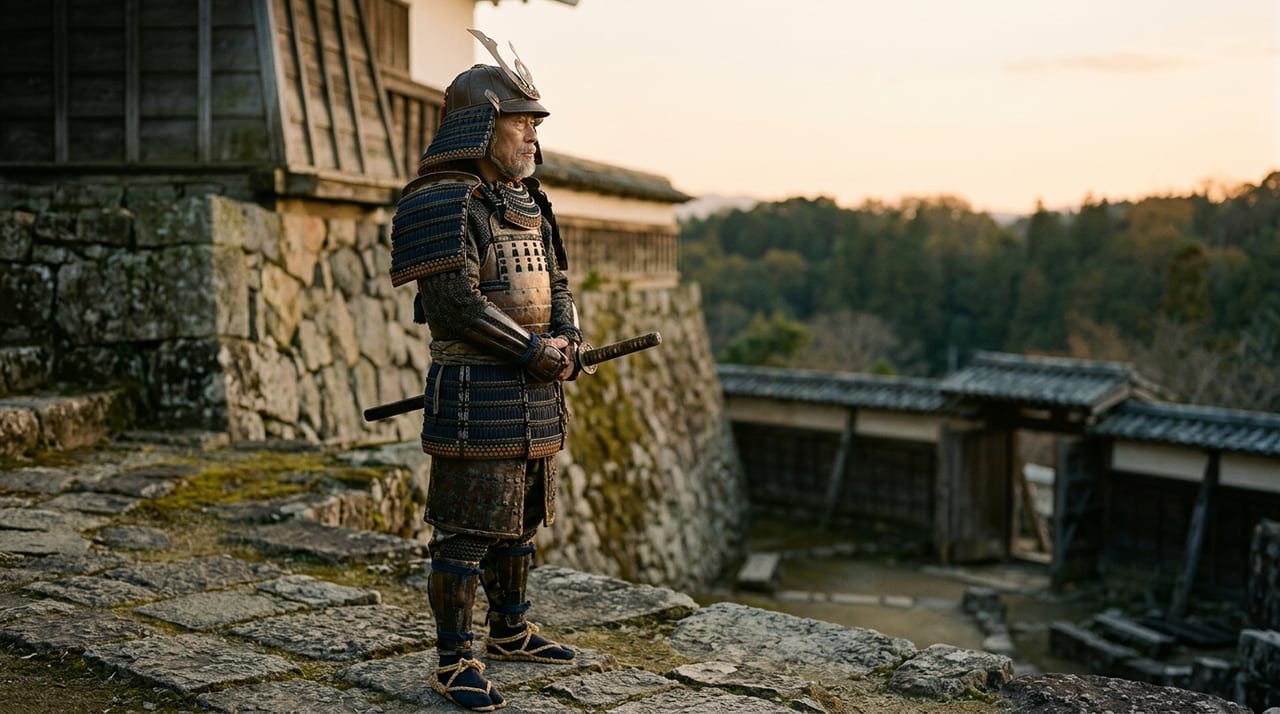
 * Image is for illustrative purposes only.
Yagyū Munenori
柳生宗矩
Sword Instructor to the Shōgun
Description
Lineage of the Shinkage-ryū
Yagyū Munenori was born in Genki 2 (1571) in Yagyū-no-shō in Yamato Province. As sword-fighting instructor to the Tokugawa shogun family, he spread the Shinkage-ryū throughout the realm and raised swordsmanship from a mere martial technique to a "way" of governing the state and bringing peace to all under heaven, which made him a swordsman-daimyō. His father, Yagyū Sekishūsai Muneyoshi, was a master who received certification of mastery from Kamiizumi Nobutsuna, founder of the Shinkage-ryū. Munenori, as his legitimate successor, systematized the Shinkage-ryū and established the standard of swordsmanship for the Tokugawa shogunate.
Yagyū Munenori's Training
The core of Munenori's thought lies in katsujinken (life-giving sword). His Heihō Kadensho (Book of Family Traditions on the Art of War) is both a book on swordsmanship and a philosophy of governance, and it runs through with the idea of katsujinken: "kill one evil person to give life to ten thousand good people." This is a grand philosophy that goes beyond swordsmanship as a mere technique for killing and wounding. It holds that the sword should be used to govern the realm and give life to people. For Munenori, the sword was a political tool for calming an age of chaos and maintaining peace, and a means of spiritual cultivation.
The Philosophy of the Life-Giving Sword
This philosophy of katsujinken is deeply tied to the Zen teachings of the eminent Rinzai Zen monk Takuan Sōhō. Takuan sent Munenori the Fudōchi Shinmyōroku and expounded on the state of mind that swordsmanship requires. "Ken-zen ichinyo" (sword and Zen are one) lifted Munenori's swordsmanship from a technique to a spiritual state. The "fudōchi" that Takuan taught is a state in which the mind does not stop in one place but works freely. This teaching matched remarkably well with the Shinkage-ryū tactical idea of "go no sen," which means waiting for the enemy's attack and winning by seizing the opening it creates.
Sword Instructor to the Shogun's House
Munenori excelled as a politician as well as a swordsman. Serving the two shoguns Tokugawa Hidetada and Tokugawa Iemitsu, he did not limit himself to the role of sword instructor. In Kan'ei 9 (1632) he became the first sōmetsuke (ōmetsuke, inspector general) of the shogunate, and he oversaw the supervision of the senior councilors and the daimyō. He held 12,500 koku in Yagyū in Yamato Province. That a swordsman obtained the status of daimyō is without parallel in Japanese history. This shows that both Munenori's swordsmanship and his political skill were indispensable to the shogunate.
The Way of Governing the State and Bringing Peace to the Realm
In the Heihō Kadensho, Munenori called the martial art of settling a contest with two swords "a very small art of war," and he taught "a great art of war," in which one person wins and the realm wins. He also said of "mutō" (no-sword) that it does not necessarily mean taking the opponent's sword. It is a principle for not being cut down by others when one's own sword is absent.
The Heihō Kadensho
The Heihō Kadensho, which summarizes Munenori's thought, is praised as one of the two great peaks of early-modern martial arts writing, alongside Miyamoto Musashi's Gorin no Sho (The Book of Five Rings). It also influenced works outside the martial arts, such as Hagakure and Nitobe Inazō's 'Bushidō'.
Swordsmanship Turned into Philosophy
In Shōhō 3 (1646), Munenori died in Edo at the age of seventy-six. The Shinkage-ryū swordsmanship and the philosophy of the life-giving sword that Munenori established became the foundation of samurai education in the Edo period and defined the proper role of the sword in an age of peace. From a tool for killing people to a tool for giving life to people: this transformation by Munenori is one of the most profound philosophical achievements in Japan's sword culture.