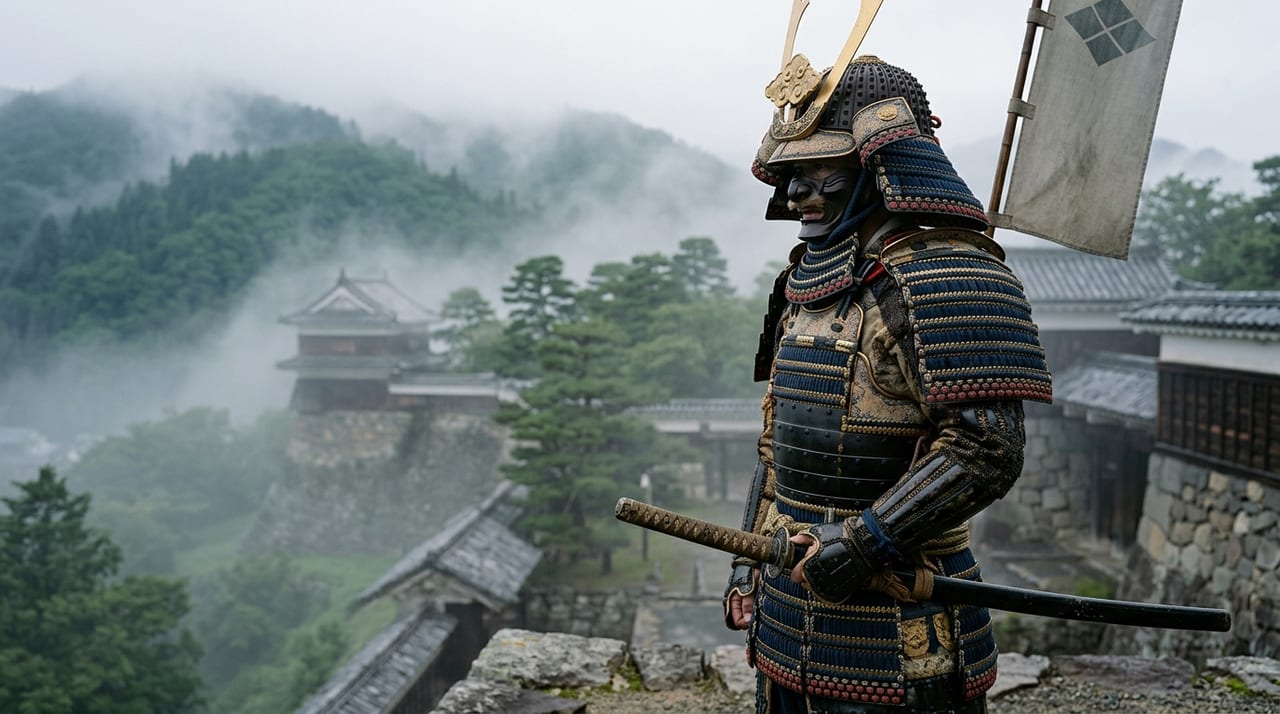
 * Image is for illustrative purposes only.
Ukita Naoie
宇喜多直家
The Dark Strategist of Bizen
Description
The Birth of a Kyōyū
Born in Bizen Province in Kyōroku 2 (1529), Ukita Naoie was a kyōyū (a ruthless, cunning warlord) who left his name in Sengoku history as a "master of assassination" and a "virtuoso of marriage diplomacy." The greatest feature of Naoie's life was that he expanded his power by skillfully using intrigue, assassination and marriage diplomacy rather than pure military force. Naoie's methods, which earned him the title of the kyōyū of Bizen, were condemned by contemporary observers as "cowardly" and "inhuman," while at the same time they were spoken of with awe as "rare strategic genius" and "a ruthless rationality possible only for a hegemon of the age of chaos."
From Declining House to Rising Power
According to war chronicles, his grandfather Ukita Yoshiie, a senior retainer of the Urakami clan, was assassinated during Naoie's childhood, and the Ukita family fell into decline. Naoie wandered together with his father Ukita Okiie. Naoie began as a minor warrior serving Urakami Munekage, and gradually rose to prominence through his talent and intrigue. The war chronicles state that Naoie had several men murdered by plot, including Shimamura Morizane, said to be the enemy of his grandfather, and his father-in-law Nakayama Katsumasa. In Eiroku 9 (1566), he had Mimura Iechika of Bitchū shot dead with a firearm by a hired assassin. This method could not escape censure under the samurai ethics of the time, but Naoie carried it out without any moral hesitation.
Swords and Intrigue in Bizen
Bizen Province has been known since ancient times as a great center of sword production. The swords made by the smiths of Osafune, known as the "Bizen-den" (Bizen tradition), are one of the most important schools in the history of the Japanese sword. From the late Heian period to the present, the region has produced more famous blades than any other in Japan. In Bizen Province under Naoie's rule, the smiths of Osafune continued to be active, mass-producing battle swords to meet the demands of a chaotic age, and they also continued to produce masterpieces by famous craftsmen.
Independence from the Urakami Clan and Conquest of Bizen
Naoie spent many years building up his strength under Urakami Munekage, becoming the most capable figure in the Urakami clan. He then allied with the Mōri clan, which was opposed to Munekage, rebelled against his own lord, the Urakami clan, and in Tenshō 3 (1575) drove Munekage out to Harima. Naoie brought Bizen Province and parts of Mimasaka and Bitchū under his control.
From the Mōri to Nobunaga: Shifting Diplomacy
The core of Naoie's diplomatic sense lay in a thoroughgoing realism: always reading the tide of the times in advance and riding the side that would win. Having defeated the Urakami clan in alliance with Mōri Terumoto, Naoie defected from the Mōri clan in Tenshō 7 (1579) and made contact with Oda Nobunaga. This came when Hashiba Hideyoshi advanced into the Chūgoku region and Terumoto gave up on going up to the capital. Nobunaga did not trust Naoie at once, since Naoie had repeated his betrayals, and it is said that more than a month passed before his pardon was granted. Thereafter, Naoie fought the Mōri clan in various parts of Mimasaka and Bizen. To survive in an age of chaos, rational judgment must take precedence over emotion and personal obligation. Naoie understood this better than anyone.
Late Years and His Heir Hideie
Sometime between the end of Tenshō 9 (1581) and the beginning of the following year, Tenshō 10 (1582), Naoie died of illness at Okayama Castle. His heir, Ukita Hideie, was still a child, so he succeeded Naoie and led the Ukita family. Toyotomi Hideyoshi favored the young Hideie, who later married Hideyoshi's adopted daughter and became a pillar of the Toyotomi regime, counted among the Five Elders (Go-Tairō). Ukita Hideie, for whom the kyōyū Naoie had sown the seeds and whom Hideyoshi had raised to prominence, fought as the main force of the Western Army at the Battle of Sekigahara. Even after his exile, Hideie survived on Hachijō Island until he was aged 84.
The Beauty of Bizen Blades and the Sword of a Kyōyū
The swords made by the smiths of Osafune still boasted the highest standard of beauty and practicality in Naoie's time. In the Osafune of that era, the smiths known as Sue-Bizen ("late Bizen"), among them Sukesada and Tadamitsu, were active and left works that combined a beauty that captivates the viewer with a reliable sharpness. Naoie's mind as a schemer and the "practicality within beauty" of Bizen blades may seem contradictory at first, yet at a deep level they resonate. Just as the finest Bizen blades were not mere art objects but battle swords used on the battlefield, Naoie was not merely a schemer. He was a warlord who embodied the cold-blooded rationality needed to survive an age of chaos.