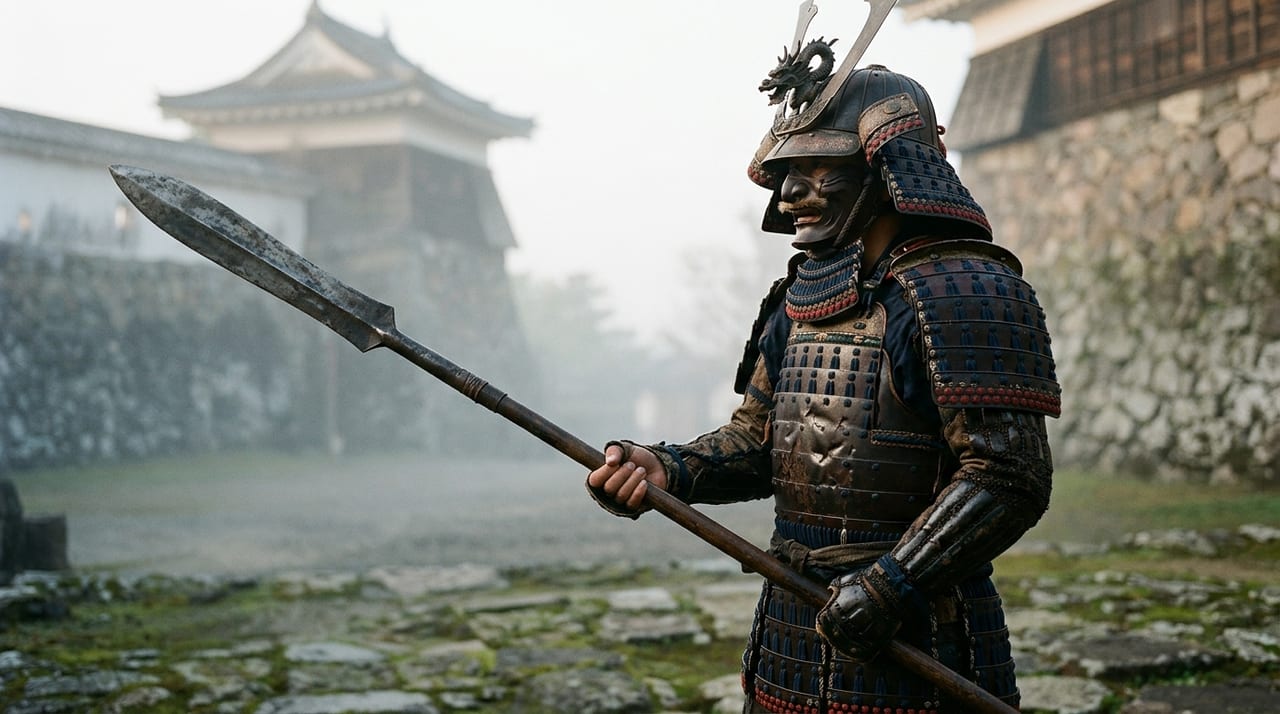
 * Image is for illustrative purposes only.
Mori Nagayoshi
森長可
Oni Musashi—The Fiercest Warlord Who Swept Across Battlefields, Elder Brother of Ranmaru and the Sengoku Era's Last Mad Knight
Description
The Birth of Oni Musashi
Born in Eiroku 1 (1558) as the second son of Mori Yoshinari, a formidable warlord of Mino Province (he succeeded to the family headship after his eldest brother Mori Yoshitaka was killed in battle), Mori Nagayoshi lived up to his nickname 'Oni Musashi' ('Demon Musashi') throughout his life, and he is remembered in history as the last pure warrior of the Sengoku period. His father, Yoshinari, served as a prominent commander under Oda Nobunaga, but he was killed in action at the Battle of Usayama Castle in Genki 1 (1570). Afterward, Nagayoshi succeeded to the family headship while still young, served Nobunaga, and began to display tremendous martial prowess while still in his teens. Whereas his younger brother Ranmaru was a trusted page attendant favored by Nobunaga for his intelligence and good looks, Nagayoshi, known as a fierce commander with the spear skill and martial valor he inherited from his father, contributed to Nobunaga in a completely different way.
The Martial Fame of Oni Musashi
In Tenshō 2 (1574), during the assault on the Nagashima Ikkō-ikki, Nagayoshi crossed a river by boat, charged in, and killed 27 rebels, showing his valor early on. During the Conquest of Kai (Tenshō 10, 1582), he served as vanguard together with Dan Tadamasa, and in the attack on Takatō Castle he climbed onto the castle's roof to fire guns into the castle, and he also took up his spear and fought valiantly. For this service, Nobunaga granted him the four districts of Kawanakajima in Shinano and Kaizu Castle. Because of his martial valor, his skill with the spear, and his honorary title Musashi-no-kami (Governor of Musashi), Nagayoshi was called 'Oni Musashi.'
His Favored Spear, 'Ningen Mukotsu'
The most famous of the weapons Nagayoshi favored was a jūmonji-yari (cross-bladed spear) named 'Ningen Mukotsu.' It was made by Izumi-no-kami Kanesada (also called Nosada) of Mino, and it is said that 'ningen' was carved on the front and 'mukotsu' on the back. The origin of the name is not clear, but some view it as a metaphor for a spear that could pierce through as if human bones were practically nonexistent. This spear was handed down in the Mori family, and it is now privately owned.
Aftermath of Nobunaga's Death and the Battle of Komaki and Nagakute
In the Honnō-ji Incident in the 6th month of Tenshō 10 (1582), his lord Nobunaga was killed, and his younger brother Ranmaru also perished in the same flames. At that time Nagayoshi had been campaigning in Echigo, but many of the Shinano local lords (kokujin) defected, so he withdrew with hostages to his former domain at Kaneyama in Mino. After the Honnō-ji Incident, when Hashiba (Toyotomi) Hideyoshi defeated Akechi Mitsuhide and seized actual power, Nagayoshi served Hideyoshi. However, because Oda Nobukatsu, a son of Nobunaga, allied with Tokugawa Ieyasu to oppose Hideyoshi, the Battle of Komaki and Nagakute broke out in Tenshō 12 (1584).
The Last Stand at Nagakute
On the 9th day of the 4th month of Tenshō 12 (May 18, 1584), Nagayoshi met a fierce end in the Battle of Nagakute. Nagayoshi led the second division of Hideyoshi's Mikawa raiding force (Mikawa nakairi) and captured Iwasaki Castle, but he was cut off from his line of retreat by Ieyasu's main army, and he joined Ikeda Tsuneoki in a decisive battle against the Tokugawa forces. Nagayoshi clashed with the forces of Ii Naomasa and fought valiantly, but he was shot between the eyebrows with a gun and died instantly. He was aged 27 by East Asian reckoning. It was an end that could hardly have been more fitting for the strongest fierce warrior known as 'Oni Musashi.' In this battle, Nagayoshi went into battle wearing a white robe over his armor, and he is said to have faced it with an unwavering resolve.
The Legacy of Oni Musashi
Mori Nagayoshi represents one extreme type of warrior of the Sengoku period. Although known for his bold valor, Nagayoshi also showed skill in domestic administration, including developing the Kaneyama castle town and instituting a monopoly on salt and sea fish, and he had a side that favored calligraphy and the tea ceremony. If his younger brother Ranmaru embodied the fusion of beauty and martial skill, Nagayoshi embodied the pure violence and terrifying intensity of the warrior's way. The fact that these brothers both perished at a young age symbolizes the beautiful yet cruel face of the Sengoku era itself.
Notable Swords
- Ningen Mukotsu (jūmonji-yari, made by Izumi-no-kami Kanesada, handed down in the Mori family, privately owned): the spear best known as Nagayoshi's signature weapon. It is said that 'ningen' was carved on the front and 'mukotsu' on the back.