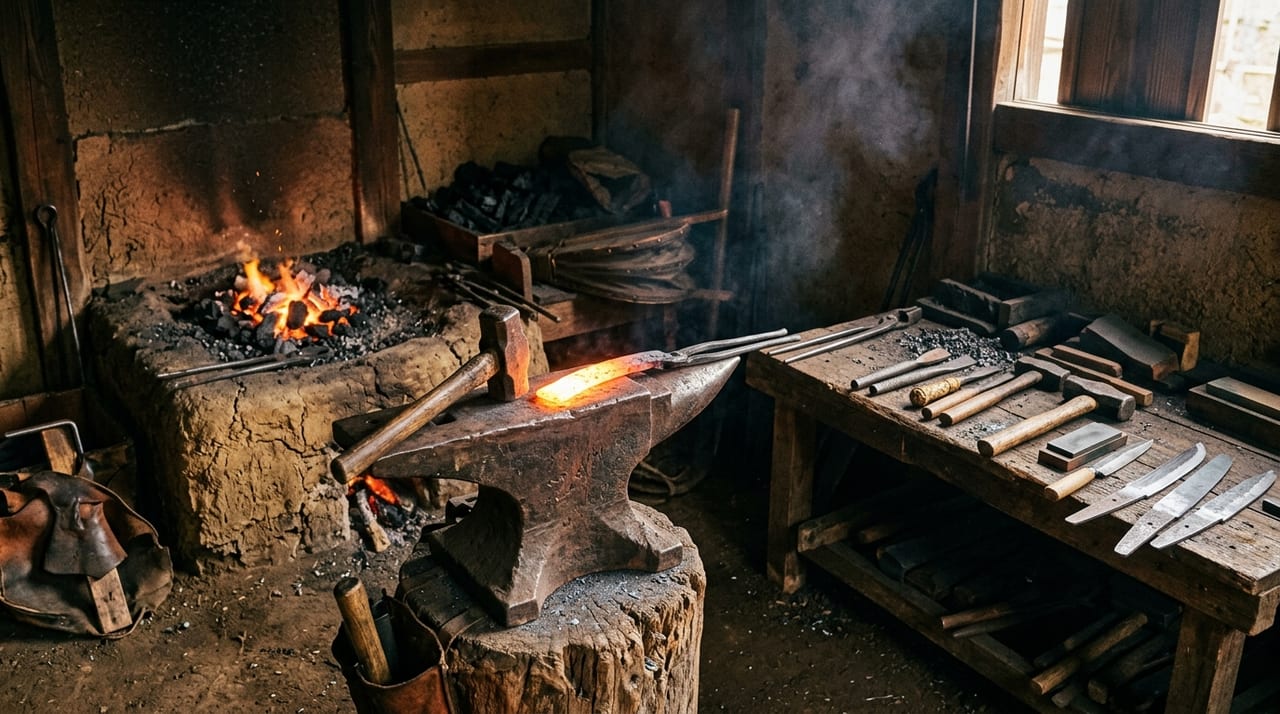
 * Image is for illustrative purposes only.
Yukimitsu
行光
Description
Yukimitsu, the Pioneer Who Laid the Foundations of the Sōshū Tradition
Yukimitsu was a swordsmith active in Kamakura, Sagami Province (Kanagawa Prefecture), in the late Kamakura period. He is traditionally regarded as the father or teacher of Masamune and is an important pioneer of the Sōshū smiths. He is said to have been a disciple of Shintōgo Kunimitsu. Early on, he established the Sōshū tradition style, which broke away from the Yamashiro tradition and is marked by bold hardened edges and refined jigane.
Yukimitsu is widely known through his master-disciple (or father-son) relationship with Masamune, who later gained fame as the greatest swordsmith in Japan. However, Yukimitsu's own works are also highly valued as independent masterpieces. Although few of his works are signed, a tanto by Yukimitsu held by the Tokyo National Museum (provenance: Maeda family of Kaga) has been designated a National Treasure. Some unsigned katana and tantō attributed to Yukimitsu have also been designated Important Cultural Properties.
The Formation of the Sōshū Tradition: Kamakura as a Special Setting
Kamakura, as the seat of the warrior government, had become the political and military center of Japan since the late Heian period. Demand for swords in this city far outstripped that of other regions, both in quality and in quantity, and it became a place where outstanding swordsmiths gathered from across the country. Shintōgo Kunimitsu, while building on the precision of the Yamashiro tradition, pioneered a new style of sword-making that placed importance on the powerful practicality demanded by Kamakura's warrior culture.
Yukimitsu trained under Kunimitsu and further developed his master's style. In particular, in forging the jigane he achieved a powerful expression with thick ji-nie and well-expressed chikei. This became a milestone on the path to the completion of the Sōshū tradition later achieved by Masamune.
Characteristics of His Swords: The Fusion of Boldness and Refinement in the Sōshū Tradition
Yukimitsu's works show the defining qualities of the Sōshū tradition at a high level, in both the jigane and the hamon. The jigane has densely packed itame-hada, thick ji-nie, and well-expressed chikei, giving it a rich appearance. Within its strength there is a distinctive dignity and lustre, and this is the greatest appeal of Yukimitsu's jigane.
The hamon ranges from suguha to ko-midare, and with well-developed nie it has a clear and vivid finish. Kinsuji and sunagashi also appear actively, and traces of the nie technique he inherited from his master Kunimitsu, further developed, can be seen throughout. Particularly fine examples are known among his tanto, and works that are evaluated as among the greatest tanto masterpieces of the late Kamakura period survive today.
Relationship with Masamune: Master and Disciple, or Father and Son?
The historical documents and traditions concerning the relationship between Yukimitsu and Masamune are tangled, and no definitive conclusion has been reached. The oldest sword book, Meizukushi, lists both Yukimitsu and Masamune as belonging to the lineage of Shintōgo Kunimitsu. The Takeya Rian manuscript of Tenshō 7 (1579) identifies Masamune as Yukimitsu's son. Another theory holds that Masamune was Yukimitsu's younger brother who later became his adopted heir.
The technical and stylistic foundation built by Yukimitsu lies behind the completion of the Sōshū tradition achieved by Masamune, the supreme realm in which kinsuji and sunagashi dance across a jigane of ō-nie. When speaking of the great achievements of Masamune, the greatest genius in the history of Japanese swords, the existence of Yukimitsu, who built that foundation, cannot be ignored.
TOUKENZA and Yukimitsu
TOUKENZA introduces Yukimitsu as an outstanding pioneer who stands before Masamune, the supreme peak. The techniques of the Sōshū tradition, passed down from master to disciple or from father to son, reached their greatest flowering in the history of Japanese swords through the mediation of Yukimitsu. Yukimitsu's works are still highly valued today as independent masterpieces, and at the same time they are an important key to understanding the miracle of Masamune.
Famous Works
- Tantō Signed Yukimitsu (National Treasure)
- Katana, unsigned (mumei), attributed to Yukimitsu (Important Cultural Property)