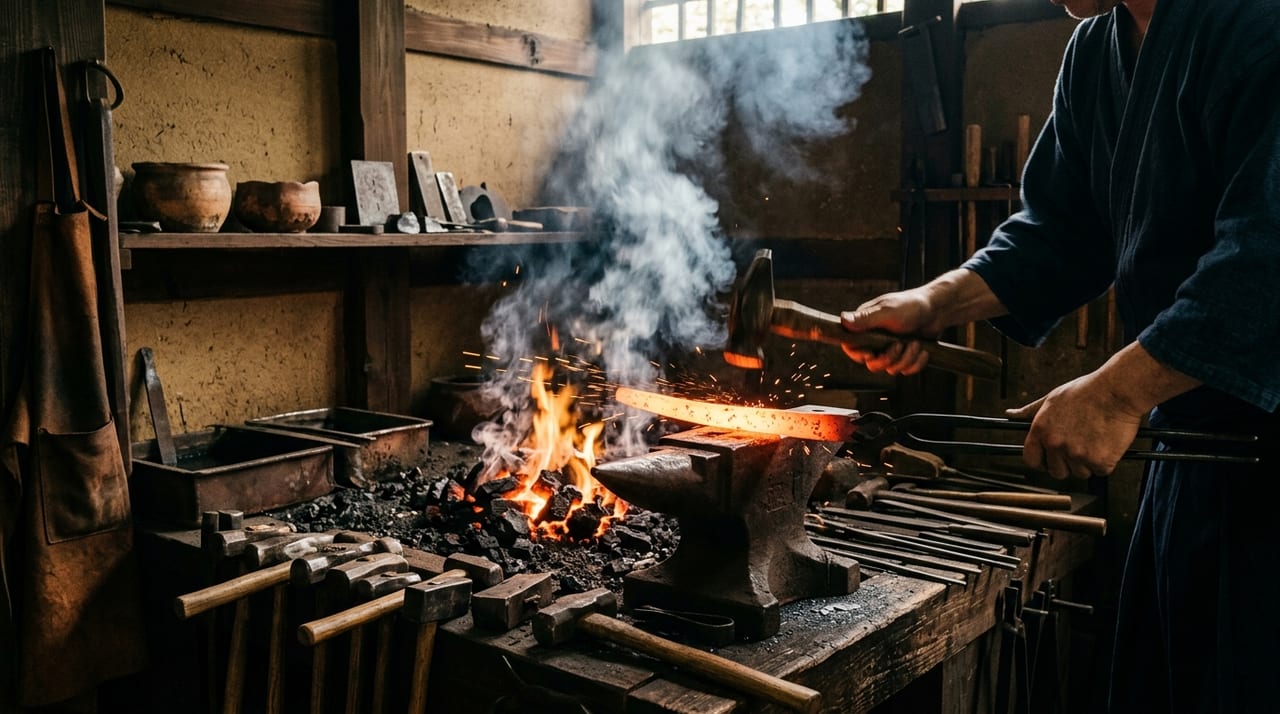
 * Image is for illustrative purposes only.
Tegai Kanenaga
手掻包永
Description
Tegai Kanenaga was the founder and representative smith of the Tegai school, one of the Five Yamato Schools that flourished in Yamato Province (present-day Nara Prefecture). His common name is transmitted as Heizaburō. The Tegai school was an active lineage spanning from around the Shōō era of the late Kamakura period (ca. 1288) through the Kanshō era of the mid-Muromachi period (ca. 1460), with Kanenaga, a smith of the late Kamakura period, marking the beginning of the school's prominence. Yamato smithcraft developed in antiquity under the patronage of major temples, and the Tegai school likewise was subordinate to Tōdai-ji Temple, establishing its workshop before the Tengai Gate, which stood to the west of the temple precinct. The name "Tegai" derives from the corruption of "tengai" (the gate name); this same gate is also known as the Tegai Gate. Besides Kanenaga, the lineage produced numerous swordsmiths—Kanekiyo, Kaneyoshi, Kanetsugu, Kanetoshi, Kanemitsu, and Kanezane—all bearing the character 包 at the beginning of their names. It is also transmitted that Shizu Kaneuji, who is counted among the Masamune no Jittetsu, originally bore the signature Kaneuji and is said to have originated from the Tegai school.
His characteristic style is marked by ground steel in which small itame skin is mingled with masame skin, with strong ji-nie formation—a manifestation of Yamato tradition metalwork. In the Tegai school, this appears as a gentle itame structure mixed with masame. The blade pattern is fundamentally straight (suguha), with the middle-straight (chū-suguha) variation displaying hatarakis such as kuichigaiha, nijūba, and hotsure; the edge grain shows nie particles standing in bright ranks to pleasing effect. Besides the straight blade, examples appear with gunome arranged in the pattern called tamagaki-ha, and with ko-midare mixed throughout; the tip (bōshi) displays hakikake. The sugata is sound and exhibits the dignity characteristic of Yamato tachi form.
Over the school's long continuation, works made until the Nanboku-chō period are called Tegai, while those of the later Muromachi period are customarily termed Sue-Tegai (later Tegai). As the same signature was inherited by successive generations, the Tegai school produced more extant works than any other Yamato group and is counted among the most representative schools of Yamato smithcraft. The abundance of fine signed tachi is a principal reason the school remains widely known.
Most famous among his representative works is the National Treasure tachi with signature Kanenaga, housed in the Seikadō Bunko Art Museum. Measuring 73.0 centimeters in blade length, this is a Kamakura period work of graceful, high-curved tachi form, displaying itame ground steel flowing and mingled with masame, strong ji-nie, and a suguha-style blade with strong nie, remaining sound even after seven hundred years—a superior example of Kanenaga's craftsmanship. It passed through the former collection of Akaboshi Tetsuma before being transmitted to the Iwasaki family, and is now in the Seikadō collection. The famous blade "Konotegashiwa," said to have been presented to Tokugawa Ieyasu by way of Hosokawa Fujitaka, survived the Great Kantō Earthquake of Taishō 12 (1923) in burned condition and remains extant, now housed in the Tokugawa Museum in Mito. As these authenticated signed works demonstrate, Kanenaga is held in high regard as a superior craftsman who embodies the Yamato tradition.
Famous Works
- tachi, signed Kanenaga (National Treasure; collection of Seikado Bunko Art Museum)