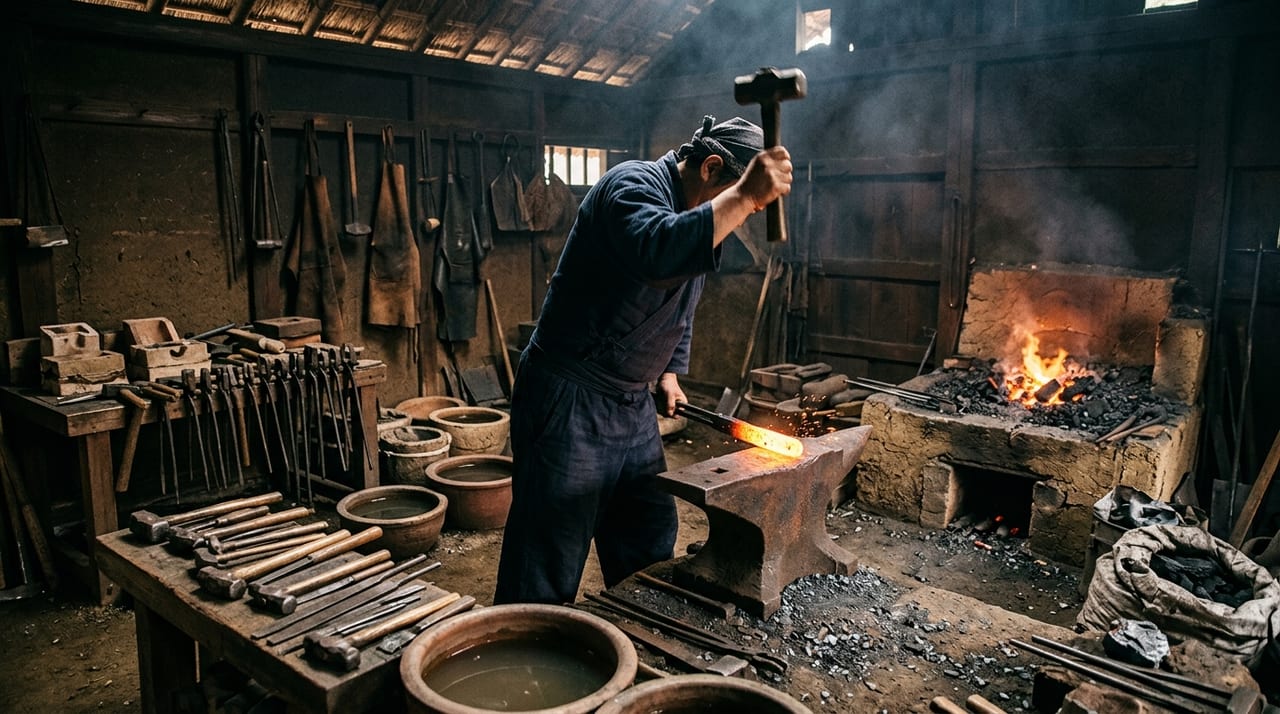
 * Image is for illustrative purposes only.
Sumitani Masamine
隅谷正峯
Description
Sumitani Masamine (1921–1998) was a master swordsmith who represented the contemporary swordsmiths of the Shōwa and Heisei eras. In 1981 (Shōwa 56), he was certified as a holder of Important Intangible Cultural Property (Living National Treasure) for his techniques in making nihontō. A native of Mattō, Ishikawa Prefecture (now Hakusan), he inherited and revived the orthodox Bizen-den tradition in modern times, and his name is permanently inscribed in the history of Japanese swords.
Masamine dedicated his life to reviving sword forging, which had declined after the Haitōrei (the edict abolishing the wearing of swords). He trained in forging techniques under his teacher, Sakurai Masayuki, and continued on the path of a swordsmith even through the turmoil of the postwar period. He studied the styles of Ko-Bizen and Osafune thoroughly and devoted his life to restoring the exquisite chōji-midare and utsuri that the Osafune school of the Kamakura period was proud of.
The greatest feature of Masamine's swords is the reproduction of the magnificent chōji-midare peculiar to the Bizen tradition. The jigane shows a bright, lustrous surface with finely packed ko-itame, and utsuri stands out on the ground, presenting the typical Bizen-hada. The hamon shows a vigorous development of varied chōji forms, including ō-chōji, kawazuko-chōji, and saka-chōji, and along the habuchi, a bright, clear nioiguchi runs in good balance. His hamon, which he completed by mastering the sword-making methods of the Bizen tradition of the Kamakura period, is called "Sumitani chōji."
He received the highest award, the Masamune Prize, several times at the Shinsaku Meitō-ten (new sword exhibition), and he also produced sacred treasure tachi for the periodic rebuilding (Shikinen Sengū) of Ise Jingū. He served as a judge for the Society for the Preservation of Japanese Art Swords (NBTHK) and holds mukansa (exempt from judging) status.
His signature (mei) was cut as "Masamine" and variants. His works are still valued today as one of the pinnacles of modern swords.
Famous Works
- Tachi, sacred treasure for the Shikinen Sengū at Ise Grand Shrine