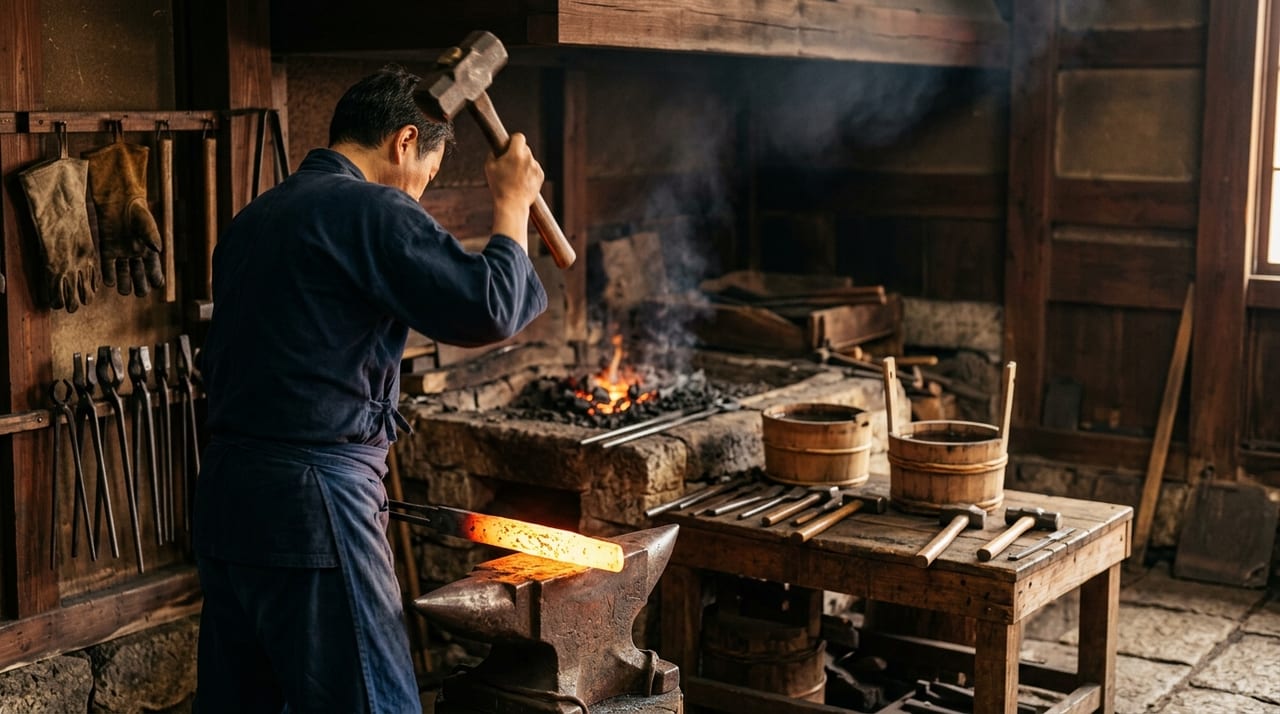
 * Image is for illustrative purposes only.
Settsu-no-kami Tadayuki
摂津守忠行
Description
Settsu-no-kami Tadayuki was a Shintō-period swordsmith active in Osaka during the mid-Edo period. The title Settsu-no-kami (Governor of Settsu Province) was an honorary court rank conferred in recognition of exceptional swordsmithing skills. The name was transmitted across multiple generations, with the first generation (Shodai Settsu-no-kami Tadayuki) regarded as the most technically accomplished.
School and Tradition
Active within the Osaka Shintō tradition, Tadayuki developed a personal style influenced by the prominent Osaka smiths of his era while maintaining distinctive characteristics.
Style
The jigane displays the refined ko-itame ground steel typical of Osaka Shintō, dense with fine ji-nie. The hamon is based on gunome with a bright, tight nioikuchi. His blades balanced practical cutting performance with aesthetic refinement.
Legacy
Listed as Ryō-wazamono (Good Excellent Blade) in the Kaihō Kenjaku blade-testing records. Because the name Settsu-no-kami Tadayuki was passed through multiple generations, attribution of individual works to specific generations requires detailed connoisseurship.
Related Swordsmiths
堀川国広
Soshu tradition (New Sword)Horikawa Kunihiro
Momoyama to Early Edo period (New Sword genesis era)
山浦真雄
Sōshū and Bizen traditionYamaura Saneo
Late Edo Period (Shinshintō era)
肥後守輝広
ShintōHigo no Kami Teruhiro
Azuchi-Momoyama to early Edo period (around Keichō)
越前下坂
Sōshū tradition lineage (Shintō period)Echizen Shimosaka
Early Edo period (Shintō era)