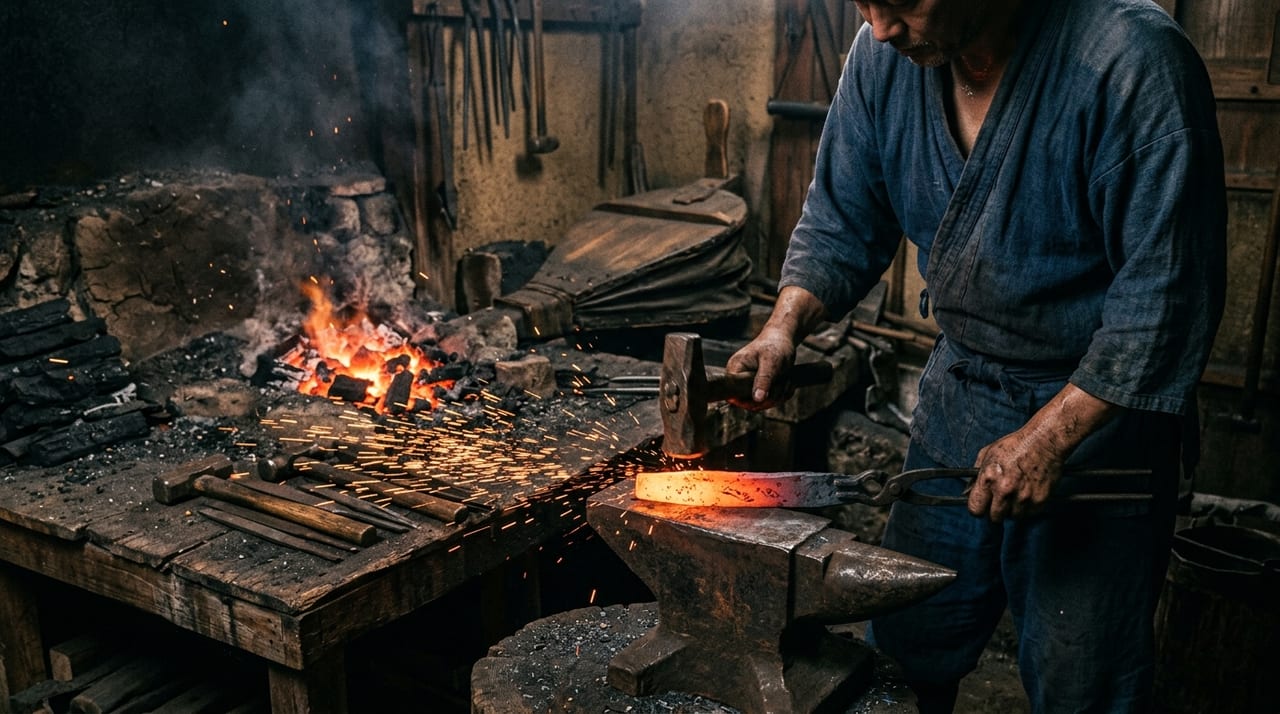
 * Image is for illustrative purposes only.
Gassan Sadakazu II
月山貞一(二代)
Description
Gassan Sadakazu II (1907–1995) was a contemporary swordsmith who represented the Shōwa and Heisei eras. In 1971 (Shōwa 46) he was certified as a holder of an Important Intangible Cultural Property (Living National Treasure) for his Japanese sword-making techniques. As head family (sōke) of the Gassan school, he carried the traditions of the Gassan lineage, which had continued since the late Edo period, into the present day and developed them further. Gassan Sadakazu I is known as a master smith of the shinshintō period, while Gassan Sadakazu II established a new pinnacle for the Gassan school in the contemporary sword world and left an enduring name in the history of Japanese swords. He inherited the forging of ayasugi-hada, the hallmark of the Gassan school, and was also accomplished in the sword-making methods of the Sōshū tradition, Yamato tradition, Yamashiro tradition and Bizen tradition. Ayasugi-hada is a distinctive forging expression in which the forged surface of the jigane (base steel) shows a cedar-twill pattern like wood grain, and it is a secret technique that the Gassan school has passed down uniquely. The hamon takes many forms, including sugu-ha (straight temper), notare (undulating temper) and gunome (choppy temper), but all of them place importance on harmony with the ayasugi-hada jigane, and they show a dignified quality with fine, evenly distributed nie. The taihai covers a wide range of types, including tachi, katana, wakizashi and tantō, but its basis is a dignified form that honors classical style. Born in Osaka, he was responsible from 1929 (Shōwa 4) for making goryō-tachi (ceremonial tachi) and sacred-treasure tachi for the Shikinen Sengū of the Ise Grand Shrine. In 1966 (Shōwa 41) he succeeded to the name Gassan Sadakazu II, and in 1968 (Shōwa 43) he opened the Gassan Japanese Sword Forging Dōjō, trained many disciples and formed the lineage of the contemporary Gassan school. At the New Work Sword Exhibition (Shinsaku Meitō-ten) he won the Masamune Prize three times, and he continues to be valued today as the pinnacle of contemporary swords.
Famous Works
- Imperial-offering and sacred-treasure tachi for the Ise Grand Shrine Shikinen Sengū (made from 1929 [Shōwa 4])
- Masamune Prize winner, Shinsaku Meitō-ten (1967–1969)