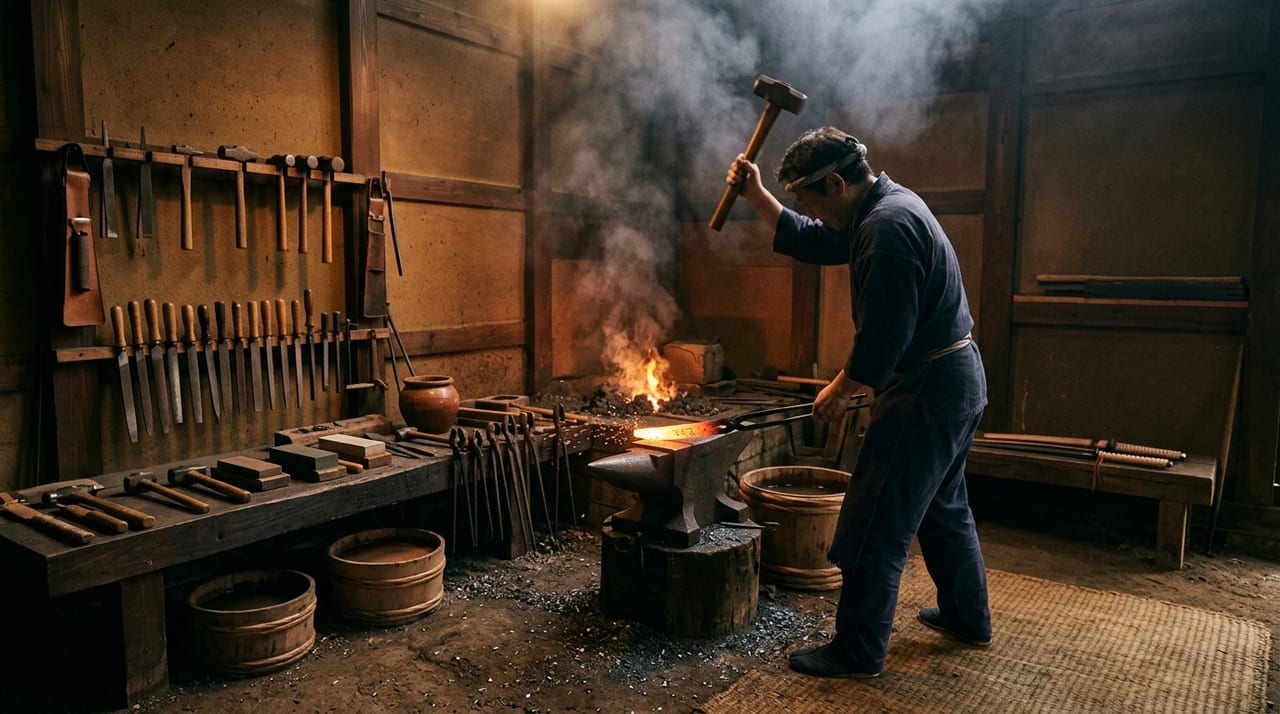
 * Image is for illustrative purposes only.
Etchū-no-kami Masatoshi
越中守正俊
Description
Etchū-no-kami Masatoshi was a swordsmith of the early Edo period who worked in Yamashiro Province (present-day Kyoto Prefecture), and he is one of the leading master smiths of the Mishina school. The Mishina school was a major shintō school that flourished in Yamashiro Province, and Masatoshi is known as the embodiment of its technical peak.
A characteristic of the Mishina school is that its jigane shows flowing itame, with abundant ji-nie that gives a moist, lustrous surface. While faithfully inheriting these features, Masatoshi's swords complete a distinctive jigane expression by adding refined ko-itame. The hamon is based on notare, mixed with gunome and ko-gunome, and shows refined variation. Within the blade, the nioi-guchi is tight, ko-ashi and yō are at work, and the precise craftsmanship typical of the Mishina school is seen throughout.
Masatoshi received the title Etchū-no-kami in Keichō 2 (1597), which shows the high social standing of a swordsmith of that time. He often signed with the long-form inscription “Etchū-no-kami Fujiwara Masatoshi,” and a shortened form, “Etchū-no-kami Masatoshi,” is also seen.
His active period in the early Edo era was a time when shintō-era techniques were maturing. Masatoshi fully absorbed the technical accumulation of this age, and by adding his own ingenuity to the basic techniques of the Mishina school that he inherited from his father, Mutsu-no-kami Daidō, he established a dignified and distinctive style. The range of his works is said to be the broadest among the four brothers, and he is remembered by later generations as a smith especially highly regarded within the Mishina school.