 * Image is for illustrative purposes only.
Urashima Tōshirō
浦島藤四郎
Also known as: Urashima—a tanto by Awataguchi Yoshimitsu, a famous sword (meibutsu), passed down through the Ashikaga shogun family
Description
Urashima Tōshirō is a notable tantō forged by Awataguchi Yoshimitsu (commonly called Tōshirō Yoshimitsu), the preeminent master of the Kyoto Awataguchi school. Yoshimitsu was a smith based in Awataguchi, Yamashiro Province (present-day Awataguchi, Higashiyama Ward, Kyoto), and was celebrated as the finest smith of his era, earning the epithet "Presiding Master of the Smiths" (kaji-osa) for his exceptional skill. The tantō he created became widely known under the affectionate name "Tōshirō" (derived from his name), and many such blades survive today as National Treasures and Important Cultural Properties. Urashima Tōshirō is distinguished among the "Tōshirō" tantō as a particularly elegantly named blade.
The name "Urashima" is said to derive from the blade's provenance through a shrine or priestly family connected to the legend of Urashima Tarō, or from the name being bestowed by the Ashikaga shogunate in allusion to the Urashima legend. It is also possible that the name was given because the blade's refined form and clear hamon evoke the fantastical world of the Urashima tale.
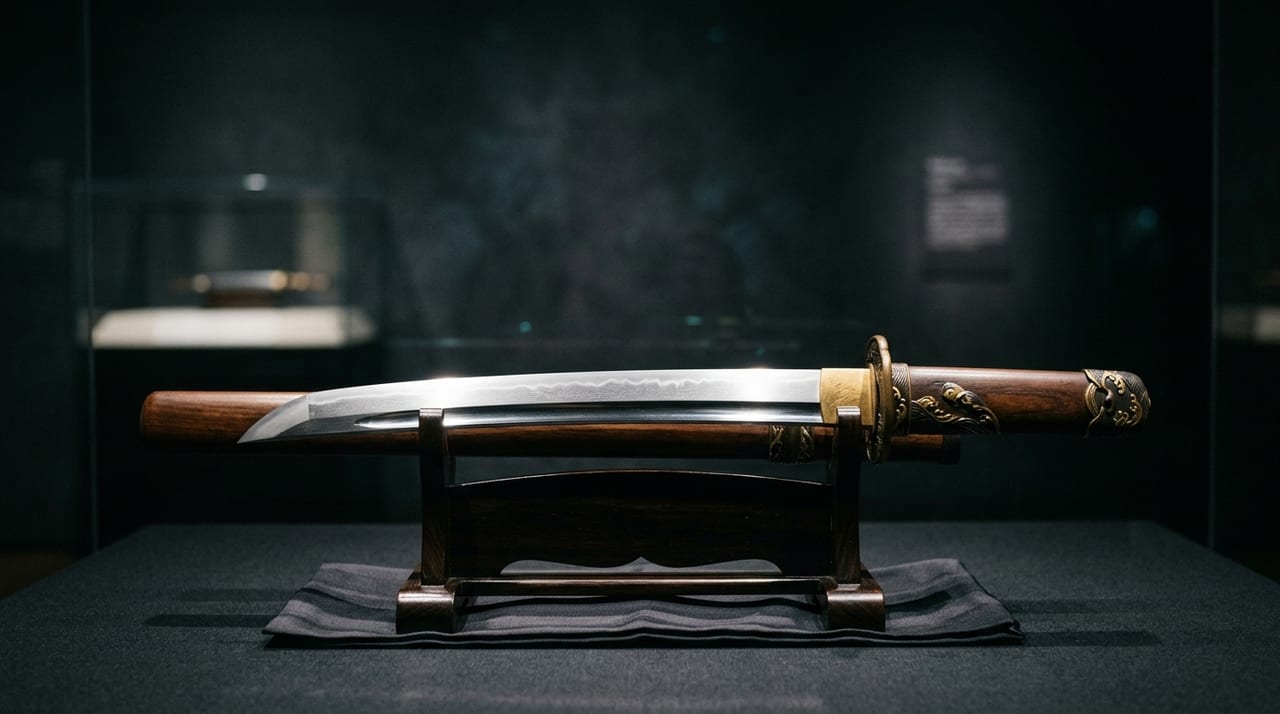
The blade, approximately 26 cm in length, exhibits hira-zukuri construction characteristic of Yoshimitsu's tantō, maintaining an elegant, well-composed form. The jigane displays the Awataguchi school's distinctive tightly-packed ko-itame-hada, presenting a fine, silk-like grain with evenly distributed, delicate ji-nie that imparts profound depth and subtle luminosity. The hamon is primarily suguha (straight edge) with slight ko-midare and ko-chōji intermixed — a pure, refined style in which the nie is calmly gathered and the nioi-guchi shines bright and white. The hallmark of Yoshimitsu's hamon is precisely this simultaneous achievement of deep nie and white brilliance, which Urashima Tōshirō exemplifies.
Transmitted from the Ashikaga shogunate to the Toyotomi and Tokugawa houses, the blade is now carefully preserved at the Tokugawa Art Museum as an important part of its collection and is held in high regard by sword appraisers as an ultimate expression of Yoshimitsu's art. The tantō of the Awataguchi school are often described as "a treasury of National Treasures," and among them, Urashima Tōshirō has long been cherished by both enthusiasts and scholars for its particularly elegant name and serene hamon.
Legends & Stories
The Urashima Tōshirō carries a legend befitting its name, one that transcends time. According to one tradition, the blade's lustre never fades despite the passage of years. When an appraiser polished it after centuries, it was found to be mirror-bright even before the work began. This mysterious phenomenon—as if the blade itself were resisting the flow of time—was interwoven with the tale of Urashima Tarō, who lost track of time in the Dragon Palace, giving rise to the legend that "the Urashima blade will not rust because it has passed through the waters of Ryūgū-jō, the Dragon Palace."
According to an anecdote from when it was passed down to the Ashikaga shogunate, the shogun who kept this blade at his pillow each night saw visions in his dreams of beautiful seascapes and a banquet held in a palace like the Dragon Palace. Upon awakening, the shogun gazed at the blade's hamon and said, "This reflects the treasures of the Dragon Palace"—and from that moment, the name "Urashima" is said to have become established.
In another legend, when Toyotomi Hideyoshi took this blade in hand, he declared, "This must surely be one of the treasures that Urashima Tarō brought back from the Dragon Palace." Among the many Tōshirō tantō that Hideyoshi prized, the Urashima Tōshirō was treated as exceptional, believed to be inhabited by the "spirit of the Dragon Palace." This tantō, which continues to stir people's imagination across the ages, today still preserves an eternal, Dragon Palace-like radiance while quietly being passed down.