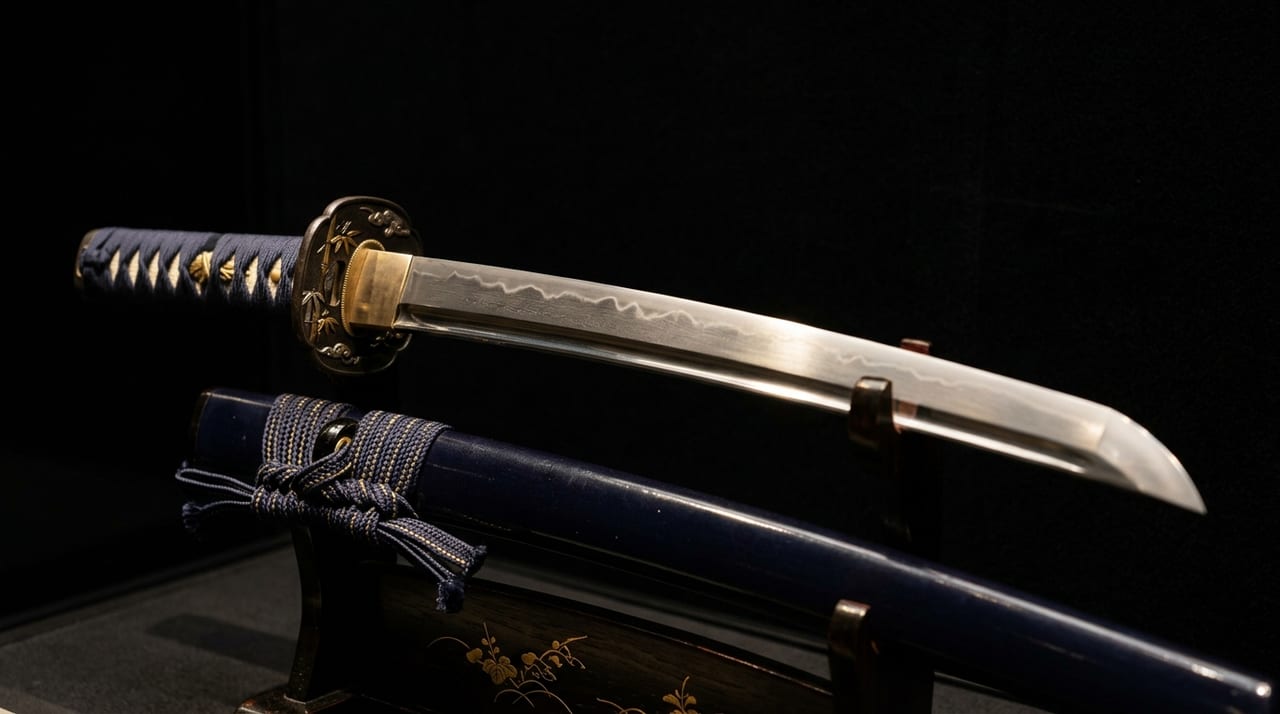
 * Image is for illustrative purposes only.
Urashima Kotetsu
浦島虎徹
Also known as: Urashima Tarō Horimono Kotetsu
Description
Overview of Urashima Kotetsu — A Wakizashi with Urashima Tarō Engraved on the Tang
Urashima Kotetsu is a wakizashi (short sword) forged by Nagasone Kotetsu Okisato (active circa Kan'ei to Enpō eras, early Edo period), the master swordsmith representative of the early Edo period. Kotetsu followed an unconventional path, coming from Echizen province to Edo and transitioning from armor-making to sword-forging, reportedly beginning his career as a swordsmith past the age of fifty. Despite this unusual start, his exceptional skill earned him recognition as the finest swordsmith of the Shintō ("New Sword") era, and his blades were treasured by the Tokugawa shogunate and daimyō lords alike. The name "Urashima Kotetsu" derives from an engraving (horimono) on the tang depicting the figure of Urashima Tarō. While horimono appear on many Kotetsu works, this blade stands out for the ingenuity of its composition and the precision of its carving, earning it the alternate name "Urashima Tarō-carved Kotetsu."
The blade measures approximately 34.1 cm (one shaku one sun four bu) in blade length and is a wakizashi of commanding presence, with a relatively wide blade width and moderately thick spine. The hamon (temper pattern) is based on gunome-midare, with abundant nie (coarse martensite) appearing along the ha (edge), and the nioiguchi (boundary line of the hardened edge) is sharp and clear. The jihada (surface grain) exhibits densely forged ko-itame (fine wood-grain pattern), with fine ji-nie (grain martensite) and calm hada-dachi (grain prominence), exemplifying Kotetsu's signature refined forging. The bōshi (tip temper pattern) is ko-maru (small roundness) with kaeri (turnback), finished in yakizume style. The blade embodies the quintessential Kotetsu aesthetic—a fusion of martial robustness and refined sophistication.
This sword was passed down to the Ikeda family, lords of Tottori domain, and is currently held in a private collection, occasionally exhibited at special displays. Kotetsu's reputation soared during the late Edo to Meiji period when Kondō Isami, commander of the Shinsengumi, famously wielded a Kotetsu and praised it as wazamono (a blade of superior cutting ability). In this context, Urashima Kotetsu has been celebrated as a "masterwork of Kotetsu" from the Edo period onward, holding distinct value separate from other renowned Kotetsu blades such as Hachisuka Kotetsu. The Urashima engraving on the tang is more than mere decoration—it is a precious cultural legacy that conveys the swordsmith's erudition and playful spirit across the centuries.
Legends & Stories
Urashima Tarō on a Turtle — The Horimono that Speaks to the Swordsmith's Aesthetic
The horimono of Urashima Tarō engraved on the nakago of Urashima Kotetsu is more than mere decoration — it is a vital testament to the swordsmith Kotetsu's erudition and aesthetic sensibility. The legend of Urashima Tarō appears in ancient texts such as the Nihon Shoki and Man'yōshū, recounting the tale of a fisherman who saves a turtle, is welcomed to the Dragon Palace (Ryūgū-jō), and upon his return opens a jeweled box (tamatebako) only to become an old man. By the Edo period, this folktale symbolizing the passage of time and the longing for immortality was widely beloved. By engraving this motif on the tang, Kotetsu may have allegorically expressed that the sword is an "eternal treasure" meant to be passed down through the ages.
Kotetsu originally worked as an armor-maker and was reportedly skilled in metalwork and inlay techniques. This experience informed the precision of his horimono, and the tang engraving on Urashima Kotetsu is considered first-rate in both composition and line work. The patterns on the turtle's shell, the folds of Urashima's robe, and the undulations of the waves are all rendered with meticulous care, earning this blade recognition as one of the finest examples of sword horimono in later generations. During the Edo period, owning a Kotetsu sword was considered an honor among daimyō and hatamoto (direct retainers of the shogunate), but Urashima Kotetsu received special treatment due to the beauty of its engraving. One hatamoto famously remarked, "Kotetsu swords are for cutting; Urashima Kotetsu is for elegance," acknowledging its value as both a weapon and a work of art.
When Kondō Isami's admiration for Kotetsu sparked a boom during the Bakumatsu period, many forgeries flooded the market. However, blades with horimono like Urashima Kotetsu were difficult to counterfeit, and the presence of the Urashima engraving served as partial proof of authenticity. Even today, the "Urashima horimono" remains an important clue in Kotetsu scholarship among sword enthusiasts.