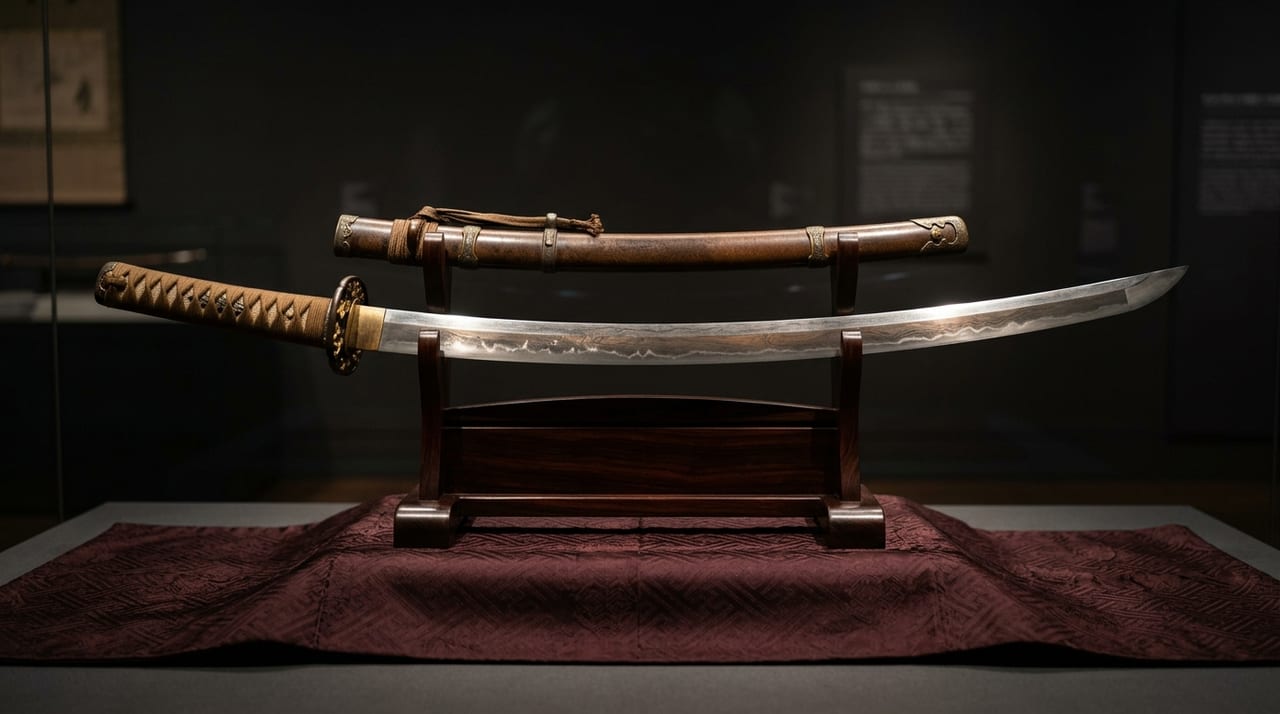
 * Image is for illustrative purposes only.
Uguisumaru
鶯丸
Also known as: Uguisumaru Tomonari; Uguisu Tachi Tomonari
Description
Overview of the Sword
Uguisumaru is a work by Tomonari, a master smith representative of Heian-period Ko-Bizen, and is a tachi bearing the signature "Bizen no Kuni Tomonari" on its tang (nakago). During the Muromachi period it was in the hands of the Ashikaga shogunal family and was treated as one of the famed meibutsu. The origin of the elegant name "Uguisu" (bush warbler) is unclear, but since the certificate of merit (kanjō) transmitted in the Ogasawara family refers to it as "Uguisu Tachi Tomonari," and the Keigen Komonjo refers to it as "Uguisumaru Tomonari," it has been known by the name Uguisumaru. Its blade length is about 81.8 cm (roughly two shaku seven sun), and it displays the graceful tachi form with deep koshi-zori typical of ancient Heian-period tachi.
Ko-Bizen and Tomonari's Style
Tomonari is a master smith of the Heian period who represents Ko-Bizen, and is known as one of the founders of Bizen blades, signing "Bizen no Kuni Tomonari." Tomonari's blades are elegant and vigorous, with a distinctive style that carries dignity even in its rugged simplicity. Uguisumaru is positioned as one of Tomonari's representative works, and it is valuable also for retaining the signature "Bizen no Kuni Tomonari" on the tang. However, the details of its style have provoked much debate, owing to the condition of the tang and the difficulty of appraising Heian-period tachi. Uguisumaru has been treasured as a signed work of Ko-Bizen and Tomonari.
Features of the Blade
The jigane of Uguisumaru shows hadatachi, with thick ji-nie, and midare-utsuri appears. The hamon is a ko-midare in the suguha-chō style, mixed with notare in the upper half. On the omote side is a five-character signature, "Bizen no Kuni Tomonari." This combination of jigane and hamon, typical of ancient blades, is a characteristic of Heian-period tachi. Based on its form and style, it is consistently evaluated as a Heian-period Ko-Bizen blade of the Tomonari tradition.
From the Ashikaga Shogunal Family to the Imperial Family
In the Muromachi period, Uguisumaru was one of the treasured swords of the Ashikaga shogunal family. The Ashikaga family was enthusiastic about collecting and appraising swords, and held many of the finest blades in the realm, such as Mikazuki Munechika, Dōjigiri Yasutsuna, and Onimaru Kunitsuna. Uguisumaru is transmitted as one of the blades especially favored by the Ashikaga family. In Kakitsu 1 (1441), in recognition of merit at the Yūki War, Ashikaga Yoshinori gave it to Ogasawara Masayasu, the Shinano shugo. From then on it was handed down through generations in the Ogasawara family, later the lords of the Echizen-Katsuyama domain. After the Meiji Restoration it left the Ogasawara family and passed through the family of Count Sō before being purchased by Tanaka Mitsuaki. In 1907 (Meiji 40), Mitsuaki presented it to the Emperor Meiji, after which it became part of the gyobutsu (Imperial Collection). It is now managed by the Imperial Household Agency as a gyobutsu. It is normally not open to the public, but it may be displayed on special occasions.
The Elegance of the Name "Uguisu"
In Japanese culture the uguisu (bush warbler) is an auspicious bird that heralds spring, and it has often been sung in poetry and waka. Giving a sword the name "Uguisu" is an act that fuses the samurai's aesthetic judgment with literary sensibility, layering the freshness of spring over the graceful form and clear steel color of the blade. This paradox of naming a weapon after a small spring bird — beauty and death, elegance and sturdiness, the joy of spring and the sharpness of the blade — embodies the aesthetic at the heart of Japanese sword culture.
Tomonari's Craft — The Essence of Ko-Bizen
Tomonari was a smith of Bizen Province in the Heian period (around the 10th to 11th centuries), and is one of the oldest master smiths representative of Ko-Bizen. Tomonari's works are placed at the pinnacle among ancient Heian-period blades, and his signed works bearing "Bizen no Kuni Tomonari" are cherished as valuable surviving pieces. That Uguisumaru is a signed work of Tomonari means that this tachi was made with the highest technique of the early age of Japanese swordmaking. Tomonari's style is characterized by a calm, dignified ko-midare hamon and the scenery of finely wrought itame-hada jigane. It is said to show the prototype of the "ideal Japanese sword" that later Bizen smiths aspired to. Detailed descriptions of Uguisumaru's hamon and jigane differ among sources, but as a work of Tomonari of the Heian period, its appearance is considered a typical elegant Ko-Bizen blade. It is a large tachi with a blade length of about 81.8 cm (roughly two shaku seven sun), and it shows the style of the battle tachi that Heian-period mounted warriors wore at the waist. It is now stored as a gyobutsu by the Imperial Household Agency, and public viewing is limited.
The Ashikaga Shogunal Family's Sword Collection
That Uguisumaru was a treasured sword of the Ashikaga shogunal family shows how highly the Muromachi shogunate valued swords as political and cultural tools. The Ashikaga family collected supreme famous blades such as Mikazuki Munechika and Dōjigiri Yasutsuna, and possessing them was proof of the shogun's authority and dignity. The tradition that Uguisumaru was in the shogun's hands means that this tachi was rated highest in the sword appraisal of its time. The "elegance of a bush warbler" implied by the name Uguisumaru matched the tastes and values of the Ashikaga family, which valued both martial power and culture. After Ashikaga Yoshinori bestowed it on Ogasawara Masayasu in Kakitsu 1 (1441), Uguisumaru was carefully guarded and handed down in the Ogasawara family. After the Meiji period, following Tanaka Mitsuaki's presentation in 1907 (Meiji 40), it has been passed down to the Imperial family as a gyobutsu.
The Standing of the Gyobutsu — A Tachi Passed Down in the Imperial Family
That Uguisumaru is now stored by the Imperial Household Agency as a gyobutsu raises the standing of this tachi to the highest rank. A gyobutsu is a cultural property owned by the Emperor and the Imperial family, and it is treated with the highest standing, distinct from National Treasures or Important Cultural Properties. The most famous sword in the Imperial family is the Kusanagi-no-Tsurugi, one of the Three Sacred Treasures (sanshu no jingi). Uguisumaru too has been cherished as a tachi holding a special position in the long history of the Imperial family. Because public viewing is limited, opportunities to see Uguisumaru's current condition in person are extremely rare. Past investigations and photographs have confirmed that it retains the typical features of Heian-period ancient swords. Uguisumaru, with the name of the supreme smith Tomonari and a lineage of the highest owners (the Ashikaga shogunal family, the Ogasawara family, and the Imperial family), will continue to be spoken of as one of the supreme existences in the history of Japanese swords.
Legends & Stories
The Origin of the Name Uguisu and Its Elegant Mystery
The origin of the name Uguisumaru is unclear. The certificate of merit transmitted in the Ogasawara family refers to "Uguisu Tachi Tomonari," and the Keigen Komonjo refers to "Uguisumaru Tomonari," and in the Muromachi period it was treated as a meibutsu. The name "Uguisumaru" expresses the uniquely paradoxical aesthetic of Japanese culture, wrapping the martial power and lethal nature of the sword in the image of a small bird that symbolizes the arrival of spring and the joy of life.
The Ashikaga Shogunal Family and Its Attachment to Famous Blades
The Ashikaga shogunal family in the Muromachi period was one of the greatest groups of connoisseurs in Japanese history in the collecting and appraisal of swords. Successive shoguns collected famous blades as symbols of authority. Uguisumaru too was one of the treasured swords of the Ashikaga shogunal family in the Muromachi period. However, at the Yūki War in Kakitsu 1 (1441), Ogasawara Masayasu, the Shinano shugo, achieved great merit on the shogunal side. Therefore, Ashikaga Yoshinori gave this Uguisumaru to Masayasu along with a certificate of merit. Thereafter, Uguisumaru was handed down through generations in the Ogasawara family, which became the lords of Echizen-Katsuyama Castle.
The Weight of the Name Tomonari
The blade of Uguisumaru bears the signature "Bizen no Kuni Tomonari." Tomonari was a master smith of Ko-Bizen who was active in Bizen in the Heian period, and ancient transmitted documents date his era to around Eien (987–989). Ko-Bizen forms the source of Bizen blades, and Tomonari's works are rated the highest as the earliest masterpieces of the school. That Uguisumaru is handed down today as a signed work of Tomonari means that this tachi carries the skill of a master of the Ko-Bizen tradition at its peak. Transmission and the physical object support each other, raising the value of the famous blade and passing it on to the next generation. Uguisumaru embodies this practice of Japanese sword culture in a typical form.
Uguisumaru as a Gyobutsu of the Imperial Family
In 1907 (Meiji 40), with Tanaka Mitsuaki's presentation, Uguisumaru became a gyobutsu of the Imperial family. Although gyobutsu are excluded from National Treasure designation, they receive the highest level of protection as the cultural and spiritual heritage of Japan. That a tachi bearing the name of a spring bird has come down to the present as a gyobutsu of the Imperial family, the highest position in the Japanese nation and culture, seems to symbolize the essence of Japanese culture: "to cherish beautiful things."
The Voice of the Bush Warbler and the Beauty of the Blade — The Japanese Aesthetic Sense
The image of the uguisu (bush warbler) embodied in the name Uguisumaru touches the core of the Japanese aesthetic sense. The uguisu has been loved by the Japanese since ancient times as the harutsugedori (the spring-announcing bird). Even in the oldest poetry collections, such as Man'yōshū and Kokin Wakashū, many poems sing of the bush warbler, and the scene of a bush warbler singing among plum blossoms is one of the most popular designs symbolizing spring in Japan. Attaching "uguisu" to the name of a sword gives the weapon a poetic and elegant dimension, which is a typical example of the cultural refinement of the samurai. In the warrior culture from the Heian to the Muromachi periods, the unyielding spirit of martial arts and admiration for the elegant courtly culture coexisted. Giving a famous blade an elegant name was a symbolic act showing that the samurai were not merely fighters but cultured people. The name Uguisumaru embodies the uniquely Japanese aesthetic of the fusion of martial spirit and elegance.
The Origin of Japanese Swords as Told by Ko-Bizen Blades
Uguisumaru, believed to be a work of Bizen Tomonari, stands near the origin of Japanese sword culture. The Heian period, when Tomonari lived, was the era when the basic form of the Japanese sword was established: a curved, single-edged blade with sharp cutting ability. The transition from earlier straight swords to the curved swords (wantō) that continued to the present was achieved through the technical explorations of smiths such as Tomonari of Ko-Bizen. As a signed work of Tomonari, Uguisumaru is counted among the earliest masterpieces in which the form of the Japanese sword was established. The significance of the Ko-Bizen ancient tachi as the starting point of Japanese sword culture, which has developed continuously for over a thousand years, is immeasurable. Even today, sword researchers value the skills of Ko-Bizen and Tomonari as the foundation of Japanese swordmaking, and Uguisumaru has become one of the important reference points in that research.
Uguisumaru's Evaluation Today
Even today, Uguisumaru holds a special place among Japanese sword enthusiasts and history fans. It is a signed work of Tomonari, a master of Ko-Bizen, and a tachi with the highest-rank provenance of the Ashikaga shogunal family, the Ogasawara family, and the Imperial family. In the sword game Touken Ranbu, Uguisumaru also appears as a popular character, depicted as an elegant character named "Uguisumaru," so the name has become widely known to younger generations. Because it is a gyobutsu, public viewing of the actual blade is limited. Still, its form can be known through photographs and catalogues, and research reports by scholars have accumulated. More than a thousand years after the Heian period, modern Japanese also hear the voice of the bush warbler in the name Uguisumaru and feel the spirit of Ko-Bizen in Tomonari's craft. This continuity of sensibility may be said to be one of the most special aspects of Japanese sword culture.