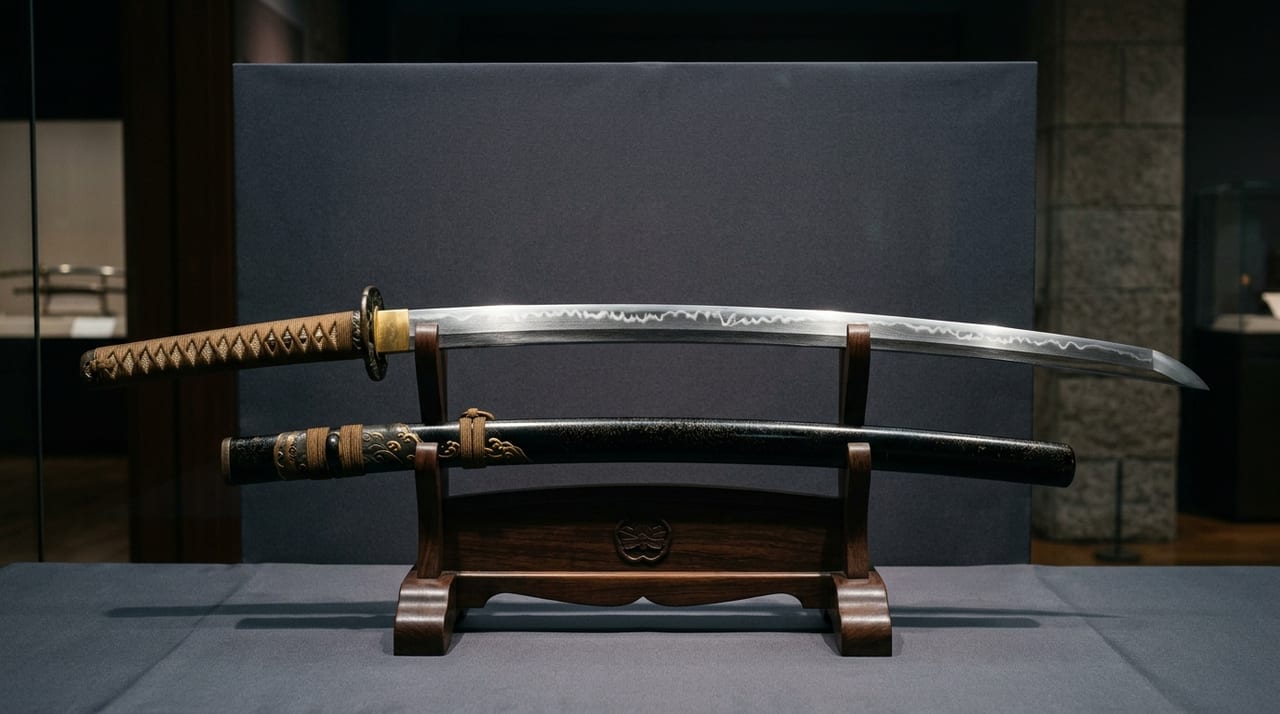
 * Image is for illustrative purposes only.
Tsuru Ichimonji
鶴一文字
Also known as: Ichimonji of the Crane
Description
Tsuru Ichimonji is a tachi forged by a swordsmith of the Fukuoka Ichimonji school, active in Bizen Province (present-day Okayama Prefecture) during the early to mid Kamakura period (13th century), and is designated an Important Cultural Property. The name "Tsuru Ichimonji"—"Ichimonji of the Crane"—is said to derive from the undulations of the chōji-midare (clove-flower irregular) hamon visible on this tachi's blade, which evokes the graceful form of a crane spreading its wings and dancing through the sky. It has been highly prized since ancient times by sword connoisseurs as a blade of refined, graceful form and a magnificent hamon that captivates the viewer.
The Fukuoka Ichimonji school was a prestigious group of Kamakura-period swordsmiths based in the Fukuoka-no-shō estate (present-day Fukuoka district, Osafune-cho, Setouchi City, Okayama Prefecture) in Bizen Province, producing distinguished masters such as Sukemune, Yoshifusa, Yoshihira, and Sukemitsu. The tachi of the Fukuoka Ichimonji school are defined above all by their heroic chōji-midare, establishing the most magnificent and powerful hamon style within the Bizen tradition (Bizen-den). Many Fukuoka Ichimonji masterworks were presented for imperial viewing (tenran-tō) and were deeply favored by the imperial court and retired emperors.
The blade of Tsuru Ichimonji embodies the typical style of the Fukuoka Ichimonji school: wide mihaba, somewhat thin kasane, and deep koshi-zori—the heroic form of the early Kamakura tachi. The hamon is centered on the Fukuoka Ichimonji characteristic large chōji-midare (ō-chōji-midare), with large, evenly matched chōji heads arrayed in vigorous succession. The nie is bright and strong, the ha-edge vivid, with active, deep nioi-ashi extending from the chōji heads. The jigane presents densely packed ko-itame-hada with even ji-nie and displays the vibrant, healthy surface characteristic of the Bizen tradition.
Currently held in a private collection or on deposit at a sword museum, it is made available for public viewing through special exhibitions. As a masterwork of the Fukuoka Ichimonji school, it continues to be highly valued by sword enthusiasts and researchers as one of the supreme expressions of Japanese sword beauty.
Legends & Stories
The most widely told legend associated with Tsuru Ichimonji concerns the episode of its naming. A certain renowned sword connoisseur of the Kamakura period — a court noble or warrior known for his skill in appraising blades — when he first viewed the hamon of this tachi, fell into a long silence, and then murmured: "A crane is dancing." The sweeping succession of great chōji in the hamon was so evocative of the movement of a red-crowned crane's wings as it kicks off the water and soars into the sky that the name "Tsuru Ichimonji" arose naturally from that moment of wonder. Another tradition holds that the lord of a certain daimyō household that owned this tachi, gazing out at his garden on the dawn of New Year's Day, saw a single crane alight on a branch of the garden pine. At that very moment, the Tsuru Ichimonji, housed in its appraisal box in the storehouse, faintly trembled — and those around him were filled with awe, saying, "The crane has come to pay its respects to the sword of the crane." It is also said that the smiths of the Fukuoka Ichimonji school held a craft-based mythological belief: "The chōji of a sword are the fingerprints of the gods." The chōji-midare was forged not as a mere technical product but in accordance with the faith that it was a sacred pattern — the breath of the gods imprinted in iron. The great chōji-midare of Tsuru Ichimonji has been transmitted within the Fukuoka Ichimonji tradition as the example in which these divine fingerprints are most abundantly manifested — the single blade of most potent divine power in that tradition.