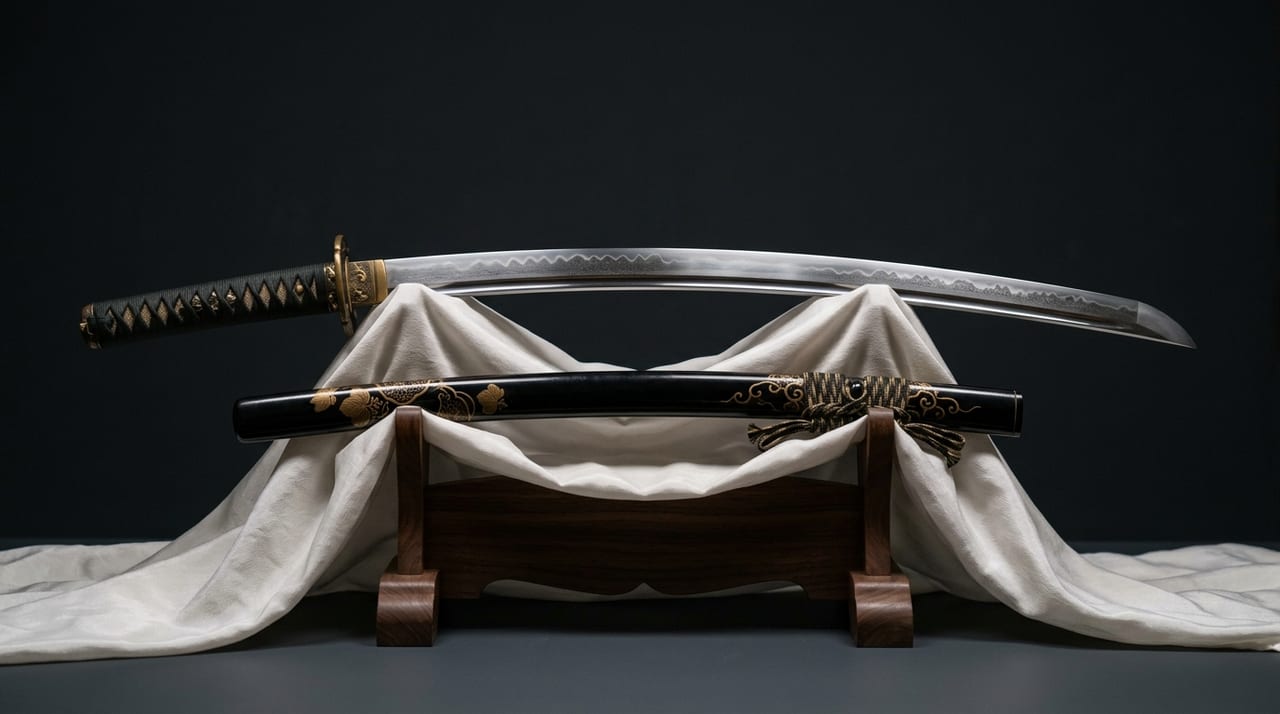
 * Image is for illustrative purposes only.
Tsuda Tōtōmi Nagamitsu
津田遠江長光
Also known as: Tsuda Tōtōmi (Tsuda Tōtōmi) • National Treasure Tachi by Nagamitsu • Handed down from the Tokugawa Shogun Household
Description
Tsuda Tōtōmi Nagamitsu is a National Treasure tachi forged by Nagamitsu, the representative swordsmith of Osafune in Bizen Province (present-day Osafune, Setouchi City, Okayama Prefecture), whose birth and death dates are unknown but who flourished in the late 13th century. Nagamitsu is said to have been either the son or disciple of Mitsutada, the master smith who perfected the Bizen tradition (Bizen-den), and established himself as the foremost swordsmith of the Osafune school who further refined the art of his father or master, securing an unwavering place in sword history. The appellation "Tsuda Tōtōmi" is said to derive from the fact that this tachi was transmitted through the hands of a samurai commander who held the title Tsuda Tōtōmi no Kami (Tsuda Tōtōmi Governor).
The tachi of Nagamitsu embodies the aesthetic sensibility of Kamakura-period warriors. Deep and flowing curves of elegant grace, well-proportioned width and thickness, and a modest ko-kissaki represent the ideal form of Kamakura-period tachi as exemplified today. The Tsuda Tōtōmi Nagamitsu is no exception, displaying refined proportions (taihai) with appropriately maintained mihaba, featuring a hamon consisting primarily of gunome chōji characterized by Nagamitsu's distinctive nie and nioi. The jigane exhibits refined itame skin as its foundation, with utsuri appearing distinctly—the most characteristic feature of Nagamitsu's tachi. In the Bizen tradition, utsuri manifests as a whitish, haze-like band of light appearing closer to the jiba, and Nagamitsu is regarded as one of the finest smiths to express this phenomenon most beautifully.
As for how it came to be housed at the Tokugawa Art Museum, during the Edo period, as the Owari Tokugawa clan assembled important swords, this tachi—said to have been transmitted from the Tsuda family—was treasured as an official shogunal blade. It has been carefully preserved and maintained as a centerpiece of the vast Owari Tokugawa clan collection. Today, the museum regularly exhibits this blade, maintained under strict National Treasure protocols and made available for viewing by Japanese sword enthusiasts.
Legends & Stories
Legends concerning supernatural occurrences surround the forging of Tsuda Tōtōmi Nagamitsu. One night while Nagamitsu was forging a tachi, the flames in the forge suddenly turned a pale blue-white, and the form of the blade appeared to emerge from the darkness. Nagamitsu understood this as divine protection, and it is said that the blade forged that night became the one later known as "Tsuda Tōtōmi."
Moreover, during the period when it was transmitted through the Tsuda family, there is an anecdote that Tsuda Tōtōmi no Kami, who wore this tachi, never sustained a single wound whenever he entered battle. Family members who believed in the blade's spiritual power passed down this account as evidence that "Nagamitsu's own spirit was guarding the warrior."
Furthermore, even after it passed to the Owari Tokugawa clan during the Edo period, there remains a record in household notes telling of a night-duty page attendant who, when passing before the sword repository, witnessed a streak of light emanating from the direction of the sword box. Thus, the spiritual essence of Tsuda Tōtōmi Nagamitsu has been transmitted across the ages.