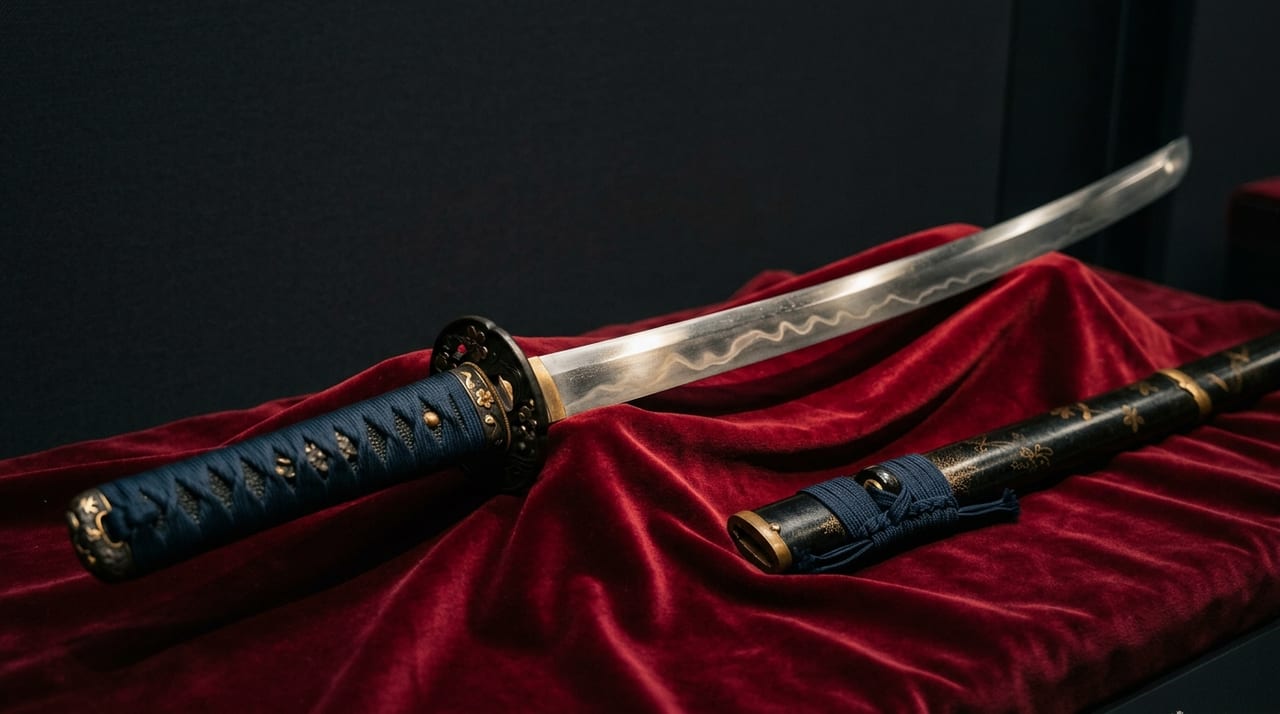
 * Image is for illustrative purposes only.
Beloved Swords of Toyotomi Hideyoshi
豊臣秀吉の愛刀
Also known as: Famous Swords Once Owned by Hideyoshi (Yoshimoto Samonji, Honebami Tōshirō)
- Smith
- Samonji, Awataguchi Tōshirō Yoshimitsu (respective smiths)
- Era
- Kamakura to Nanbokuchō period (13th–14th century)
- Type
- Katana, Wakizashi (naginata-naoshi)
- Designation
- Important Cultural Property (Yoshimoto Samonji, Honebami Tōshirō)
- Location
- Kenkun Shrine and Toyokuni Shrine (Kyoto; both on deposit at the Kyoto National Museum)
Description
Toyotomi Hideyoshi (1537–1598) was a rare hero who rose from the son of a farmer in Owari Province to become the ruler of the realm, and he had an extraordinary passion for swords. Hideyoshi further developed the spirit of meibutsu-gari (the hunting of renowned treasures) that he inherited from Nobunaga. In the course of unifying the realm, he actively collected famous blades and renowned vessels as proof of his mastery over the realm. Among the blades known as Hideyoshi's former possessions are Yoshimoto Samonji and Honebami Tōshirō.
Yoshimoto Samonji—A Famous Blade Passed Through Many Hands
Yoshimoto Samonji is a blade attributed to a smith of the Samonji school, who was active in Hakata, Chikuzen Province (present-day Fukuoka Prefecture), during the Nanboku-chō period. It was originally a tachi before suriage. It passed through the hands of powerful figures of the Sengoku and early Edo periods one after another: Miyoshi Sōzan (Masanaga), Takeda Nobutora, Imagawa Yoshimoto, Oda Nobunaga, Toyotomi Hideyoshi, Toyotomi Hideyori, and Tokugawa Ieyasu. After Imagawa Yoshimoto was killed in the Battle of Okehazama (1560), Nobunaga obtained the blade as a spoil of war, had it reshaped by suriage, and inscribed it with a gold inlay reading "the 19th day of the 5th month of Eiroku 3 (1560)…" (Because it was formerly owned by Miyoshi Sōzan, it is also called Sōza Samonji.) After the Honnōji Incident, the blade passed to Hideyoshi, and then through Hideyori to Ieyasu. It is currently held by Kenkun Shrine (Kita Ward, Kyoto City) and is on deposit at the Kyoto National Museum, and it has been designated an Important Cultural Property. Although it is unsigned (mumei), it is highly regarded by sword researchers as a blade that displays the style of the Samonji school.
Honebami Tōshirō—A Naginata-naoshi Wakizashi Revived from Fire
Honebami Tōshirō is a naginata-naoshi wakizashi attributed to Tōshirō Yoshimitsu, a renowned smith of Awataguchi in Kyoto during the Kamakura period. It is said to have gained its name from its sharpness, so keen that it could "crush even bone." In 1585 (Tenshō 13), it was presented to Hideyoshi by Ōtomo Yoshimune, and by then it had already been reshaped from a naginata into an ō-wakizashi. After the Toyotomi family, it passed to the Tokugawa shogunate. In 1657 (Meireki 3), it was burned in the Great Fire of Meireki, and Echizen Yasutsugu (3rd generation) re-forged it. In 1889 (Meiji 22), Tokugawa Iesato donated it to Hōkokukai, and it is now owned by Toyokuni Shrine (Kyoto City) and on deposit at the Kyoto National Museum. Designated an Important Cultural Property, Honebami Tōshirō is especially known as a legendary work among Yoshimitsu's blades and draws intense attention from sword enthusiasts.
Hideyoshi's View of Swords—The Aesthetic Sense of a Ruler of the Realm
Hideyoshi's collecting of swords was supported by an intense aesthetic sense that might be called a craving for famous treasures. He positioned tea-ceremony masterpieces (such as tea caddies and tea bowls) and swords side by side as demonstrations of "the qualifications of a ruler of the realm," and he also actively used them as diplomatic gifts. After Hideyoshi's death, many of the Toyotomi family's swords were burned or scattered when Ōsaka Castle fell. The surviving Yoshimoto Samonji and Honebami Tōshirō, however, are heritage that carries Hideyoshi's sword collecting into the present.
Legends & Stories
Honebami Tōshirō was a meibutsu presented to Hideyoshi by Ōtomo Yoshimune in 1585 (Tenshō 13). It is said that the Ōtomo family's repeated presentations of meibutsu stirred up talk in society. Later it passed to the Tokugawa shogunal family. It was burned in the Great Fire of Meireki in 1657 (Meireki 3), but was re-tempered by Echizen Yasutsugu (3rd generation). Yoshimoto Samonji was also burned in the Great Fire of Meireki and re-tempered. In the Meiji era, the Tokugawa family donated it to Kenkun Shrine, which enshrines Nobunaga.