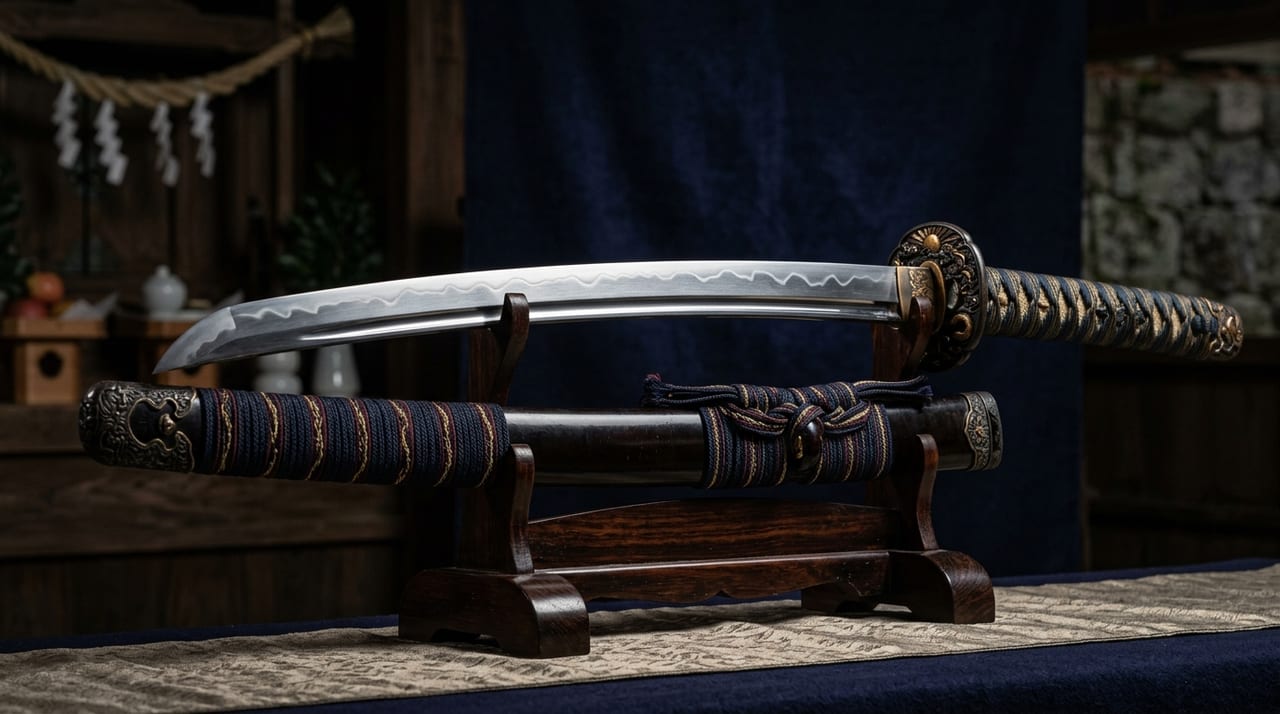
 * Image is for illustrative purposes only.
Totsuka-no-Tsurugi
十握剣
Also known as: Futsushimitama-no-Tsurugi
Description
Overview of Totsuka-no-Tsurugi — The Divine Sword of Izanagi, Ancient Slayer of the Fire God
Totsuka-no-Tsurugi is the most ancient divine sword recorded in Japanese mythology, appearing in both the Kojiki (Records of Ancient Matters) and the Nihon Shoki (Chronicles of Japan). The sword was wielded by Izanagi-no-Mikoto, the primordial deity of creation in Shinto cosmology. The term "totsuka" (十握) literally means "ten hand-spans," an archaic Japanese unit of measurement equivalent to approximately eighty centimeters in blade length. While originally a generic term for long swords in mythological contexts, this particular Totsuka-no-Tsurugi holds a sacred place in Japanese cultural memory as the weapon used to slay Kagutsuchi, the god of fire, marking the first recorded act of divine violence in Japanese mythology and establishing the archetype of the sword as both destroyer and sacred instrument.
According to the creation myths, Izanagi-no-Mikoto and his consort Izanami-no-Mikoto gave birth to the islands of Japan and numerous deities. However, when Izanami bore Kagutsuchi (Hi-no-Kagutsuchi-no-Kami), the fire god, she suffered fatal burns and descended to Yomi, the underworld. Consumed by grief and rage, Izanagi drew his Totsuka-no-Tsurugi and beheaded his own divine son. From the blood dripping from the blade and the severed body parts of Kagutsuchi, numerous deities were born, including Takemikazuchi-no-Kami, the thunder god and patron deity of martial prowess, as well as mountain deities and metal-working gods. This mythological event established the fundamental Japanese concept of the sword as an agent of both destruction and creation, death and regeneration—a duality that would permeate sword worship throughout Japanese history.
The sword is currently enshrined at Isonokami Shrine (石上神宮) in Tenri City, Nara Prefecture, where it is deified as Futsushimitama-no-Okami (布都斬魂大神). Isonokami Shrine, one of Japan's oldest Shinto sanctuaries, has been traditionally managed by the Mononobe clan and primarily venerates the Futsu-no-Mitama-no-Tsurugi, another legendary blade that aided Emperor Jimmu during his eastern campaign. The relationship between these divine swords is complex and debated among scholars. Additionally, the Kojiki and Nihon Shoki mention multiple swords called "Totsuka-no-Tsurugi," including one used by Susanoo-no-Mikoto to slay the eight-headed serpent Yamata-no-Orochi, making precise identification challenging. It should be noted that while the Kagutsuchi-slaying sword is sometimes called Ame-no-Ohabari (天之尾羽張), this is considered an alternative name for Totsuka-no-Tsurugi, distinct from Ame-no-Habakiri (天羽々斬), which is a separate divine blade.
Though Totsuka-no-Tsurugi exists only in mythological narrative rather than as a physical artifact, its symbolic significance is immeasurable. It represents the foundational concept of the Japanese sword not merely as a weapon, but as a sacred vessel of spiritual power—a shinki or divine instrument. Through its continued veneration at Isonokami Shrine, Totsuka-no-Tsurugi remains central to the Japanese cultural understanding of the sword as a bridge between the mortal and divine realms.
Legends & Stories
The Slaying of the Fire God and the Blood of Creation — A Tale of Tragedy and Rebirth
The most renowned legend surrounding Totsuka-no-Tsurugi is the tragic slaying of Kagutsuchi, the fire god, by his own father Izanagi-no-Mikoto. When Izanami-no-Mikoto gave birth to Kagutsuchi as her final divine child, the flames emanating from the infant god scorched her body, inflicting fatal burns. Unable to recover from these grievous wounds, Izanami descended into Yomi-no-Kuni, the shadowy realm of the dead. Overwhelmed by grief and consuming rage at the loss of his beloved consort, Izanagi drew the Totsuka-no-Tsurugi from his waist and cried out, "Because of you, my cherished wife has perished!" With a single, terrible stroke, he severed the head of his own son.
From this act of divine violence, an extraordinary creation unfolded. Three streams of blood dripped from the blade, and from these drops were born Takemikazuchi-no-Kami and Futsunushi-no-Kami, powerful thunder and sword deities who would later become central figures in the pacification of the Central Land of Reed Plains (Japan). From the severed body of Kagutsuchi emerged mountain deities and gods of metalworking, establishing the foundational forces of Japan's landscape and industry. Thus, Totsuka-no-Tsurugi transcended its role as a mere instrument of death, functioning instead as a "blade of creation" that birthed new life from destruction.
The sword's legend extends beyond this single act. Izanagi, still wielding Totsuka-no-Tsurugi, pursued Izanami into the underworld, hoping to retrieve her. However, upon witnessing her corrupted, decomposed form in the darkness of Yomi, he fled in horror. During his escape, he used the divine blade to fend off the Yomotsu-shikome, the hideous hags of the underworld who pursued him. In this capacity, the sword served as a guardian of the boundary between life and death, a spiritual barrier protecting the living world from the realm of the dead.
At Isonokami Shrine, the divine spirit inherited from Totsuka-no-Tsurugi is venerated as Futsushimitama-no-Okami, continuously worshipped by the Mononobe clan since ancient times. The sword embodies contradictory forces—destruction and regeneration, wrath and compassion—establishing the foundational philosophy that Japanese swords carry dual natures of violence and beauty, killing and life-giving power.