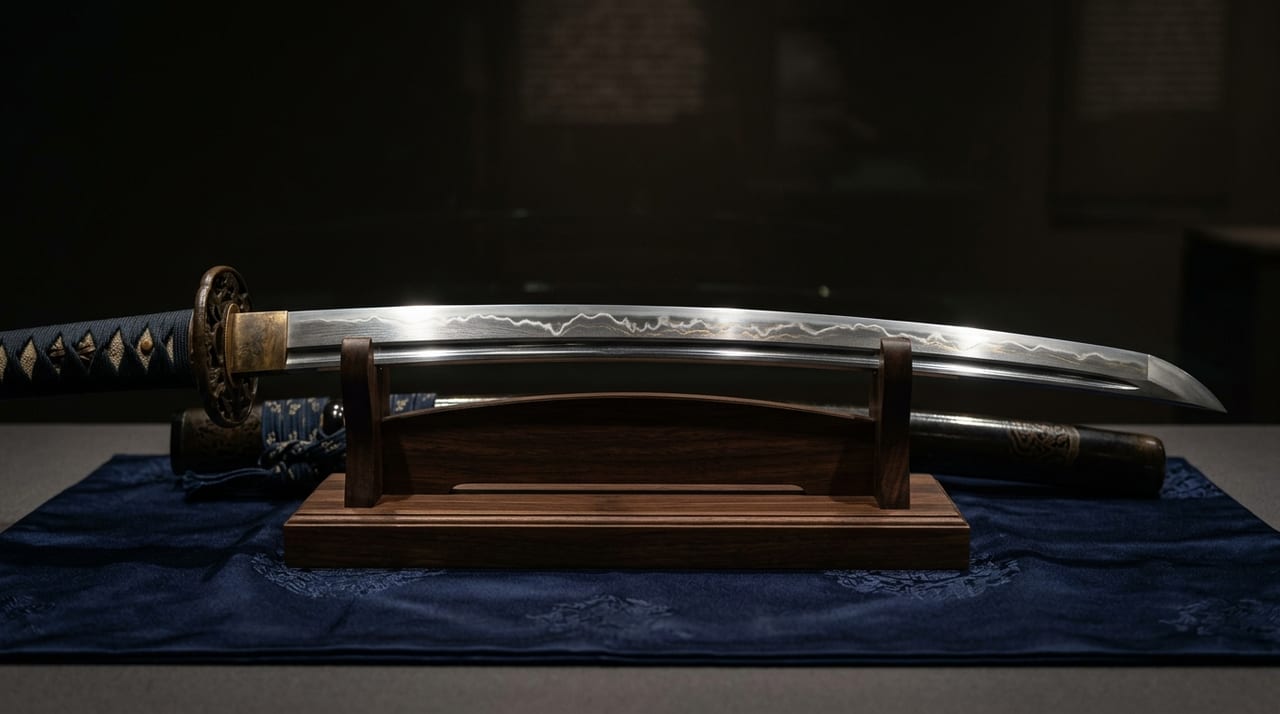
 * Image is for illustrative purposes only.
Tomita-Gō
富田江
Also known as: Tomita-Gō; one of the Maeda Clan's Gō blades
Description
Gō Yoshihiro and the "Gō" Group—Supreme Masterworks of the Most Enigmatic Master Smith
Gō Yoshihiro (郷義弘) was a legendary sword smith who worked in Etchū Province (present-day Toyama Prefecture) from the late Kamakura period through the early Nanbokuchō period, and is known as one of the most enigmatic master smiths in the history of Japanese swordcraft. Though the number of confirmed surviving examples of his work is extraordinarily small—so rare that even the existence of such a revolutionary stylist has become a matter of debate—the extant examples of Gō Yoshihiro's tantō and uchigatana are nonetheless regarded as supreme masterpieces in the history of the Japanese sword. Gō Yoshihiro's works possess a distinctive style characterized by "beautifully varied jigane, luminous utsuri, and vigorous, dynamic hamon," and he is positioned as one of the supreme exponents of the "Sōshū-den" (相州伝) tradition.
The Provenance of Tomita-Gō—From the Secret Treasure of the Maeda House to National Treasure
Tomita-Gō (富田江) is an uchigatana attributed to Gō Yoshihiro and represents one of the most important named swords (meibutsu) of the "Gō Group" passed down through generations of the Maeda clan, feudal lords of Kaga. The Maeda clan, as the greatest tozama daimyo, ruled a vast domain of one million koku, cultivated deep knowledge of culture and the arts, and possessed numerous remarkable treasures of the tea ceremony emblematic of the refined Kaga culture of one million koku. The name "Tomita-Gō" derives from its former ownership by Tomita Isseki (Sakon Shōgun), a trusted aide of Toyotomi Hideyoshi. After passing through the hands of the Toyotomi and Maeda families, it became established as a prized blade of the Kaga domain. It is currently held by the Maeda Ikutokukai as a National Treasure (designated in 1956, Maeda Ikutokukai collection).
The Style of Gō Yoshihiro—The Sparkling Beauty of Sōshū-den
The most important characteristic defining Gō Yoshihiro's work lies in the superb beauty of his jigane and the dynamic vigor of his hamon. Gō's jigane displays the distinctive quality of "complex flowing itame grain, finely gleaming jigane-nie, and vibrantly active jikage," presenting a landscape visually distinct from other smiths' work. In the hamon, he employed as his base the violent, fluctuating pattern known as "tairan" or "wanareryran," within which a rich array of subsidiary features—feet (ashi), leaves (ha), kinsuji, and sunagashi—appear in vigorous profusion, creating one of the most dynamic and energetic visual effects in sword appreciation. This style stands within the tradition of the "Sōshū-den"—the revolutionary sword-making method established by Masamune, Yukihiro, Shindotoku Kunimitsu and others of Kamakura—and Gō Yoshihiro is recorded in sword history as a rare genius who uniquely elevated this Sōshū-den style within Etchū Province.
The "Gō" Group of Blades and Toyotomi Hideyoshi
Among the works of Gō Yoshihiro, those especially known as named treasures are frequently called by nicknames containing the character "Gō" (江), and these are cherished by sword enthusiasts as the "Gō Group." Many of these "Gō" treasured swords were temporarily gathered in the sword collection of Toyotomi Hideyoshi, reflecting the heavenly ruler Hideyoshi's particular fondness for Gō Yoshihiro's work. After the Battle of Sekigahara in 1600, Hideyoshi's sword collection was dismantled and dispersed, dividing into the collections of various daimyo houses throughout the realm. However, each blade of the "Gō Group" has continued to be highly valued as a treasured sword of powerful daimyo families across Japan down to the present day. The transmission of Tomita-Gō to the Maeda house can be understood within this broader current of Toyotomi-period sword culture.
The Mystery of Etchū Sword Smiths and the Current State of Gō Yoshihiro Research
Regarding the true nature of Gō Yoshihiro, many mysteries remain even in contemporary sword research. Though recorded as a sword smith of Etchū Province (Toyama Prefecture), basic matters such as his training background, period of activity, and whether he had disciples remain difficult to confirm through historical documents. The extant examples attributed to Gō Yoshihiro—whether tantō or uchigatana—are extremely rare, and while this rarity elevates their value to an extreme degree, it also creates a tendency toward disagreement over attribution ("is this truly an authentic example?"). Tomita-Gō is evaluated as a work of certain provenance thanks to its long preservation history within the Maeda collection and clear documentary record of transmission, a certainty underscored by its designation as a National Treasure. Gō Yoshihiro's enigmatic presence—his paradoxical status as "the sword smith of fewest confirmed works yet greatest fame"—continues to offer an enduring challenge to the study of Japanese sword attribution, and Tomita-Gō serves as one of the most important reference works in that ongoing research.
Legends & Stories
The legend surrounding Gō Yoshihiro centers on his mysterious relationship with the great Masamune of Kamakura. Tradition includes Yoshihiro among the 'Ten Great Students of Masamune' (Masamune Jittetsu) — the circle of master smiths said to have studied under the greatest swordsmith who ever lived. If true, the young Etchū smith would have traveled from northern Japan to Kamakura to absorb the revolutionary Sōshū-den techniques at their source, then carried them home to produce work that in some eyes surpasses even the master. The legend is unverifiable, but the deep stylistic kinship between Yoshihiro's work and the Sōshū tradition is undeniable — making the 'disciple who became the equal of his teacher' narrative irresistible to those who study these blades. Tomita-Gō, as one of the few confirmed Gō Yoshihiro works with a traceable provenance, carries this legend in its steel: a blade forged by a smith who may have learned from the greatest master of the age, preserved through centuries by Japan's wealthiest outside lord, and still speaking today through the fire-bright nie of its hamon.