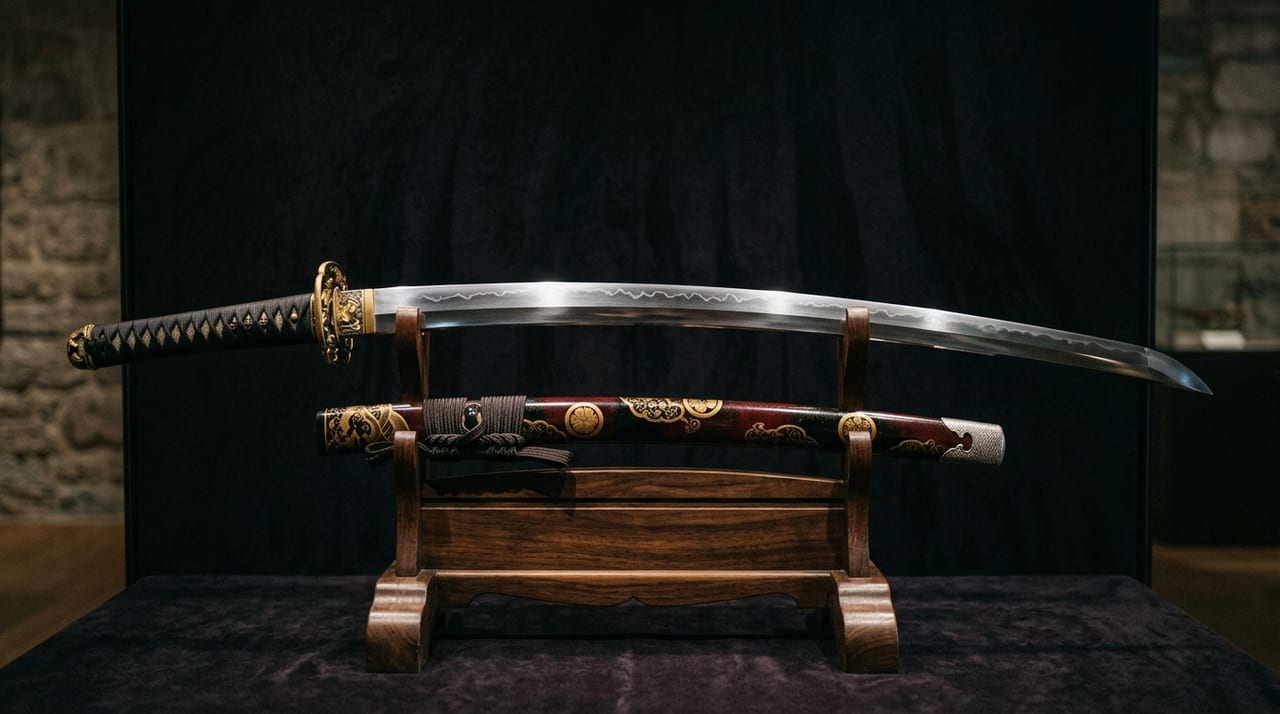
 * Image is for illustrative purposes only.
Tarō Tachi
太郎太刀
Also known as: Magara Tarō-tachi, the mightiest of the ōdachi and the pinnacle of the nodachi
Description
Overview of the Blade
Tarō-tachi is renowned as one of the longest ōdachi in Japanese history, a monstrous giant blade said to have been wielded in actual combat by the Sengoku-period warrior Magara Naotaka. Its cutting edge measures 221.5 centimeters (seven shaku three sun and a little more), and its overall length, including the tang, is 303 centimeters, an astonishing figure. An ordinary Japanese sword has a blade length of about two shaku three sun (around 70 cm), so the extraordinary scale of Tarō-tachi is immediately clear. The strength and valor of Magara Naotaka, said to have swung this giant blade on the battlefield, were truly those of a demon-god of the Sengoku era. The name Tarō-tachi was given in pairing with Jirō-tachi (said to have been used by Magara Takamoto or Naozumi, an ōdachi with a blade length of about 166.6 cm), as 'brother giant swords.' Together the two are called the 'Magara tachi,' and they are the most eloquent physical evidence transmitting the legends of Sengoku-era superhuman strength to the present day.
Magara Naotaka: A Giant Warrior of Echizen Called a Demon-God
Magara Naotaka was a warrior of Echizen Province (present-day Fukui Prefecture) who served the Sengoku daimyō Asakura Yoshikage, and he is recorded in the battle chronicles of the period as a champion. According to tradition, he was a large man of seven shaku (about 210 cm) who handled Tarō-tachi, a sword too heavy for ordinary men even to lift, as lightly as a spear. The Magara clan was a locally rooted group of country samurai (kokujin) whose base was the Magara estate in Imadate District, Echizen Province. When Ashikaga Yoshiaki went down to Echizen seeking refuge with Asakura Yoshikage, it is said that Naotaka swung the great sword lightly before the lord to display his prowess as a champion. The name Tarō-tachi derives from the custom of that time of calling the longer of two swords the Tarō-tachi and the shorter the Jirō-tachi.
The Technical Challenge of Forging Ōdachi
Forging an ōdachi with a blade length exceeding three shaku involves technical difficulties of a different order from those of ordinary Japanese swords. The larger the blade, the more exponentially difficult it becomes to control temperature, prevent distortion, and forge uniformly through the quenching process (hizukuri, then tsuchioki, then mizuyaki-ire). In particular, plunging a blade of great length into water at a constant speed and angle is a demanding group task that cannot be completed unless several craftsmen coordinate. That Tarō-tachi, despite its scale, fully functions as a sword demonstrates the high skill of the smith credited as its maker (Sue-Aoe, as the inscription indicates) and the organizational capacity of the smithing groups of the era. In the Nanboku-chō period (14th century), large blades called nagamaki, ōdachi, and nodachi were produced in quantity, answering the tactical need to sweep away mounted warriors in infantry combat. Tarō-tachi belongs among the very largest of these, and is one of the most extreme expressions that the wars of the Nanboku-chō period produced in Japan's sword culture.
Dedication to Atsuta Shrine and the Kusanagi Sword
Tarō-tachi is currently dedicated to and preserved at Atsuta Shrine in Nagoya, Aichi Prefecture. Atsuta Shrine is one of the most sacred sites for swords in Japan, enshrining the Kusanagi no Tsurugi (Ame no Murakumo no Tsurugi) as its goshintai, the sacred object said in Japanese mythology to have been carried by Yamato Takeru. That this giant sword was dedicated to the shrine by Yamada Yoshihisa in the Tenshō era, after the Battle of Anegawa, shows that beyond its function as a weapon, it was recognized by people of the time for its spiritual and cultural value. It is now displayed in the Kusanagi-kan sword treasury within the shrine grounds, together with Jirō-tachi, which Atsuta Shrine also holds. That the oldest legendary famous sword of Japan and the largest practical giant sword of the Sengoku period are enshrined in the same sacred place clearly shows the depth of the faith with which the Japanese have found special sanctity in swords.
The Battle of Anegawa and the Fate of the Magara Family
On the 28th day of the 6th month of Genki 1 (1570), the Battle of Anegawa was fought on the banks of the Anegawa in Ōmi Province. It was one of the great engagements of Sengoku history, pitting the allied Azai and Asakura forces against the allied Oda and Tokugawa forces. Magara Naotaka took part in this battle with Tarō-tachi and is said to have fought valiantly, including charging single-handedly into the enemy ranks, but he was ultimately slain by several warriors together. In the same battle, his younger brother Naozumi and his son Takamoto also died (it is said either Naozumi or Takamoto used Jirō-tachi). That a clan fought wielding giant swords and lost their lives in the same battle is passed down to this day as a typical tragic destiny of Sengoku warrior families.
The Largest Surviving Battle-Used Sword
Tarō-tachi is among the largest surviving ōdachi said to have been used in actual battle, and its existence conveys both the remarkable diversity of Japanese swords and the high physical and mental strength of Sengoku warriors. Unlike the enlarged 'decorative swords' (kazari-tachi) dedicated to shrines, Tarō-tachi is unmatched in having records and traditions of actual use in combat. The traces of use left on the blade, including the condition of its chips and wear, show that Tarō-tachi is not a museum specimen but a living witness to history, enshrined at Atsuta Shrine.
Legends & Stories
Magara Naotaka: The Warrior Called a Demon-God
Of all the warriors appearing in Sengoku battle records, few are as closely tied to a legendary giant sword as Magara Naotaka. Said to have been a man of as much as seven shaku (about 210 cm), Naotaka is told to have swung an ōdachi of seven shaku three sun (about 221 cm) effortlessly, even bare-handed. Enemy soldiers who witnessed him are said to have been terrified, believing a demon-god had appeared. Several records survive of Naotaka's end at the Battle of Anegawa, and they agree that he was finally slain only by several warriors together. They evoke the image of a champion who fought to the last, swinging Tarō-tachi.
Relationship Between Tarō-tachi and Jirō-tachi
Tarō-tachi and Jirō-tachi are passed down as the 'brother giant swords' used by Magara Naotaka and either his younger brother Naozumi or his son Takamoto. The names Tarō (blade length about 221 cm) and Jirō (blade length about 167 cm) come from the Japanese sensibility of regarding the larger as the elder brother and the smaller as the younger. That they are treated as brothers even at this size reflects the sentiment of the warrior house. That both were transmitted to Atsuta Shrine and have been preserved together to this day carries important meaning for passing down the memory of the Magara family to later generations.
Kusanagi no Tsurugi and Atsuta Shrine, Sacred Ground of Swords
Atsuta Shrine, one of Japan's three great shrines, enshrines the Kusanagi no Tsurugi (Ame no Murakumo no Tsurugi) as its goshintai. Yamato Takeru is said to have used this sword on his eastern expedition, which makes the shrine one of the most sword-rich sacred grounds in Japan. That Tarō-tachi and Jirō-tachi have been dedicated here means more than mere historical storage. It embodies the Japanese tradition in which giant blades that charged across battlefields finally come to rest before the gods. The image of Japan's oldest legendary sword lying beside the greatest giant sword of the Sengoku period is a moving sight that symbolizes the long current of Japanese sword culture.