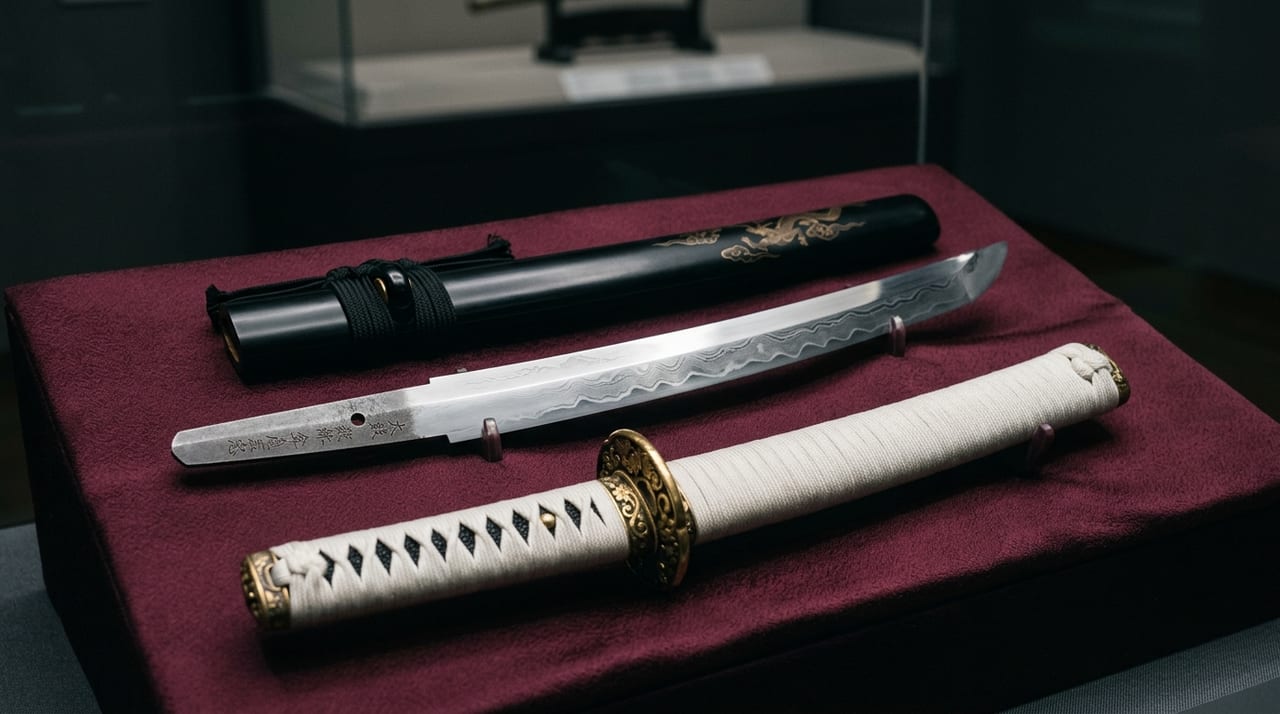
 * Image is for illustrative purposes only.
Taikogane Sadamune
太鼓鐘貞宗
Also known as: Temple Bell
Description
Taikogane Sadamune: An Overview
Taikogane Sadamune is an unsigned tantō (short sword) traditionally attributed to Sadamune, a master craftsman active in Sagami Province (present-day Kanagawa Prefecture) from the late Kamakura period through the Northern and Southern Courts period. It is recorded in the Kyōhō Meibutsu-chō (Catalog of Notable Swords of the Kyōhō Era) as "Meibuts Taikogane Sadamune." The name "Taikogane" (literally, Temple Bell) is said to derive from a merchant of Osaka and Sakai who once possessed this tantō, though the exact origin remains uncertain. Despite being a tantō, the dignity of its form and the serene beauty born of Sadamune's exceptional bladesmithing technique command the viewer's attention. It has long been valued as one of Sadamune's finest works.
The Maker: Sadamune of the Sōshū Tradition
Sadamune is a master of the Sōshū tradition, said to be the adopted son or natural son of Masamune, and was active from the late Kamakura period through the Northern and Southern Courts period. While inheriting the bold, vigorous nie-deki (coarse martensite) style of his master Masamune, Sadamune elevated it to a unique, more refined realm. The jigane (body steel) displays tightly compressed ko-itame (fine wood-grain) patterning of exquisite refinement. The hamon (blade pattern) is anchored in the nie-deki gunome and ko-gunome typical of the Sōshū tradition, with a soft, deep nioi-kuchi (scent transition) that creates a landscape of considerable beauty. Compared to Masamune's work, Sadamune's blades possess a gentler, more graceful character, yet they never sacrifice the strength and superior steel quality inherent to the Sōshū tradition. This "balance of power and elegance" is the defining hallmark of Sadamune's craft.
Transmission to the Date Clan
Taikogane Sadamune had passed to the Tokugawa shoguns by the early Edo period. When the adopted daughter of the second shogun, Tokugawa Hidetada (Princess Furi), married Date Tadamune (second lord of Sendai clan and son of Date Masamune), Hidetada presented this tantō to Tadamune as a gift, and it entered the Date family collection. Subsequently, it was transferred to the Inaba family upon the marriage of Tsunamura (grandson of Tadamune) to the daughter of Inaba Masanori, though it is said the Date family later repurchased it. As a meibuts (celebrated sword) connected to the Sendai clan lords, it stands as a symbol of swordcraft culture in Ōshū.
The Beauty and Dignity of the Tantō
Taikogane Sadamune, though a tantō, possesses the dignity and presence to rival great swords. With a blade length of approximately 8 sun (ca. 24 centimeters), it is fashioned in hirazukuri style, with a slightly thick base that maintains excellent thickness toward the point. The hamon (blade pattern) displays the characteristic nie-deki gunome of Sadamune, with a deep, soft nioi-kuchi (scent transition). The jigane displays tightly compressed ko-itame (fine wood-grain) patterning with subtle jikei (grain effects), revealing considerable visual appeal. Sadamune's tantōs are rare, and examples with clearly documented provenance, such as Taikogane Sadamune, are especially precious. It was designated an Important Cultural Property during the Showa period and is currently in private hands. Clear and lingering in resonance—this tantō continues to radiate the serene presence befitting its name, a temple bell whose beauty endures.
Legends & Stories
Origin of the Name Taikogane
The name "Taikogane" of Taikogane Sadamune is said to derive from the name of a wealthy merchant of Sakai who used "Taikogane" as his merchant name and formerly owned this tantō. Since ancient times, it has not been uncommon for famous swords to have their names fixed from those of their owners or merchant names, and this work is counted among them.
Sadamune's forging displays an exceptionally precise and uniform grain structure, and the quality of its surface and edge is highly evaluated as representing the apex of the Soshu tradition.
Transmission to the Date Family
Taikogane Sadamune is a tantō bestowed by the Tokugawa shogunal family upon Date Tadamune, the second daimyo of Sendai Domain. In Genwa 3 (1617), when Princess Shin, the adopted daughter of the second shogun Tokugawa Hidetada, married Tadamune, this work was reportedly given along with a great sword by Osafune Nagamitsu. Thereafter, Taikogane Sadamune was carefully transmitted as a treasured possession of the Date family of Sendai Domain, and is currently designated as an Important Cultural Property.
Inheritance of the Soshu Tradition
Sadamune's techniques were inherited by later generations through his disciples. From Sadamune's school emerged master craftsmen representative of the Nanboku-chō period, such as Shizu Saburō Kaneuji and Kongō Hyōe Moritaka, and the Soshu tradition spread throughout the nation, transcending the geographical boundaries of Kamakura. Taikogane Sadamune is positioned as one of the most refined achievements within the technical lineage of the Soshu tradition, embodying the unique realm of Sadamune in which "Masamune's bold grandeur" and "Yamashiro tradition's precision" are beautifully fused.