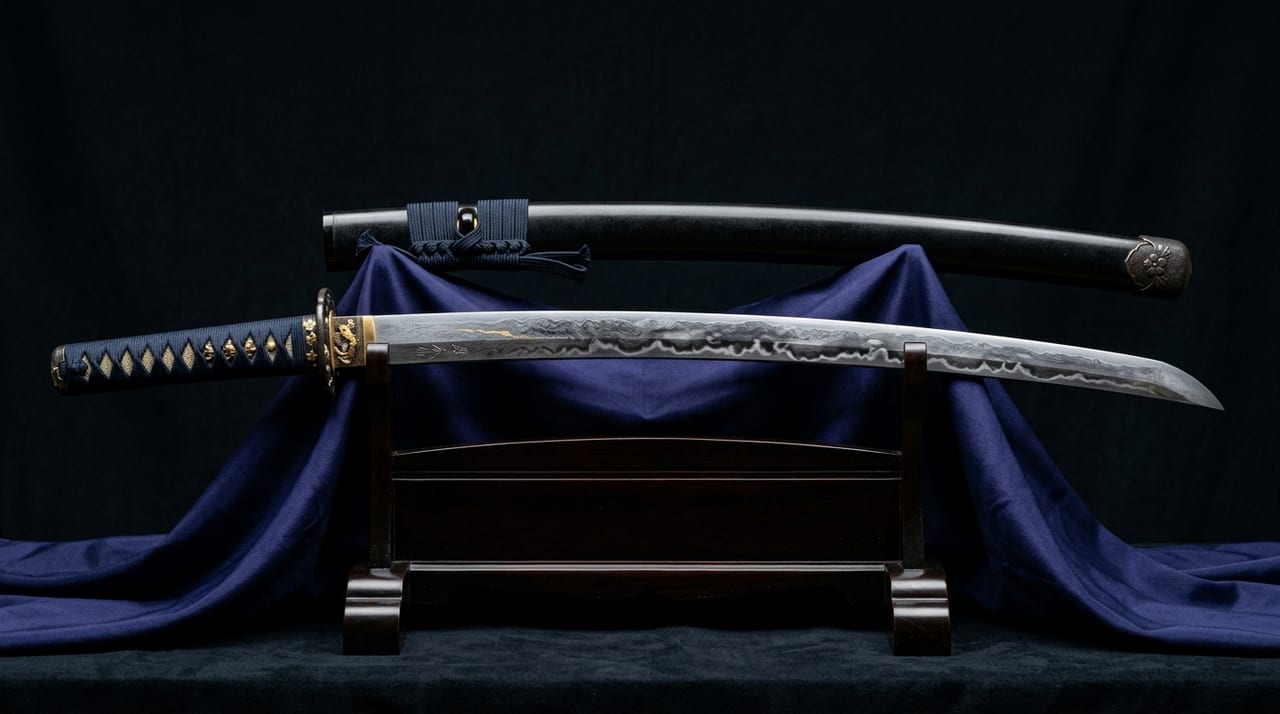
 * Image is for illustrative purposes only.
Sōshū Hiromitsu
相州広光
Also known as: Hiromitsu; Fierce Genius of Late Sōshū; Embodiment of Nanbokuchō Intensity
Description
Sword Overview
Sōshū Hiromitsu is a swordsmith who flourished in Sagami Province (present-day Kanagawa Prefecture) during the mid-to-late 14th century Nanbokuchō period, and occupies a brilliant position in Japanese sword history as a master craftsman representing the late Sōshū tradition. Hiromitsu is said to have been either the student of Masamune or the student of Sadaie, who perfected the Sōshū tradition (various theories exist), and is known as a swordsmith who fully unleashed the fiercest aesthetic of the Sōshū tradition during the Nanbokuchō, an era of upheaval. Hiromitsu's workmanship is evaluated as "the fiercest ground nie and the richest activity within the Sōshū tradition." If Masamune represents "order within the storm," then Hiromitsu embodies "a storm with order at its peak"—an intensely fierce beauty of unparalleled ferocity. He possesses multiple masterpieces designated as Important Cultural Properties and Important Swords, and receives the highest evaluation among Sōshū swordsmiths of the Nanbokuchō period.
Hiromitsu's Technique and Workmanship
The greatest characteristic of Hiromitsu's bladesmithing lies in the quantity and quality of ground nie. Compared to Masamune and Yoshihiro, Hiromitsu's ground nie appears in a thickness that might be called maximum, accumulating across the entire blade surface and creating a state in which the entire blade steel is immersed as if in an ocean of nie. Within this thick ground nie, a wealth of activity—kinsuji, inazuma, tobiyaki, and nijūba—runs in all directions, forming an overwhelming vista as if the nocturnal sky of a thunderstorm were transferred onto the blade. The hamon displays large patterns of undulating and interlocking designs, with the aroma-mouth (fragrance line) deeply sunken and creating clustering areas characteristic of the style. The grain of the blade steel shows board and burl-grain patterns running in a rough manner, with large ground nie covering the blade steel. Overall, it conveys energy far more intense than the "storm" of Masamune and Yoshihiro, yet within this intensity resides the refinement inherent to the Sōshū tradition—not mere roughness, but possessed of artistic completion as a true art form.
Blade Aesthetics of the Nanbokuchō Era
The Nanbokuchō period (1336–1392) was an age of prolonged civil warfare in which the Southern Court of Emperor Godaigo and the Northern Court of Ashikaga Takauji divided and fought for control of the entire country. The fierce combat of this era heightened practical demands upon blades, spurring the production of large and imposing swords and sword forms. The blades of Sōshū Hiromitsu are a body of work that most vividly embodies the spirit of this age, perfectly manifesting the aesthetics of Nanbokuchō upheaval—rough, fierce, yet beautiful. Hiromitsu's intense ground nie and rich activity represent the ultimate extreme of beauty born from this era of warfare, and are sometimes appreciated as "a beauty that might not have been born in an age of peace."
Hiromitsu's Representative Works
The representative works of Hiromitsu are known among his Important Cultural Property and Important Sword designations, and these are highly valued by sword researchers as the pinnacle of the late Sōshū tradition. Hiromitsu's long swords (tachi) are known as masterpieces in which the imposing proportions and intense ground nie and rich activity are perfectly combined, and are treasured as works standing at the apex of Nanbokuchō-period blade aesthetics. Multiple fine examples also survive among his shorter blades (tantō), and there are transmitted works of high refinement in which delicate straight hamon and small random patterns unfold within fierce ground nie.
The End of the Sōshū Tradition and Hiromitsu's Place
The late Nanbokuchō period during which Hiromitsu worked was also the final age in which the Sōshū tradition functioned as an independent school. As the upheaval of the Nanbokuchō era subsided and the Muromachi shogunate recovered stability, blade production in the Sagami region began to lose its former prosperity. In this sense, Hiromitsu embodies "the final flame of the Sōshū tradition," and his intense beauty may be called the final radiance at the moment the great school of the Sōshū tradition burned out. When viewing Hiromitsu through the lens of "the aesthetics of ending," his intensity takes on a deeper poetic quality.
Contemporary Evaluation and Legacy
In contemporary sword appraisal, Sōshū Hiromitsu is placed at the highest rank among Sōshū tradition masters, and his finest examples with certain signatures receive the highest evaluation. As the master craftsman who presided over the final stage of the Sōshū tradition—the most influential lineage in Japanese sword history—Hiromitsu's works possess an unparalleled presence in both historical and artistic value. In exhibitions at the Tokyo National Museum, Hiromitsu's blades consistently occupy a central position as important works in the Sōshū tradition gallery, continuing to convey to visitors the world of fierce beauty of the Nanbokuchō period.
Comprehensive Evaluation of Hiromitsu
Sōshū Hiromitsu's bladesmithing technique is evaluated by later sword researchers as the most intense expression within the Sōshū tradition and designated the "final form of the Sōshū tradition." Building upon the foundation established by Masamune and Sadaie, Hiromitsu's aesthetic—which raised the intensity also found in full-hamon blades to the extreme limit—is positioned as a once-in-history artistic achievement born from the unique historical circumstances of the Nanbokuchō period. Though Hiromitsu's successors attempted to inherit the Sōshū lineage in the Muromachi period, none reached the apex that Hiromitsu demonstrated. The name Sōshū Hiromitsu will eternally be spoken among Japanese sword enthusiasts and researchers as a proper noun indicating the absolute pinnacle that the fierce intensity of Japanese sword expression can achieve. Hiromitsu's works designated as Important Cultural Properties and Important Swords are held in scattered locations throughout the country, and are always introduced as renowned masterpieces commanding great attention at Japanese sword exhibitions. When standing before a Hiromitsu blade that inspires awe of the warrior spirit, we can directly experience as art the weight of history—the upheaval of the Nanbokuchō seven hundred years ago—sealed within the crystal structure of iron. That is the timeless cultural power possessed by the blades of Sōshū Hiromitsu.
Legends & Stories
The Fire of Nanbokuchō and the Blades of Sōshū
To understand how the intensity of the Nanbokuchō era shaped the beauty of the swords of Sōshū Hiromitsu, one must imagine the actual reality of the civil strife of that time. The internal conflict of Nanbokuchō was not a simple change of regime but a fundamental clash of values that engulfed all of Japan. Around the fundamental question of "Who is the Emperor?" and "What is legitimacy?", the generals of the Northern and Southern Courts battled for two and three generations. In the midst of this prolonged warfare, warriors lived under existential tension, not knowing when they would die, and this tension fundamentally changed what was demanded of weapons. Hiromitsu's fierce jie and rich hataraki crystallized this existential tension of the era in the form of the blade itself — a beauty that could not have been born in stable peace was perfected in the extreme state of warfare.
Akihiro and the Sōshū Lineage
Alongside Hiromitsu, Akihiro was a representative swordsmith of Sōshū during the Nanbokuchō period, and both men were skilled in the hitatsura hamon as master craftsmen of the Sōshū tradition of the same era. Akihiro and Hiromitsu were not in a master-student relationship but rather in a relationship of fellow students or close relatives (some accounts hold that Akihiro was Hiromitsu's younger brother), demonstrating that, as successors to the Sōshū tradition deriving from Masamune, the techniques of the Sōshū school maintained their highest standards even in the Nanbokuchō period.
Hiromitsu as "The Final Flame"
The Sōshū tradition began with Shintōgo Kunimistu of the late Heian and early Kamakura periods, and continued through Masamune, Yoshihiro, and Sadamune to Hiromitsu and Akihiro of the Nanbokuchō period. After Hiromitsu, the region of Sōshū rapidly lost its distinctive character as a sword-producing center, and the techniques of the Sōshū tradition were absorbed and fused into other production centers and schools. In this historical context, Hiromitsu is "the final pure bearer of the Sōshū tradition," and his fierce beauty can be interpreted as "the final greatest brilliance emitted by a dying tradition." In the history of art, there often occurs a phenomenon where "the moment just before the end reaches the highest flowering," and Hiromitsu's fierce beauty is recorded in Japanese sword history as one typical example of this.
Daimyō Collections and Hiromitsu
After the Muromachi period, the tachi and katana of Hiromitsu were collected by powerful daimyō throughout the regions. The fierceness of the Sōshū tradition was favored by warriors as a symbol of "samurai spirit," and it is said that in particular the daimyō of the Kantō and eastern regions such as Hōjō, Uesugi, and Takeda favored the Sōshū tradition. Looking at a list of the great houses through which Hiromitsu's swords passed down, there is significant overlap with the list of powerful daimyō of the Muromachi through Sengoku periods, and the history of Hiromitsu's blades passing through the hands of those in power contributed to the formation of the concept that "Sōshū = the sword of the ruler of the realm." Multiple works of Hiromitsu are recorded in the Kyōho Meibutsu-chō, and the fact that the Edo Bakufu officially recognized Sōshū Hiromitsu as one of the supreme peaks of Japanese swords proves that the evaluation of Hiromitsu remained unwavering over seven hundred years from the Muromachi period to the Edo period.
Hiromitsu for the Modern Viewer
When a modern viewer sees the swords of Sōshū Hiromitsu, there is an experience in which the air of the Nanbokuchō era from seven hundred years ago is transmitted directly from the blade. While swords of other eras communicate "beauty" and "dignity" above all else, the swords of Hiromitsu communicate "tension" and "energy" first and foremost. His fierce jie and rich hataraki sharply stimulate the senses of the viewer, bringing with it the astonishment: "Is it possible to pour such energy into a single blade?" For those seeing a Japanese sword for the first time, it may be experienced as "impact" rather than "beauty," but that is precisely the honest beauty of Hiromitsu's swords, and it is the inevitable form of expression born from the Nanbokuchō era. The impact beyond words felt before the swords of Sōshū Hiromitsu continues to strike the hearts of viewers even now, crossing the seven hundred years of time.
What Sōshū Hiromitsu Left in Japanese Sword History
Hiromitsu's attempt to push the fierceness of the Sōshū tradition to the absolute limit is profound in that it permanently demonstrated the possibility of "fierce beauty" to the aesthetics of Japanese swords thereafter. The fierceness of the Sōshū tradition was inherited by some of the new swords (shintō) and new-new swords (shinshintō) of the subsequent Edo period, and continues to influence modern smiths as an aesthetic ideal of the "storm of boiling." Modern swordsmiths studying Hiromitsu's blades endeavor to approach his realm while changing every element — the temperature of forging, the selection of iron sand, the angle of hardening — but perfect recreation has not been achieved even to this day. Hiromitsu's existence, continuing to function as this "unreachable ideal," has become a permanent driving force for the advancement of Japanese sword-making technique, embodying the healthy tradition of Japanese sword culture in which the legacy of master craftsmen functions as a spiritual and aesthetic standard promoting technical progress. Those who have actually viewed the swords of Sōshū Hiromitsu uniformly speak of "overwhelming presence and the compelling force of beauty difficult to approach," and the fact that Hiromitsu's swords possess the power to directly appeal to the viewer's senses as works of art transcending the framework of mere craftsmanship remains unchanged even today, after seven hundred years. Sōshū Hiromitsu — his name will continue to shine as an eternal standard indicating the most fierce peak of Japanese sword culture.