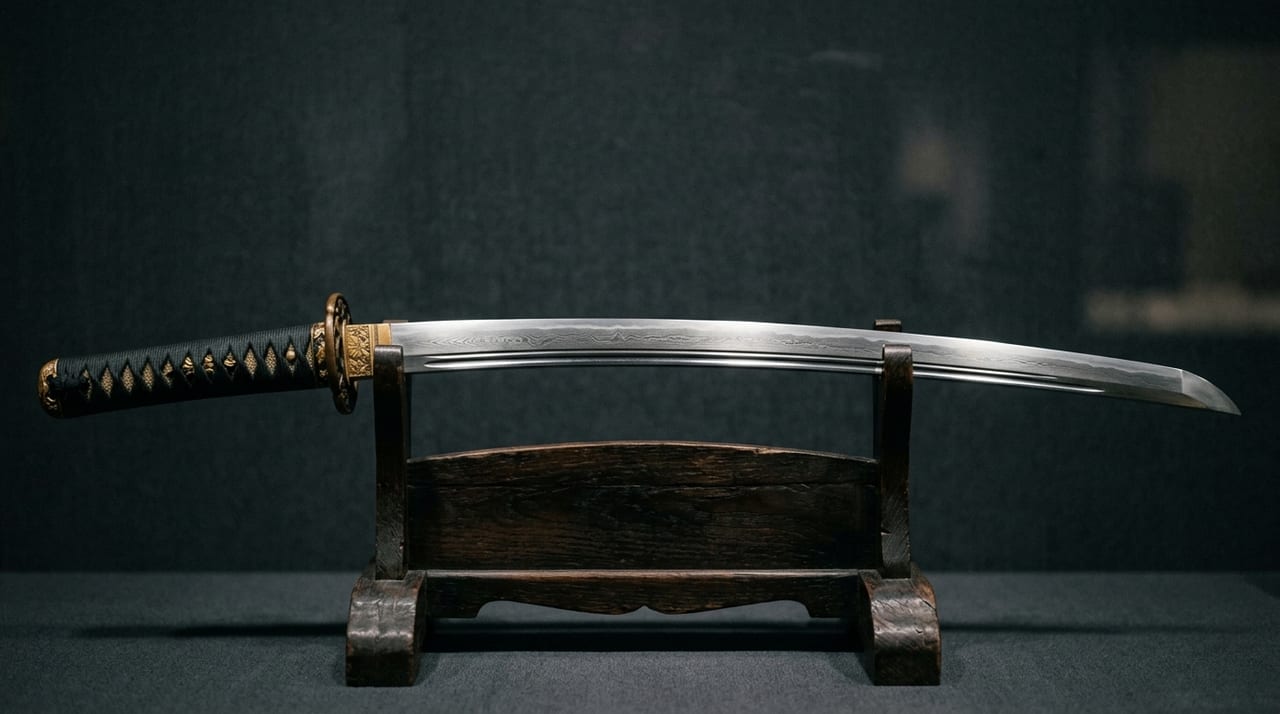
 * Image is for illustrative purposes only.
Shishiō
獅子王
Also known as: Lion King
Description
Sword Overview
A famed tachi said to have been bestowed upon the master archer Minamoto no Yorimasa by Emperor Konoe (r. 1141–1155) in recognition of his achievement in vanquishing the nue, a chimera-like monster. The name "Shishiō" (Lion King) embodies the meaning of a sword possessing the dignity of a lion—king of all beasts—that repels all evil. The blade measures 2 shaku 5 sun 5 bu (approximately 77.3 cm) in length, with a deep and graceful waist curvature that exemplifies the typical form of late Heian tachi. The body width is somewhat narrow, and the ridgeline stands high, demonstrating solid workmanship.
Manufacture and Characteristics
The maker remains unknown, but the characteristics of the metal suggest attribution to a swordsmith of the Yamato tradition. The Yamato tradition is a forging school that developed primarily in Yamato Province (Nara Prefecture), typically characterized by a solid style featuring straight-grain (masame) surfaces; however, Shishiō's metal displays a somewhat complex pattern mixing board-grain (itame) with straight-grain. The blade pattern is primarily straight-edged (suuha), with a gentle and clearly defined edge boundary displaying refined execution that values dignity and grace above ornamentation. Minamoto no Yorimasa (1104–1180) was a military commander and poet of the late Heian period, celebrated throughout the realm as a master archer. He received this tachi from Emperor Konoe after skillfully shooting down the nue, a monster that appeared nightly above the Shishinden palace and afflicted the emperor.
Provenance
After being transmitted through the imperial court and nobility for centuries, the sword is now housed in the Tokyo National Museum and designated as an Important Cultural Property. The legendary splendor of the nue-slaying, combined with Yorimasa's tragic demise, endows Shishiō with a unique presence as "the sword of valor and tragedy."
Legends & Stories
Legend and Anecdotes
The tale of the nue-slaying associated with Shishiō is recounted in detail in the Heike Monogatari. During the Ninpei era (1151–1154), Emperor Konoe was afflicted by mysterious suffering each night. At the Hour of the Ox (around 2 a.m.), black clouds would gather above the Seiryōden hall, from which eerie cries echoed forth. The court nobles trembled in fear, and even prayers by renowned high priests proved ineffective. At last, the imperial court decided to rely upon martial prowess, and a royal decree was issued to Minamoto no Yorimasa, renowned as a master archer. Holding his ancestral bow, Yorimasa lay in wait, concealed in the darkness. When the Hour of the Ox came again and black clouds rose above the Seiryōden, a shadow stirred within them. Yorimasa drew his bow without hesitation and loosed an arrow. The shaft tore through the darkness, piercing into the black clouds, and in the next instant, with a terrible shriek, an unearthly form plummeted to the ground. Ino Hayata, Yorimasa's retainer, rushed forward and delivered the final blow with his sword. Illuminated by torchlight, the creature's true nature was revealed: a nue—a monstrous being with the head of a monkey, a body of a tanuki (or tiger), a tail of a serpent, and limbs of a tiger—no creature that belonged to any form of nature. The nue's cry was an eerie "Hyō hyō," and to this day the call of the Scaly Thrush is described as the "voice of the nue," a tradition stemming from this legend. In recognition of this achievement, Emperor Konoe bestowed upon Yorimasa the sword "Shishiō." The lion is the sovereign of Indian lands, and in Buddhism, the lion's roar is symbolized as the power to vanquish evil. The name "Shishiō," envisioning the majesty of the lion that repels all demons and phantoms in a blade, was meant to eternally honor Yorimasa's martial deeds. Yet Yorimasa's final years were marked by tragedy. In Jishō 4 (1180), at the age of seventy-seven, Yorimasa answered the decree of Prince Mochihito, son of the Retired Emperor Goshirakawa, and raised an army to overthrow the Taira. However, his forces were woefully insufficient, and defeated by the Taira's vast army at the Battle of Uji River, Yorimasa composed his death poem within the grounds of Byōdō-in:
"Buried wood— whose flowers never bloomed— sad is the end my form has come to,"
and took his own life. A master of the bow and a poet, a hero who slew the nue and yet a tragic warrior defeated by the Taira—as if condensing the whole life of Minamoto no Yorimasa, Shishiō is a blade that embodies both martial valor and pathos.