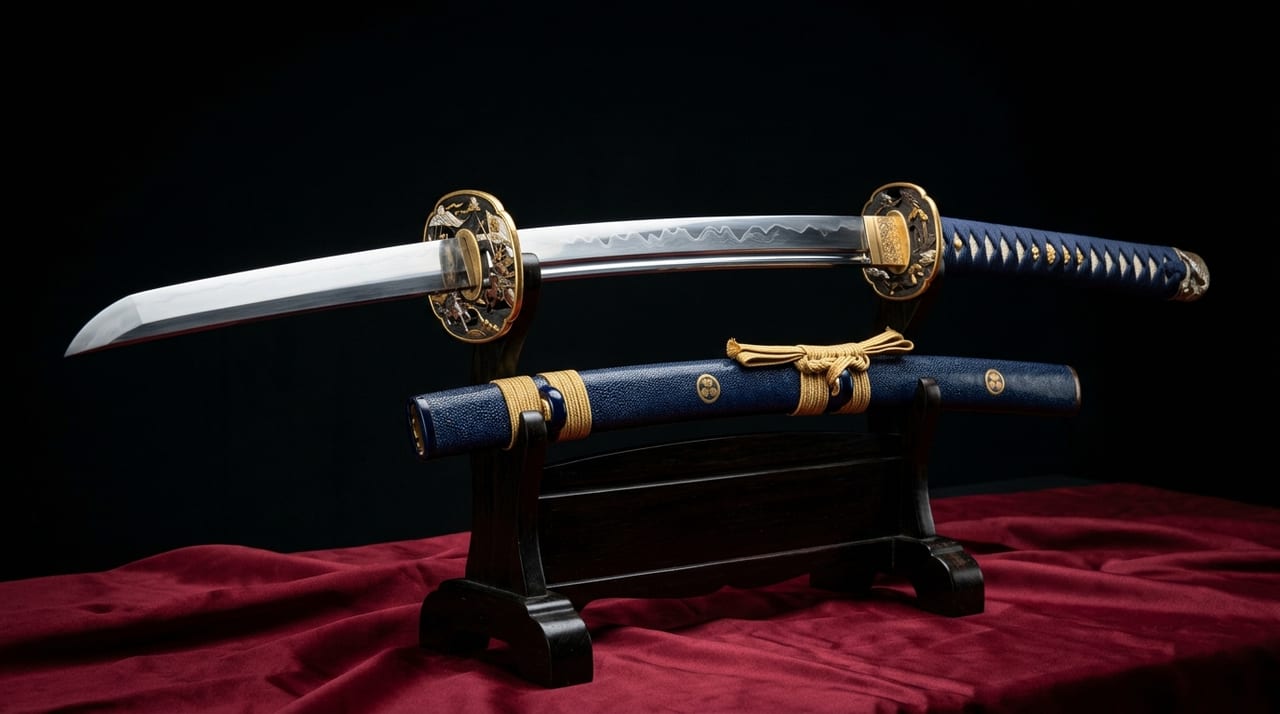
 * Image is for illustrative purposes only.
Beloved Sword of Shima Sakon
島左近の愛刀
Also known as: Sword of Shima Kiyooki (The Trusted Blade of Ishida Mitsunari, Fierce General of Sekigahara)
Description
Shima Sakon (c. 1540–1600) — real name Shima Kiyooki — was a fierce general of the Azuchi-Momoyama period and the trusted lieutenant of Ishida Mitsunari, so celebrated for his valor that a verse of the time declared: "Two things exceed Mitsunari — Shima no Sakon and Sawayama Castle." Born in Yamato Province (present-day Nara Prefecture), he served Tsutsui Junkeiei and others before being recruited by Ishida Mitsunari at the remarkable stipend of two thousand koku. Recognized as the finest general of the age, he earned merit in the campaigns in Korea as well. At the Battle of Sekigahara (September 15, 1600), he led the Western Army's vanguard in a fierce clash with Fukushima Masanori's forces, inflicting heavy losses on the Eastern Army before being gravely wounded by Kuroda Nagamasa's arquebus fire. His fate thereafter is unclear: some accounts say he died on the battlefield; others hold that he escaped gravely wounded. His beloved sword is attributed to smiths of Yamato (Senjuin or Hōshō traditions) or Ōmi. After Sekigahara, swords said to be his were enshrined at temples and shrines in Yamato, where they are venerated as sacred blades consoling a warrior's spirit. Sakon's image as the paragon of loyal service has been a fixture of popular culture since the Edo period, and his sword continues to be revered as an embodiment of devotion to one's lord.
Legends & Stories
Several legends of Sekigahara surround Shima Sakon's sword. On the eve of the battle, it is said that when Sakon presented himself at Ishida Mitsunari's camp and declared "I will lead tomorrow's vanguard," Mitsunari gave him his beloved sword with the words "Use this to uphold the righteousness of the realm," and Sakon swore as he prepared for the morning charge that he would fulfill his lord's ambition with that blade. In another tale, during Sakon's final charge his sword cut down seven Eastern Army commanders in succession, planting a dread among enemy soldiers — "the sword of Demon Sakon spares no one." In farming villages near Sekigahara, a streak of red fire crossing the fields on autumn nights is said to be "Sakon's soul swinging his beloved sword, still fighting the battle" — a belief that a fallen warrior's grievance has taken up residence in the land alongside his blade, and one that continues to live in local tradition today.