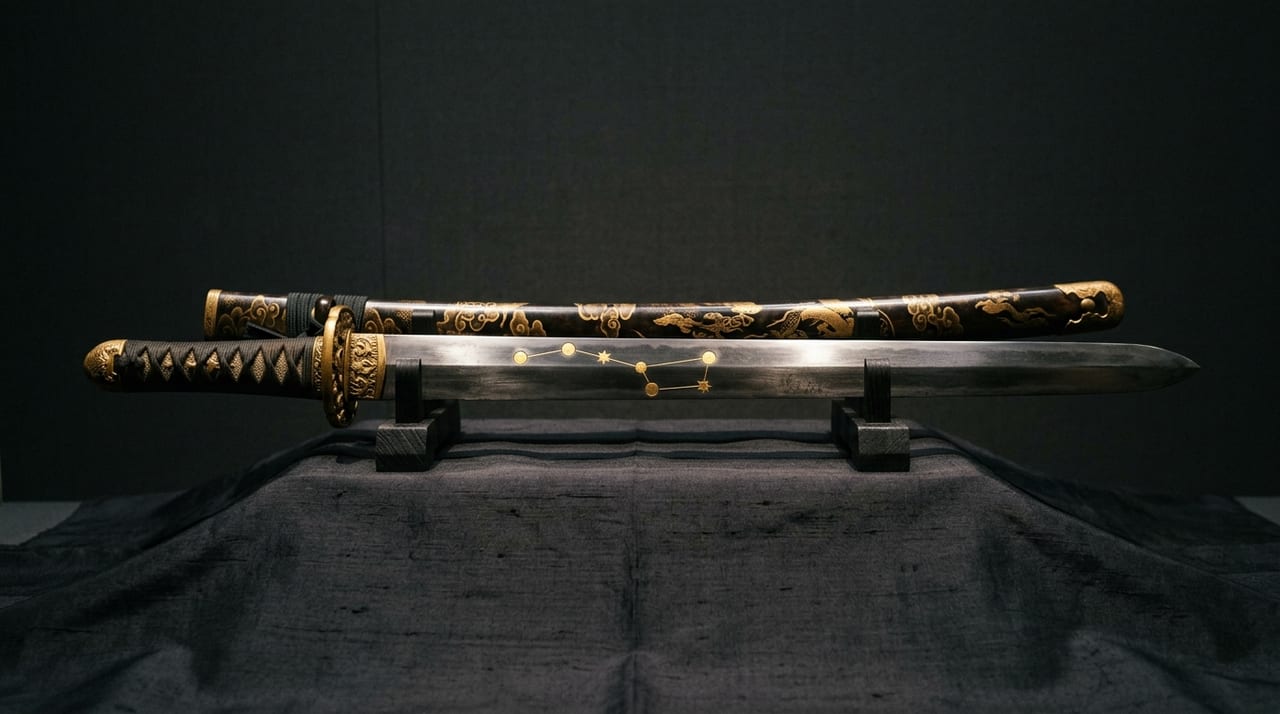
 * Image is for illustrative purposes only.
Seven Star Sword
七星剣
Also known as: Big Dipper Sword / Sacred Sword of Prince Shōtoku / Twin Swords of Shitennoji
Description
Overview of the Seven Star Sword—Sacred Sword of Prince Shōtoku Bearing the Big Dipper
The Seven Star Sword (Shichiseikin) is an ancient chokutō of the Asuka period transmitted to Shitennoji Temple in Tennōji Ward, Osaka City, and is designated as a National Treasure as one of the "twin swords" said to have been worn by Prince Shōtoku (574–622), along with the Heishi Shōrinken. The name "Seven Star" derives from the Big Dipper, and refers to the seven gold-inlaid star motifs on the blade that represent the Big Dipper. Measuring 62.1 cm in overall length, the seven-star motifs decorating the blade demonstrate strong influence from continental Chinese Daoism or astral worship. The decorative and religious concept of "a sword bearing the Big Dipper" indicates that the Seven Star Sword was created as a "ritual object symbolizing cosmic and divine power," transcending mere weaponry.
Symbolic Meaning of the Big Dipper—Daoism and Astral Worship
The symbolic meaning of the "Big Dipper gold inlay," the most distinctive feature of the Seven Star Sword, must be understood within the context of continental Chinese Daoism and astral worship. The Big Dipper (part of Ursa Major) held special religious and philosophical significance in ancient China as "the chariot of the Celestial Emperor" and "the stars commanded by the Celestial Ruler who governs all things," and Big Dipper worship was an important element of Daoism. To inscribe the Big Dipper on a sword was a magical and religious act—"to imbue the sword with the authority and power of Heaven"—and concretely embodied the belief that "the wielder of this sword is protected by the power of Heaven." This veneration of the Big Dipper is direct evidence of the influence of Chinese thought and Daoism transmitted from the continent to Japan in the Asuka period, and the Seven Star Sword is academically recognized as one of the most visually direct material artifacts demonstrating the "acceptance of Daoist cosmology in Asuka-period Japan."
The International Cultural Environment of the Asuka Period
The Asuka period (592–710), when the Seven Star Sword was created, was when Japan fully entered the international society of East Asia. The reforms promoted by Prince Shōtoku—the "Cap Rank System of Twelve Ranks," the "Seventeen-Article Constitution," and the "dispatch of envoys to the Sui dynasty"—represented attempts to transplant advanced Chinese (Sui and Tang) governmental systems and culture to Japan. Within this context, it was a natural historical progression for highest-grade crafted goods and treasures to be brought from continental China or the Korean Peninsula. The Daoist cosmology demonstrated by the Big Dipper decoration on the Seven Star Sword can be understood as part of the "package of continental culture" that Japan accepted during this era—Buddhism, Confucianism, Daoism, bureaucratic institutions, writing, and the decorative arts—and the Seven Star Sword holds special value as the most beautiful and direct evidence of this cultural reception.
Technical Characteristics of the Seven Star Sword
The Seven Star Sword, measuring 61.5 cm in overall length (approximately 52 cm of blade), is an outstanding example representative of Asuka-period swords, alongside the Heishi Shōrinken. The seven-star motifs created by gold inlay on the blade are executed with fine precision, demonstrating the high level of metalworking technique of the era. The cross-sectional shape and steel composition of the blade show typical characteristics of Asuka-period ancient swords and are believed to resemble manufacturing styles from continental China or the Korean Peninsula. Gold inlay as a technique developed from China's Han dynasty (202 BCE–220 CE) and represents continental metalworking craft. The fact that this technique appears on Asuka-period Japanese swords constitutes direct evidence of the influence that continental metalworking had on Japanese sword manufacture, making it of significant scholarly value. In comparison with the Heishi Shōrinken, the Seven Star Sword features "cosmic and religious decoration," while the Heishi Shōrinken is characterized by "inscribed naming through characters"—an interesting contrast that demonstrates the diversity of Asuka-period sword culture.
Preservation at Shitennoji and the Cult of Prince Shōtoku
The Seven Star Sword, together with the Heishi Shōrinken, has been transmitted as a treasure of Shitennoji Temple through successive generations. Shitennoji is one of the oldest official temples of Japan, founded by Prince Shōtoku for the protection of Buddhism, and became the supreme sacred site of the "Shotoku Cult" that developed from the medieval period onward. Within the context of Prince Shōtoku veneration, the Seven Star Sword became an object of religious reverence as a "physical embodiment of the prince's spiritual power," and the distinctive characteristic of the sword "bearing the Big Dipper" merged with the religious narrative that "the power of the stars protected the Prince," conferring special spiritual aura upon the blade. When pilgrims devoted to the Prince gathered at Shitennoji, the existence of the Seven Star Sword served to reinforce their faith by materially proving "the sanctity of the Prince." In the modern era, the Seven Star Sword remains preserved in Shitennoji's treasure hall and is displayed to visitors during periodic special exhibitions—a "sword bearing the Asuka period's cosmic vision" that transmits fourteen centuries of history, shining with unique radiance among Japan's cultural treasures.
Contemporary Evaluation
The Seven Star Sword was designated a National Treasure in 1952 (Showa 27), and together with the Heishi Shōrinken, receives the highest evaluation within the cultural category of "Sacred Swords of Prince Shōtoku." Recent scientific investigation has advanced detailed analysis of the metal composition, gold-inlay techniques, and manufacturing period of the Seven Star Sword, establishing its status as important primary material for research in the history of Asuka-period metallurgy and continental cultural exchange. The very fact that "an Asuka-period treasure sword inscribed with the Big Dipper has been transmitted to the modern era" constitutes a miracle of Japanese cultural preservation. The Seven Star Sword stands as the most precious physical evidence of the prehistoric era of Japanese sword culture—and as one of the most direct artifacts of Prince Shōtoku, a giant figure in Japanese history—destined to continue shining at the center of Japan's cultural memory.
Legends & Stories
The Cosmos Revealed Through the Big Dipper Sword
The deepest appeal of the Seven Star Sword lies in the fact that the Big Dipper motifs inscribed on its blade directly reveal the cosmology of Asuka-period people. In ancient Chinese astronomical thought, the Big Dipper (part of Ursa Major) was the central axis of the cosmos, the chariot of the Celestial Emperor, a star governing life and death, holding special religious and philosophical significance. In Daoism, prayers to the Big Dipper were believed to bring longevity, protection, and disaster prevention. When this philosophy was transmitted to Asuka-period Japan and the Big Dipper was chosen to decorate the most important treasure sword, it embodied the religious and magical cosmology of the Asuka period most directly: "by imbuing the sword with the symbol of the cosmic ruler, one grants the sword and its wielder cosmic power." Standing before the Seven Star Sword, modern viewers can simultaneously feel the night sky that Asuka-period people gazed upon fourteen hundred years ago and their desire to "revere and command the cosmos" by inscribing it upon a blade—an experience of temporal and spiritual resonance extraordinarily rare among Japan's cultural treasures.
Prince Shōtoku's Spiritual World Transcending Religious Boundaries
The fact that Prince Shōtoku encompassed both Buddhism (prayer to the Four Heavenly Kings, the founding of Hōryūji and Shitennoji temples) and Daoist cosmology (the Big Dipper on the Seven Star Sword) within his spiritual world demonstrates the richness and diversity of the religious and intellectual life of Asuka-period Japan's elite. Though the Prince demonstrated in his "Seventeen-Article Constitution" a unique governing philosophy integrating Buddhism, Confucianism, and Shinto, the existence of the Seven Star Sword suggests this "religious synthesis" was a personal and spiritual practice transcending mere political policy. The combination of "a prince sworn to protect Buddhism wielding a sword inscribed with Daoist cosmology" may appear contradictory from the standpoint of religious puritanism, yet it reveals that for Asuka-period spiritual elites, "the coexistence and integration of diverse religious wisdom" was supreme wisdom. The Seven Star Sword is sometimes cited as among the most concrete material evidence of Prince Shōtoku's intellectual progressivism—his open spirit of "learning the best from various religious traditions."
Resonance with the Dōgyō Theft Incident—Swords and the Korean Peninsula
In contrast to the traditions surrounding the Seven-Branched Sword, in which "the Silla monk Dōgyō attempted to steal a divine sword," the narrative of the Seven Star Sword also holds fascinating dimensions. If the Seven Star Sword were indeed an import from the Korean Peninsula, then the process whereby "a sword brought from the Peninsula became the precious relic of a Japanese sage" would constitute one of history's most intriguing examples of how objects "cross borders" and undergo "cultural transformation" in ancient East Asia. The principle of cultural transformation—"swords transcend the culture of their makers and acquire new meaning within the culture of their recipients"—is realized in its purest form in the Seven Star Sword. The narrative of transformation—"a continental sword inscribed with Daoist cosmology becomes venerated as the relic of a Buddhist sage among Japan's people"—continues to stimulate scholars' imagination as among the richest subjects in cultural history.
Surviving Through the Siege of Ōsaka and the Pacific War
The Seven Star Sword has survived to the present day thanks to the unfailing devotion of those who protected Shitennoji across the centuries and their religious conviction that "to preserve the Prince's treasure sword is to preserve Buddhism itself." During the Siege of Ōsaka (1614–1615), Shitennoji's buildings burned, and during the Great Ōsaka Air Raid in the final stages of the Pacific War, the city was reduced to ashes, yet the Seven Star Sword has been transmitted across these flames of war to the present day. That the Seven Star Sword survives, preserved under the care of its owning temple, Shitennoji, is the result of the devotion of countless unnamed individuals who repeatedly performed the act of "preserving the sword," and the survival of the Seven Star Sword quietly testifies that the religious motivation of "guarding the Prince's relic" functioned as the oldest form of cultural preservation long before the modern concept of "cultural property protection" was born. As the Big Dipper continues to shine in the night sky, so does the Seven Star Sword shine across the storms of time, delivering the dreams and religious passion that Asuka-period people saw in the heavens to the modern era, fourteen hundred years hence.