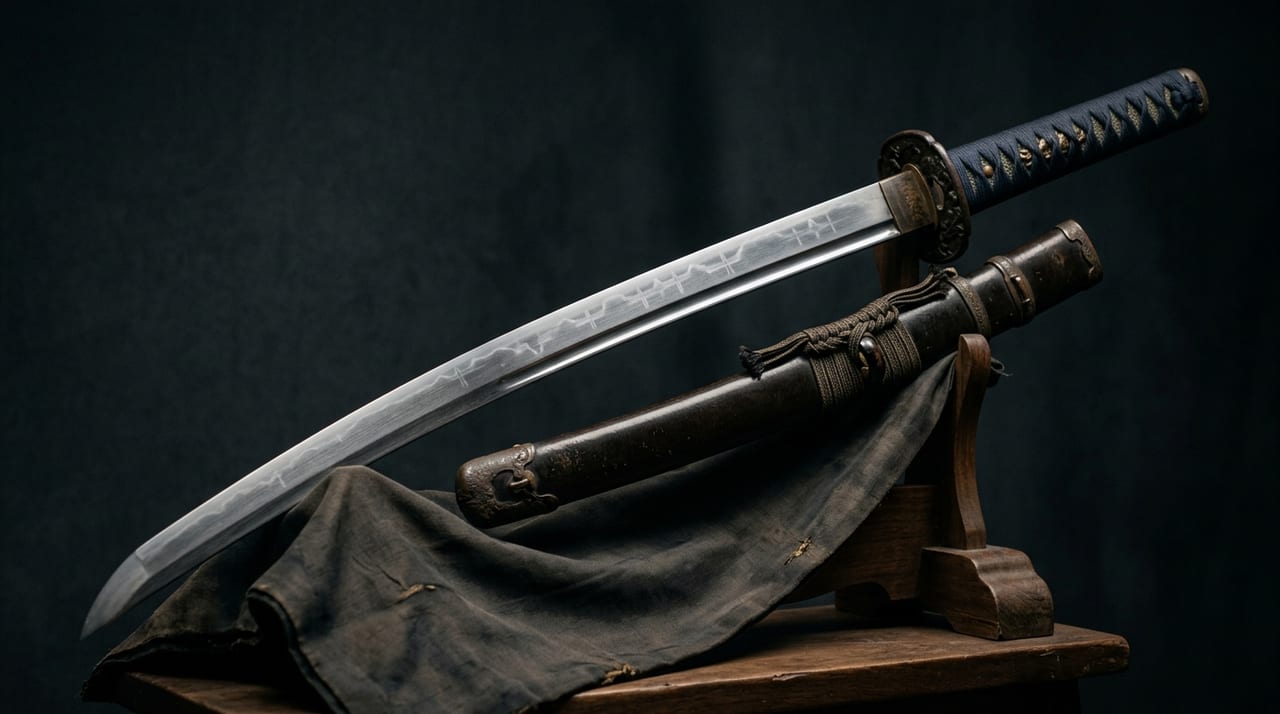
 * Image is for illustrative purposes only.
Saimura Sadamune
斎村貞宗
Also known as: The Sadamune confiscated from Saimura Masahiro / Owari Tokugawa heirloom
Description
A Sadamune carried by a retainer of the Akamatsu
The Saimura Sadamune is a wakizashi by Sadamune. Reliably signed Sadamune blades are almost unknown, and this one too is unsigned in itself, though it bears a gold-inlaid attribution reading "Sadamune" on the front, added by the appraiser Hon'ami Kōtoku, with his vermilion-lacquer signature and kaō on the back. The temper line is a shallow notare-based suguha mixed with irregularities, and the tang is unshortened. It measures 30.4 cm with a curvature of 0.5 cm. The name comes from Saimura Masahide, a retainer of the Akamatsu house of Harima province, who first owned it.
Confiscated after the burning of Tottori Castle
Masahide's son, Saimura (Kinoshita) Masahiro, initially sided with the Western army at Sekigahara but surrendered to the Eastern army on hearing of its collapse, and on Tokugawa Ieyasu's order attacked Tottori Castle in Inaba province, held by the Western side. He set fire not only to the castle but to the surrounding town, and for this offense Ieyasu ordered him to commit seppuku; the sword is said to have been confiscated at that time. In the eleventh month of 1615 it was granted to the Owari Tokugawa house as part of a distribution of Ieyasu's effects, and has remained in that family's tradition since.
Designation and present whereabouts
The blade is designated an Important Cultural Property. It is now privately owned and held at the Tokyo National Museum.
Legends & Stories
Valor and punishment intertwined
Saimura Masahiro distinguished himself in the attack on Tottori Castle, yet was ordered to commit seppuku by Ieyasu for the military breach of burning the surrounding town. The episode shows that the rewards and punishments following Sekigahara judged not only victory or defeat but the conduct of the fighting itself. That a blade confiscated from a punished retainer came to be treasured by the senior Owari branch of the Tokugawa house is a quiet reminder of how a meibutsu can carry the memory of a punishment within its provenance.
Related Famous Swords
一期一振
Gomotsu (Imperial Collection)Ichigoichifuri
Awataguchi Yoshimitsu
織田信長の愛刀
National Treasures and Important Cultural Properties (multiple)Oda Nobunaga's Beloved Sword
Awataguchi Tōshirō, Samonji, Yukimitsu, Hasebe (respective smiths)
肥前忠吉
Important Cultural Property • Important Sword (multiple works)Hizen Tadayoshi
First Hizen Kuni Tadayoshi
会津正宗
Imperial Treasure (Imperial Household Treasure, Imperial Household Agency custody)Aizu Masamune
Masamune