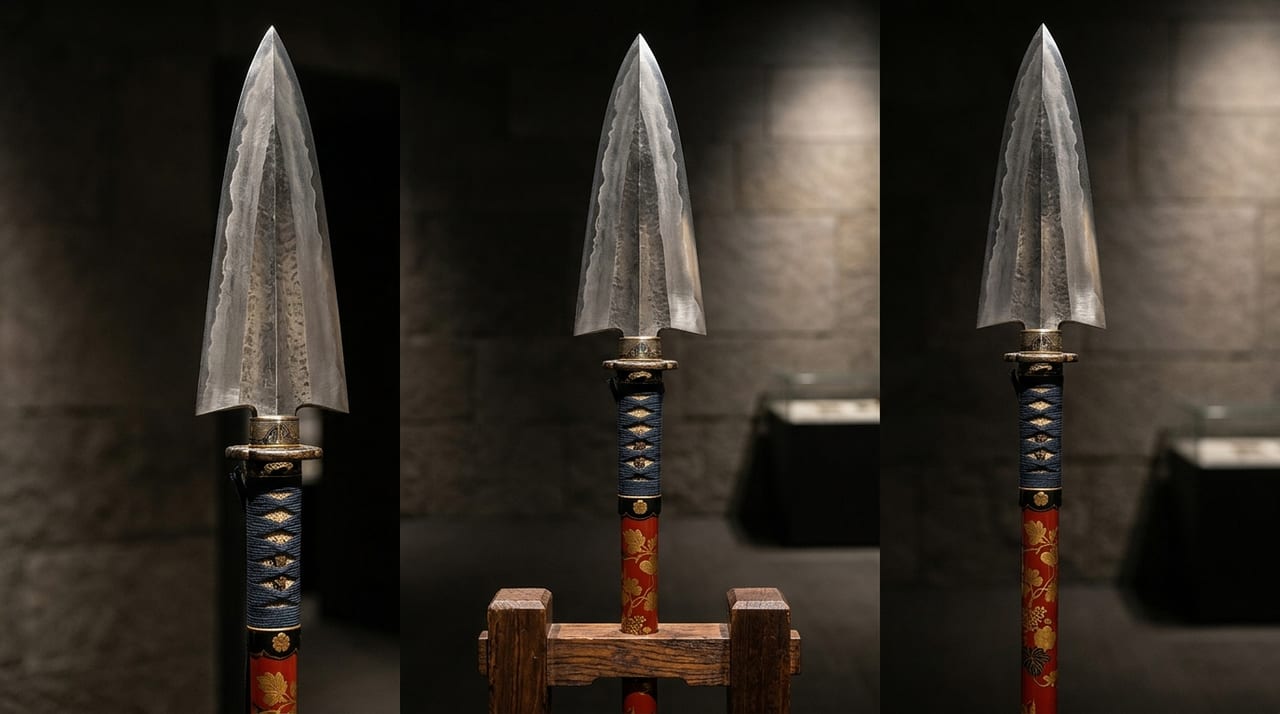
 * Image is for illustrative purposes only.
Tachi signed "Sa" (Meibutsu Ōsamonji)
太刀 銘 左(名物 大左文字)
Also known as: Ōsamonji, Nijō Castle presentation sword
Description
Overview
Ōsamonji is a tachi attributed to Samonji (Yasuyoshi), the founding master of the Samonji school active in Chikuzen Province (present-day Fukuoka Prefecture) during the Nanbokuchō period. The tang bears the single-character inscription "Sa." Notably larger and more accomplished than other Samonji blades, it earned the name "Ōsa" or "Ōsamonji" ("Great Sa"), and it was recorded at the head of the Toyotomi family's inventory of prized swords.
Style
Samonji (Yasuyoshi) is said to have trained under Sōshū Masamune and, upon returning to his native Chikuzen, to have received a torn sleeve from Masamune's own robe — the origin, by tradition, of his adopted name "Sa." His style shows the strong influence of the Sōshū tradition, with a vigorous character: coarse itame grain with thick ji-nie, and a varied hamon combining notare with gunome. This blade is among the largest of Samonji's tachi, and its commanding presence gave rise to the name Ōsamonji.
Provenance
The sword was regarded as a meibutsu of the highest order, listed first in the Toyotomi family's inventory of treasured swords. In 1611, at the historic meeting between Tokugawa Ieyasu and Toyotomi Hideyori at Nijō Castle in Kyoto, Ieyasu presented this tachi and a companion short sword to Hideyori during their ceremonial exchange of cups. This meeting symbolized the shifting balance of power between the Tokugawa and Toyotomi houses. After the fall of the Toyotomi house in the Siege of Osaka, the blade returned to Tokugawa hands, recorded among the shogunal house's treasured swords in the Suruga Bunbutsu-chō, and was passed down through the Owari Tokugawa family.
Designation and Current Location
Although not a nationally designated cultural property, it has long been revered among warrior society as a meibutsu recorded in sword catalogs such as the Kyōhō Meibutsuchō. It is now held by the Tokugawa Art Museum in Nagoya, forming a centerpiece of the museum's sword collection.
Legend
The exchange of swords at the Nijō Castle meeting, held on the eve of the Siege of Osaka, was far more than ceremony — it embodied the political power dynamics between the two houses. Given that the Toyotomi clan would fall within a few years, this scene of gift-giving is remembered as a moment that marked a turning point in history.
Legends & Stories
At the 1611 Nijō Castle meeting, Tokugawa Ieyasu presented this tachi to Toyotomi Hideyori as part of their ceremonial exchange. Given that the Toyotomi clan would fall within a few years in the Siege of Osaka, the gift quietly foreshadowed the shift in power between the two houses.