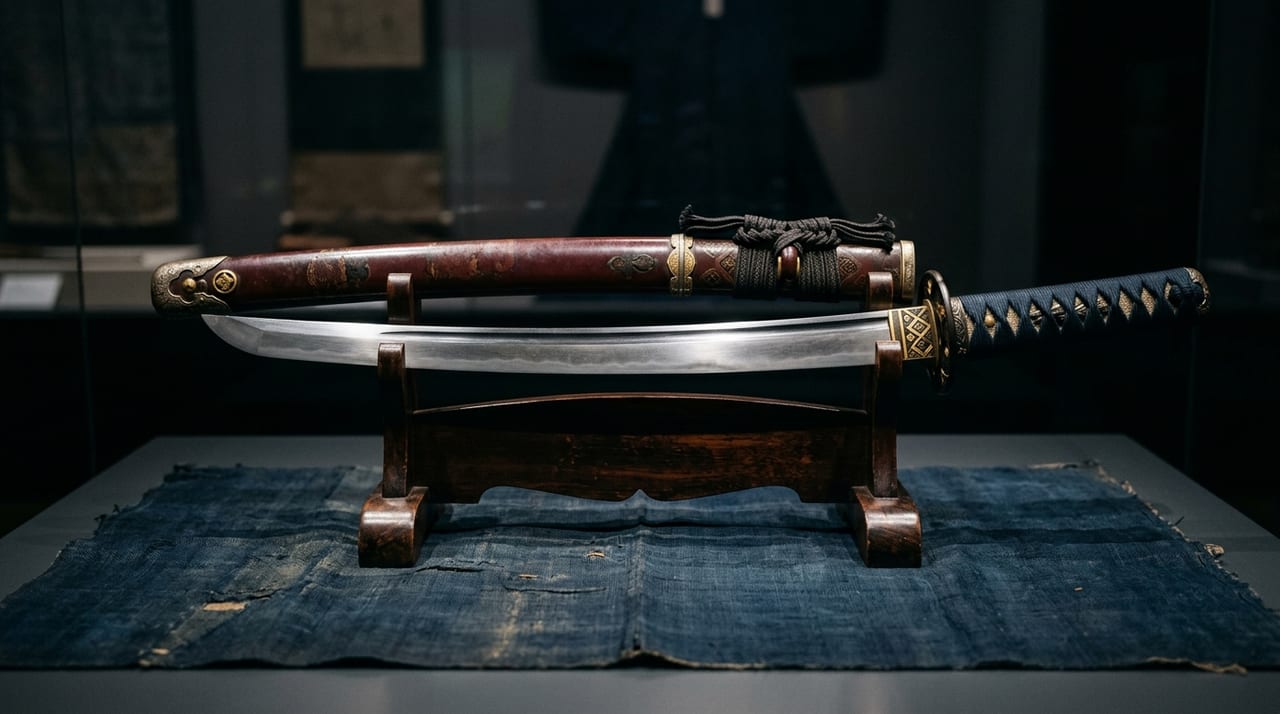
 * Image is for illustrative purposes only.
Nikkari Aoe
にっかり青江
Also known as: Grinning Ghost Cutter
Description
Overview of the Sword
Nikkari Aoe is a wakizashi (short sword) forged by a smith of the Aoe school based in Bichū Province (present-day western Okayama), and it is a legendary blade accompanied by a yokai tale in which "a smiling female ghost appeared and was cut down." The name "Nikkari" derives from the female ghost who "grinned" or "smirked," and it is designated as an Important Cultural Property (Jūyō Bijutsuhin) among the finest wakizashi. It is currently housed at the Marugame City Museum in Marugame City, Kagawa Prefecture, and has a history of transmission from the Kyōgoku clan to Marugame Domain.
The Smith and the Aoe School
The Aoe school was a group of sword smiths based in Bichū Province (present-day areas of Kurashiki and Sōja in Okayama Prefecture) who were active from the late Heian period through the Nanboku-chō period. The Aoe school is classified into three periods: "Ko-Aoe" (Early Aoe), "Chūko-Aoe" (Middle Aoe), and "Sue-Aoe" (Late Aoe), with Nikkari Aoe classified as Middle Aoe. The most distinctive characteristic of Aoe school sword-making is the unique "sumihadaa" or "bōbōeri" (reflected patterns) that appear in the body of the steel. Utsuri refers to misty, luminous patterns visible within the steel; while such phenomena also appear in the Bizen tradition, the Aoe school's utsuri is particularly clear and beautiful, earning it the distinction of being the exemplar of Japanese sword utsuri known as "Aoe utsuri." The hamon (edge pattern) is characterized by calm straight edges or subtle wavy lines, with a style that values formality and refinement over ostentation. This unpretentious yet profound beauty embodies the ancient charm common to Japanese swords of the Heian to Kamakura periods, emanating a quiet elegance entirely distinct from the later, grander Sōshū tradition.
Provenance and the Kyōgoku Clan
The provenance of Nikkari Aoe traces back to the ownership of Kyōgoku Takatsugu (1569–1609), a Sengoku warlord of Ōmi Province (present-day Shiga Prefecture). The Kyōgoku clan was a prominent family of the Muromachi period; under Takatsugu's leadership, they served as daimyō under the Toyotomi regime and at the Battle of Sekigahara contributed to the Eastern Army's success by holding Ōtsu Castle under siege. After Takatsugu's death, the Kyōgoku clan continued to exist as daimyō in various locations, and when they became lords of Marugame Domain (Kagawa Prefecture), this blade was also transferred to Marugame. Preserved as a treasured item of Marugame Domain throughout the Edo period, Nikkari Aoe remained in Marugame after the Meiji period and is now regularly displayed as a collection piece of the Marugame City Museum.
The Wakizashi Form
It is notable that Nikkari Aoe is not a katana (long sword—tachi or uchigatana) but rather a wakizashi (short sword). A wakizashi is a blade with an edge length of at least one shaku (approximately 30 cm) but less than two shaku (approximately 60 cm), worn by samurai as a secondary sword in combination with a larger sword (tachi or uchigatana). It was used for practical purposes in situations unsuitable for a long sword, such as self-defense indoors or seppuku assistance (kaishakunin duties). That Nikkari Aoe has been treasured as a renowned blade despite being a wakizashi reflects both the high refinement of the Aoe school's craftsmanship and the elevated prestige conferred by its unique yokai legend. That an ancient wakizashi from the Heian to Kamakura periods has survived seven to eight hundred years and remains preserved as an Important Cultural Property today demonstrates how carefully and reverently this blade has been transmitted through the generations.
Modern Popularity
Through its portrayal as a character in the game Touken Ranbu, Nikkari Aoe has gained nationwide recognition. Depicted as a character with a graceful, smiling appearance, the gap between its otherworldly legend of slaying a ghost and its refined aesthetic has captivated many fans. The Marugame City Museum has experienced a sharp increase in visitor numbers from Touken Ranbu fans, creating a phenomenon in which Marugame City in Shikoku has attracted national attention. The quiet, formally refined style of the Aoe school, the distinctive name "Nikkari," and the mystical legend of the ghost—these elements combined have created a unique worldview that embodies the multifaceted appeal of Japanese swords.
Legends & Stories
The Ghost Who Smiles "Nikkari"
The legend that gave the sword Nikkari Aoe its name is particularly striking among Japanese sword ghost tales. According to the tradition, one night as a samurai walked alone along the road, a woman appeared before him. The woman drew near with a "nikkari" smile—that is, a thin, unsettling grin. The samurai instantly perceived that the woman was not a living human being and, in a reflexive motion, drew his wakizashi from his hip and cut her down. But the moment he thought he had struck, the woman's figure vanished, and what lay in its place was a stone lantern (or a tree root, in some accounts) toppled to the ground. When confirmed the next morning, the stone lantern bore unmistakable sword cuts, and the severed surface was a clean break made by a sharp blade. He thought he had cut down a ghost, but he had actually cut through a stone lantern—this "ghost-slaying" legend was transmitted through the generations as a tale celebrating both the belief in the Japanese sword's power to sense and sever even supernatural things, and the samurai's split-second judgment. The name "nikkari" is said to derive from the ghost's manner of smiling, and the "nikkari smile" borne by the phantom became the sword's epithet itself.
While other legends of "cutting supernatural beings with a sword" exist (such as Dōji-giri Yasutsunas slaying of the Sake-drinking Demon), the unique quality of the Nikkari Aoe legend lies in the ambiguity and uncanniness of the episode: "I thought I had cut it down, but it turned out to be a stone lantern." Did he cut down a ghost, or a stone, or what actually transpired?—it is precisely this ambiguity that creates the legend's eerie allure.
The Aoe Reflection and Eerie Beauty
The "Aoe reflection" that appears in the jigane (ground steel) of Nikkari Aoe is in remarkable harmony with this sword's mysterious provenance and strange character. The light of the misty, undulating reflection overlaps with the image of the nikkari-smiling phantom woman who appeared in the darkness of night, evoking in the viewer an indescribable eeriness. The straight blade pattern and exquisite jigane characteristic of the Bichū Aoe school of the Northern and Southern Courts period shine with a quiet beauty entirely different from the bold, undulating blades of later eras, and within that quietude seems to lurk the uncanniness of the phantom legend. Many visitors who have beheld this sword in person at the Marugame City Museum find themselves speechless before this "quiet eeriness."