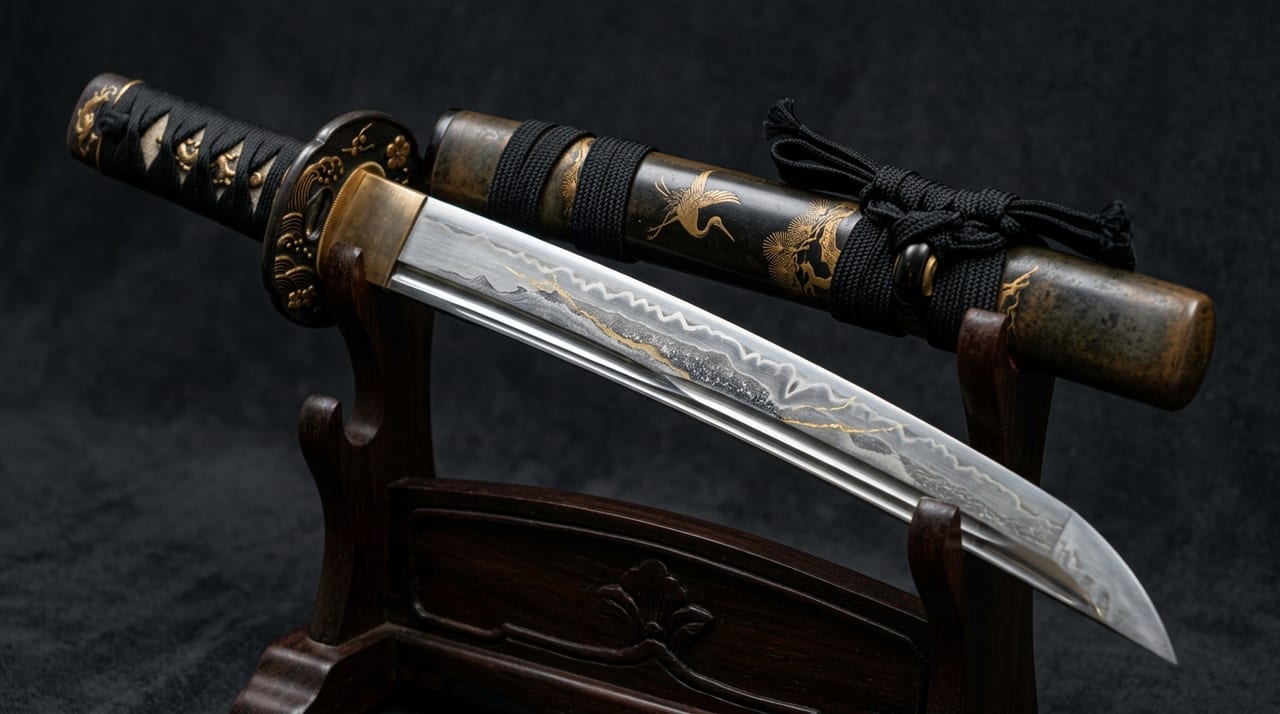
 * Image is for illustrative purposes only.
Nakatsukasa Masamune
中務正宗
Also known as: Nakatsukasa — Quintessential Sōshū Masamune, Important Cultural Property at Tokyo National Museum
Description
Nakatsukasa Masamune is a sword forged by Masamune (Okazaki Masamune, dates unknown), the progenitor of the Sōshū tradition who flourished from the late Kamakura period into the early Nanbokuchō era, and is designated an Important Cultural Property held at the Tokyo National Museum—a masterwork exemplifying the highest achievement of Sōshū-den. The appellation "Nakatsukasa" is believed to derive from the court rank "Nakatsukasa-no-Taifu" (Assistant Minister of the Department of Central Affairs) of Honda Tadakatsugu, one of the Four Heavenly Kings of the Tokugawa. Because Tadakatsugu was the first daimyo of Kuwana Domain, the blade is also known as "Kuwana Masamune."
Masamune studied under his master Shintōgo Kunimitsu and perfected his unique forging methods at Kamakura in Sagami Province (present-day Kamakura City, Kanagawa Prefecture), becoming the greatest revolutionary in sword-forging history by completing the sword aesthetic known as Sōshū-den. The core of Masamune's style is the aesthetic of nie—fine granular steel particles gleaming at the boundary of the hardened edge—deployed in large quantities that fundamentally overturned all prior conceptions of hamon. In particular, the large, turbulent hamon patterns (ō-midare, ō-gunome, hako-midare) and the complex visual effects of utsuri and ji-nie in the steel body are the defining characteristics of Sōshū-den.
Nakatsukasa Masamune is a blade of reshaped form with no signature, with a blade length of approximately 67.0 cm and displaying Masamune's characteristic vivid midare hamon. The jigane shows itame grain flowing in undulating patterns, with fine and abundant ji-nie imparting luster and profound depth. The hamon is based on Masamune's quintessential large-gunome-midare, with long nie-ashi flowing into the blade and flamboyant kinsuji and sunagashi that overwhelm the viewer with breathtaking beauty. The visual effects within the blade are extraordinarily complex, and sword appraisers note that fresh scenery emerges no matter what angle the light strikes the blade.
This blade was acquired by Honda Tadakatsugu through the mediation of Honami Kōtoku and authenticated as a Masamune work; it subsequently passed through Tokugawa Ieyasu and the Mito Tokugawa House before entering the possession of the Tokugawa shogunal house. It was designated as an Important Cultural Property in 1957 (Showa 32). Through this designation, opportunities for public display have been established, offering precious opportunities for sword enthusiasts and researchers to observe the actual blade.
Legends & Stories
Legends about Nakatsukasa Masamune's hamon harboring a special power have been passed down since the Muromachi period. When a certain general received the blade, a retainer who noticed a pale blue light leaking from the sword room in the night opened the door in trepidation to find the nie of the hamon glowing from within as it caught the moonlight — as if the blade were alive. It is also said that successive appraisers of the Hon'ami family, when closely observing the blade interior of Nakatsukasa Masamune, would feel that "Masamune's face appeared," giving rise to the belief that the spirit of the Kamakura swordsmith dwells eternally within the edge. Sword treatises of the Edo period include the statement that "one who takes Nakatsukasa in hand is directly taught the essence of the sword by Masamune himself," and it is said that warriors and men of letters alike held the wish to behold this blade at least once as a goal for their entire lives.