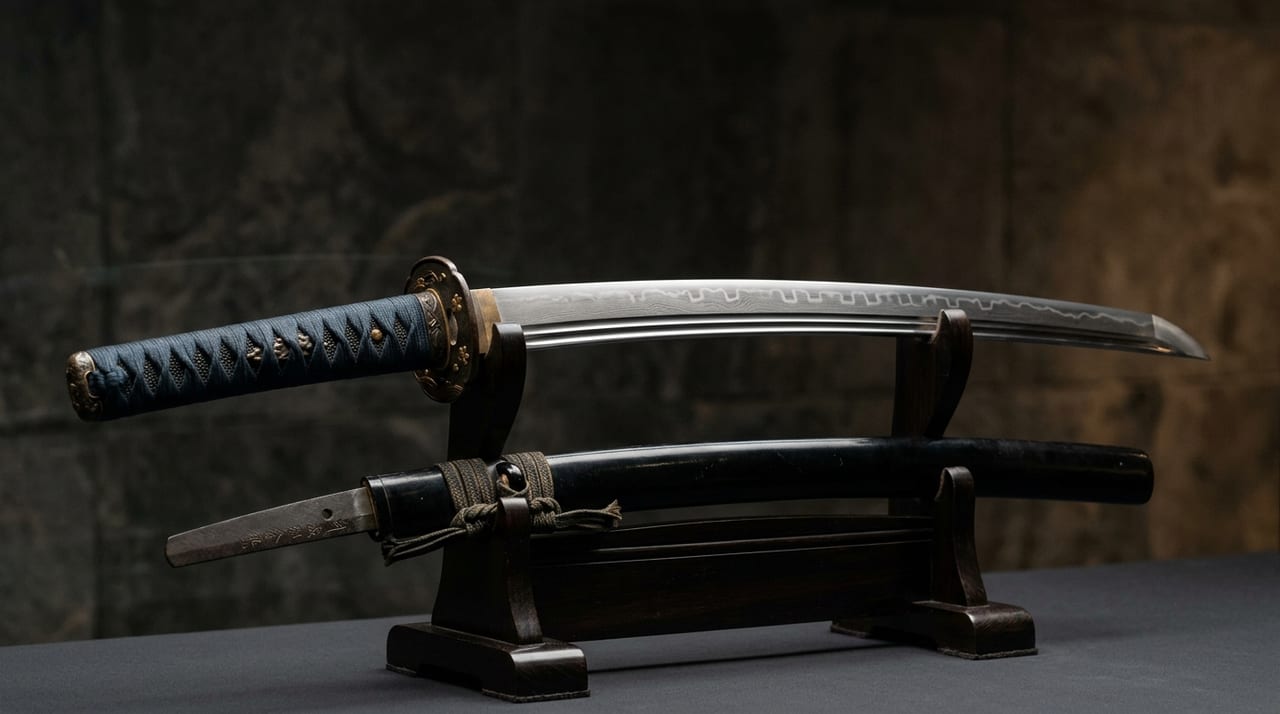
 * Image is for illustrative purposes only.
Myōhō Muramasa
妙法村正
Also known as: Hokke Muramasa
Description
Myōhō Muramasa — The Lotus Sutra Sword of the Sengoku Era
Myōhō Muramasa is a katana attributed to Sengo Muramasa, a master swordsmith active in Kuwana, Ise Province (present-day Kuwana, Mie Prefecture), during the late Muromachi to early Sengoku periods (16th century). Muramasa stands as one of Ise Province's most celebrated smiths, renowned for his Sōshū-tradition-derived forging techniques that produced blades of exceptional sharpness and distinctive tempering patterns highly prized by Sengoku-period warriors. The defining characteristic of this particular blade is the engraved inscription 妙法蓮華経 (Myōhō Renge Kyō, the title of the Lotus Sutra) on its nakago (tang), which gave rise to the names "Myōhō Muramasa" or "Hokke Muramasa" (Lotus Sutra Muramasa).
The blade measures approximately 70 centimeters in length (roughly 2 shaku 3 sun), with moderate curvature, broad mihaba (blade width), and a robust sugata (overall shape) typical of practical Sengoku-period combat swords designed for battlefield efficacy rather than ceremonial display. The hamon (temper pattern) exhibits Muramasa's signature hako-midare (box-shaped irregular) configuration, characterized by a crisp nioi-guchi (boundary line of the hardened steel edge), interspersed with sharp ashi (legs) and yō (leaves) extending into the ji (blade surface). The jihada (surface grain) displays tightly forged ko-itame (fine wood-grain pattern) with abundant jinie (surface martensite crystals), testament to meticulous forging craftsmanship. The kissaki (point) is of chū-kissaki (medium) proportion, embodying the characteristically acute geometry that defines Muramasa's cutting prowess.
Muramasa swords acquired legendary notoriety during the Edo period as "cursed blades" (yōtō) believed to bring catastrophic misfortune to the Tokugawa clan. This sinister reputation stems from a series of tragic coincidences: Tokugawa Ieyasu's grandfather Matsudaira Kiyoyasu was assassinated by a retainer wielding a Muramasa blade in 1535; his father Hirotada died under circumstances involving a Muramasa sword; and most devastatingly, Ieyasu's eldest son and heir Nobuyasu was ordered to commit seppuku in 1579, reputedly using a Muramasa blade for the act. These unrelated incidents were later woven into an elaborate narrative of supernatural vendetta, and Muramasa blades were officially prohibited within Tokugawa domains. However, this ban paradoxically increased their mystique and value. In reality, Muramasa swords were prized as superior combat weapons and were treasured by many samurai houses, including the Kishū Tokugawa branch and numerous daimyō families, who recognized their practical excellence beyond the Edo period's mythologized accounts.
The nakago inscription "妙法蓮華経" references the Saddharmapuṇḍarīka Sūtra, the fundamental scripture of Nichiren Buddhism (Hokke-shū / Lotus School). This inscription indicates Muramasa's deep devotion to the Lotus Sutra faith, a Buddhist tradition that emphasized the salvific power of the sutra itself. During the Sengoku period, Nichiren Buddhism saw vigorous propagation throughout Ise Province and central Japan, attracting followers from all social strata including artisans and warriors. It was not uncommon for swordsmiths to inscribe expressions of religious devotion—whether Buddhist invocations, Shinto dedications, or protective mantras—onto their works as spiritual talismans. Myōhō Muramasa thus represents a profound synthesis of martial craft and spiritual conviction, embodying the elevated spirituality characteristic of an era when the line between the sacred and the martial was often indistinct.
Currently designated an Important Art Object (Jūyō Bijutsuhin), the sword remains in private collection within Mie Prefecture. Among extant Muramasa works, examples bearing Lotus Sutra inscriptions on the tang are exceedingly rare, making this blade a precious cultural artifact that transmits the fusion of faith and martial culture emblematic of the Sengoku period. It continues to command high regard among sword connoisseurs, Buddhist art historians, and cultural researchers as a tangible window into the spiritual and martial landscape of sixteenth-century Japan.
Legends & Stories
The Protection of Myōhō — A Prayer Engraved in Steel
A legend surrounds the characters 妙法蓮華経 engraved upon the tang of Myōhō Muramasa.
In the turbulent Sengoku era, the Ise swordsmith Sengo Muramasa was a devout adherent of the Lotus Sutra, chanting its sacred verses morning and evening as he worked at the forge. One year, an epidemic swept through Kuwana, claiming many lives. Muramasa himself fell gravely ill, but as he continued to recite the Lotus Sutra from his sickbed, he experienced a mysterious vision. A monk standing upon a radiant lotus blossom appeared before him, declaring: "Infuse your craft with the protection of the Buddha-dharma. Thus shall your blades sever calamity and guard those who bear them." Upon waking, Muramasa found himself restored to health. From that day forward, he began inscribing the characters "妙法蓮華経" upon the tangs of swords into which he had poured his utmost devotion.
This particular Myōhō Muramasa came into the possession of a Sengoku-period warrior, who carried it through numerous campaigns and achieved distinguished military honors. It is said that before each battle, the warrior would reverently gaze upon the Myōhō inscription and chant passages from the Lotus Sutra before advancing to the field. Remarkably, he emerged unscathed from arrows and bullets time and again, escaping mortal danger on countless occasions. While Muramasa blades were often feared as "cursed swords," examples like Myōhō Muramasa that bore the blessings of Buddhist dharma also existed—a reminder, the elders said, that a sword's function shifts according to the heart of its wielder.
When the age of warfare finally subsided, Myōhō Muramasa was either dedicated to a Buddhist temple or entrusted to successive generations of descendants, depending on which version of the tale one follows. This blade, inscribed with the prayer of the Lotus Sutra, transcends its identity as a mere weapon, standing instead as a symbol of the union between faith and martial valor, quietly marking the passage of time to this day.