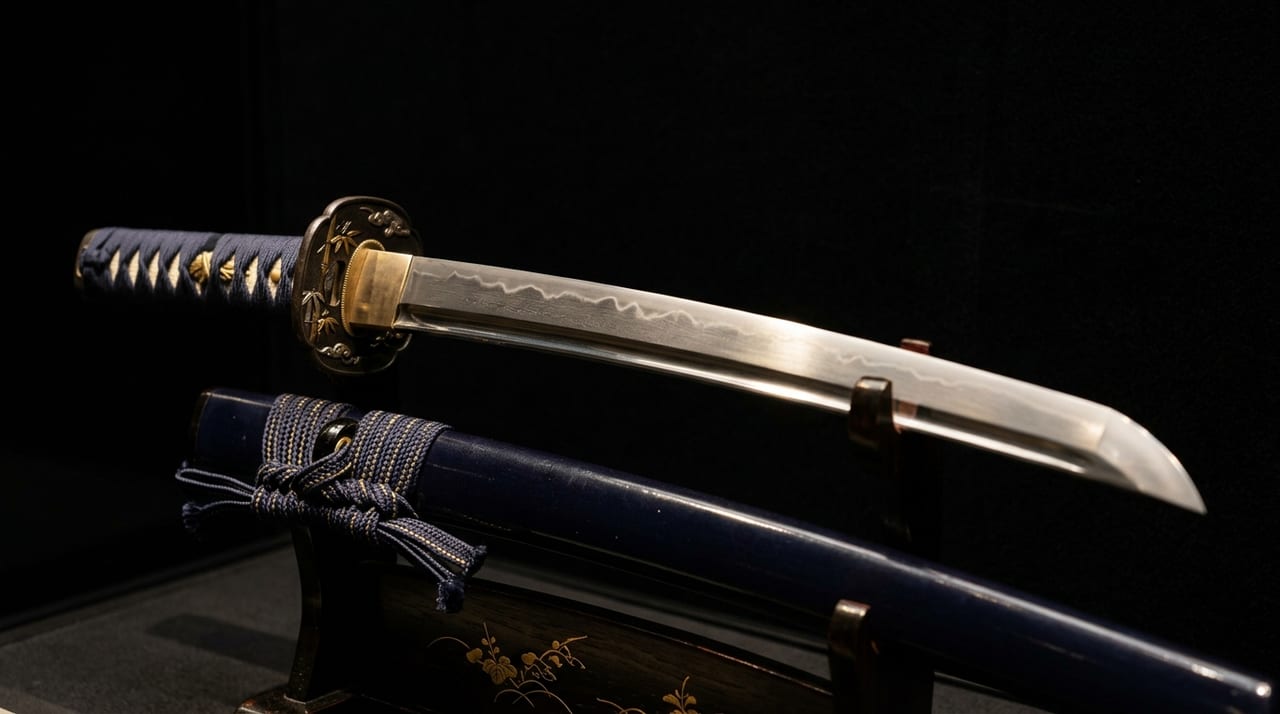
 * Image is for illustrative purposes only.
Monoyoshi Sadamune
物吉貞宗
Also known as: Good Omen Sword — Tokugawa Ieyasu's Talisman of Victory
Description
Overview of the Sword
Monoyoshi Sadamune is a masterpiece wakizashi forged by Sadamune, the master smith of the Sōshū tradition, and shines brilliantly in the history of Japanese swords as the "good-omen sword" that Tokugawa Ieyasu cherished and used throughout his lifetime. The name "Monoyoshi" (物吉) means literally "good fortune comes to all things" or "auspicious in all endeavors," derived from the tradition that whenever Ieyasu took this wakizashi into battle, he invariably achieved victory. A sword held especially dear by Ieyasu, who unified the realm and laid the foundation for three centuries of Tokugawa peace—Monoyoshi Sadamune is, in this sense, a singular and extraordinary object, one of the spiritual cornerstones of the Tokugawa shogunate itself.
Master Sadamune of the Sōshū Tradition and His Wakizashi
Sadamune was a master smith of the Sōshū tradition who flourished from the late Kamakura period through the Northern and Southern Courts period, inheriting from his teacher Masamune the vigorous nie-forging technique ("boiling") while establishing his own refined and elegant aesthetic. Sadamune's wakizashi, like his long swords and short swords, earned the highest regard, and Monoyoshi Sadamune is known as an exceptional specimen among the wakizashi that Sadamune forged. The steel surface displays a tightly compressed small-plate grain (ko-itame) of exceptional beauty; the nie appears throughout in fine particles, presenting a lustrous iron tone. The blade pattern is founded on the interlocking-wave (gunome) motif of nie-forged workmanship, enriched with gold streaks and sand-wash patterns, while the edge shows a soft and deep hamon finish. This "perfect fusion of strength and elegance" represents the very essence of Sadamune's mastery, and Monoyoshi Sadamune is its supreme embodiment. The wakizashi, being shorter than the long sword and katana, was a companion blade worn close to a warlord's side in daily life. That Monoyoshi Sadamune remained constantly at Ieyasu's side as his personal protection blade demonstrates his singular trust in this weapon.
Tokugawa Ieyasu and Monoyoshi Sadamune
Although detailed records of how Ieyasu acquired Monoyoshi Sadamune are lacking, given Ieyasu's passion for sword collecting and his discerning eye, it was perhaps inevitable that this wakizashi—one of Sadamune's supreme masterworks—would come into his hands. Ieyasu is said to have declared that "the finest sword in Japan is Masamune," so devoted was he to the Sōshū tradition; he likewise treasured the works of Sadamune, Masamune's adopted son (also said by some to be his biological son). The repeated victories achieved in battles fought while bearing Monoyoshi Sadamune—whether based on actual experience or transmitted as legend—gave rise to the name "Monoyoshi," and thereafter this wakizashi became for Ieyasu far more than a masterwork blade: it became a guardian presence itself.
There is a tradition that Ieyasu wore Monoyoshi Sadamune at the Battle of Sekigahara (the fifth year of Keichō, 1600). If this is true, then this wakizashi, worn at Ieyasu's hip in the great battle that determined the fate of the realm and brought forth three centuries of Tokugawa peace, was a witness to that historic moment. It is said that after his victory, Ieyasu remarked, "Indeed, the blade of Monoyoshi proves its spiritual efficacy," a remark that has been preserved as a testament to his profound trust in this sword.
The Auspiciousness of "Monoyoshi"
The concept of "Monoyoshi" held extraordinary significance in Japanese samurai society. When a warlord departed for battle, it was essential to "secure good fortune," and great care was taken in the selection of auspicious directions, auspicious dates, auspicious regalia, and auspicious blades. Bestowing an auspicious name upon a masterwork sword brought spiritual confidence and stability to the warrior who wore it, while simultaneously conveying to his retainers and enemies alike a symbolic and intimidating power: "This lord possesses a good-fortune blade." The name "Monoyoshi Sadamune" represents one of the most ideal names for a masterwork sword, wherein the tangible excellence produced by Sadamune's supreme forging skill and the spiritual and symbolic power conferred by the name of auspiciousness become one.
Housed at the Tokugawa Art Museum
Monoyoshi Sadamune is presently housed at the Tokugawa Art Museum in Nagoya. The Tokugawa Art Museum, which preserves the vast legacy of the Owari Tokugawa clan, stands as Nagoya's premier museum and holds one of the finest sword collections in the world. Among its holdings, Monoyoshi Sadamune is kept as the most important blade and receives special preservation and exhibition, attracting sword enthusiasts from across the nation during special exhibitions held several times each year. The good-fortune wakizashi beloved by Ieyasu continues to shine in Nagoya as a spiritual legacy of the Tokugawa house.
Legends & Stories
The name 'Monoyoshi' — meaning 'all goes well' or 'auspicious in all things' — encapsulates a philosophy at the heart of samurai sword culture. Japanese warriors were intensely attentive to omens and auspicious signs, and a sword associated with victory became far more than a weapon: it became a channel for confidence, focus, and the belief that one's cause was favored by heaven. Tokugawa Ieyasu had endured more reverses and near-disasters than almost any other figure of the Sengoku period: crushed at Mikatagahara by Takeda Shingen, forced to flee through Iga after Honno-ji, compelled to make peace with Hideyoshi despite his equal power. In that context, a sword that seemed to bring good fortune was no trivial thing — it was a source of the psychological steadiness that allowed a great commander to act decisively when everything depended on the next decision. At Sekigahara in 1600, Ieyasu wore this blade. By nightfall, he had won the battle that gave him Japan. Whether the sword brought the victory, or whether Ieyasu's genius brought it, the sword was there — and that was enough to make it, in the Japanese understanding of these things, a vessel of the greatest good fortune in Japanese history. The blade now rests in the Tokugawa Art Museum in Nagoya, close to the heart of the Tokugawa family's heritage — the lucky sword of the man who built three centuries of peace.